
Translated material
"Stravinsky is not a modernist, but a classic"
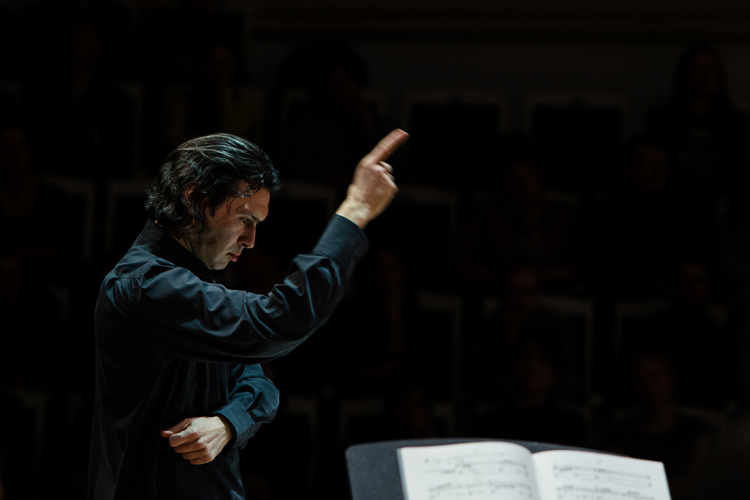
On February 9, in the Great Hall of the Conservatory, Vladimir Yurovsky is punishable by the “funeral song” of Stravinsky-an essay lost more than 100 years ago and recently accidentally found in the reserves of the library of the St. Petersburg Conservatory. On the eve of the Moscow premiere, which opens the year of Stravinsky (on the occasion of the 135th anniversary of the composer) at the Moscow Conservatory, Vladimir Yurovsky explains how important and interesting the resurrected score is and in what context it will sound that evening.
- The story of the “funeral song” makes a desire to rephrase the Bulgakov phrase “manuscripts do not burn”. In our case, “manuscripts do not disappear”! We will restore the course of events. The full set of orchestral votes of the “funeral song”, lost together with the Partura after the premiere in 1909, was discovered by the vice-rector for the scientific work of the St. Petersburg Conservatory, Natalia Braginskaya, among the materials of the musical library of the Conservatory when moving from a historical building that closed for repairs. The parties allowed the score to reconstruct, and in December 2016 the essay was performed by the Mariinsky Theater orchestra under the direction of Valery Gergiev. Now you are holding the notes provided by the Boosey and Hawkes London Publishing House. What feelings do you experience?
“Of course, we all had some kind of phasmagoric ideas about what the“ funeral song ”could have been for a long time. Stravinsky was very lamented about her loss, saying that, after so many years, he could no longer restore the essay from memory, while it seemed very important to him in the process of his maturation as a composer. Since it was in it that the complication of his harmonic language was outlined, which later led to many late works, including the “symphonies of the spiritual” memory of Debyussi.
The parties found allowed us to restore the score, and we see here an alloy of influences. First of all, the influence of his teacher Rimsky-Korsakov. Moreover, not so much the “Legend of the invisible City of Kitezh” is the opera where Diano reigns - how many “strokes” and partly the “golden cockerel”, where the chromatic prevails. I also see the shadow of Bayroit, the reflection of Wagnerian operas, especially the music of Klungzor from Parsifal. The “funeral song”, in my opinion, is closely connected with the late -romantic era, is one of the final strokes. Stravinsky’s sprouts are then found in the “Firebird”, but he takes the final break and step forward only in Parsley.
The individuality of Stravinsky is found in the “funeral song” in connection with his interest in rituality. The whole essay is actually built on one topic, colorful of the various techniques of the orchestration. The play is quite simple in shape and approaches the crying genre, prison. Perhaps Stravinsky subsequently never allow himself to be so expressive, to invest so many human feelings.
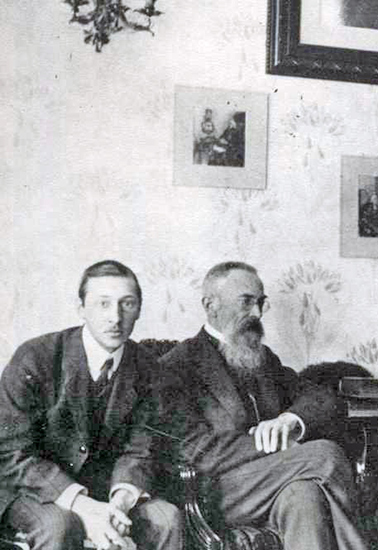 Igor Stravinsky and Nikolai Rimsky-Korsakov, 1908
- How do you explain this?
- I think that Igor Fedorovich then really felt orphaned. Rimsky-Korsakov was for him to everyone in those years: Stravinsky, except in the gymnasium, did not officially study anywhere. Rimsky-Korsakov strengthened him to enter the conservatory, protecting the originality of the young man’s thinking, and became for him the main and only teacher, whose death was a difficult blow. Stravinsky sincerely mourned him in the "funeral song."
- A program in which such compositions close in style and aesthetics are chosen will not be monotonous? Or is that your intention?
- I do not see anything wrong. I note that a similar question was somehow asked in connection with the scores of Rimsky-Korsakov. Say, "if you observe exactly the author’s tempo instructions, then the music will become monotonous." But the composer wanted so! This is the peculiarity of his personal style. Our current program is opened by a suite from the Golden Cockerel - the opera of the extremely cold, deliberately aero -national. Then the “funeral song” will be made, where Stravinsky, as I said, allowed himself an extreme degree of expression, and his same suite from the “firebird”, stylistically close, but much more decorative.
- The composer's works and so often appear in your programs. What are the ideas for this anniversary year?
- I will spend my year of Stravinsky throughout 2018 in London - from January to December. From Opus number one - symphony - to late works, variations of the memory of Oldos Haxley and the Kantata "Training". We finish the symphony of Berio, because the concept of the London festival is Stravinsky in the context of time, that is, almost the entire 20th century. His early works will be heard surrounded by the music of Rimsky-Korsakov, Tchaikovsky, Glazunov, Debussy, and at the end-Stokhausen, Boulez, Berio. They were already famous composers in the 1950s and 1960s.
- Is the official announcement of the Stravinsky year in Russia a good for the composer?
- Formally yes, although I am every opponent of planting above the “love” for music, literature and so on. Because, as this happened in the year of Prokofiev, the majority performs the most popular works to put a “tick”, and what needs to be popularized, to extract from the shelves, it remains to lie there.
I played and will play Stravinsky outside the dates and official decrees. The best proof of this is our project, implemented last year with the symphony orchestra of students of the Moscow Conservatory. Then there was not even a year of Stravinsky in the project, and we played a monographic program, which included many rarities - “Fantastic Scherzo”, “Fireworks”, “Starver”. It seems important to me that people finally realize that Stravinsky is not a modernist, but a classic, and appropriately approached his heritage.