
Translated material
Red wall
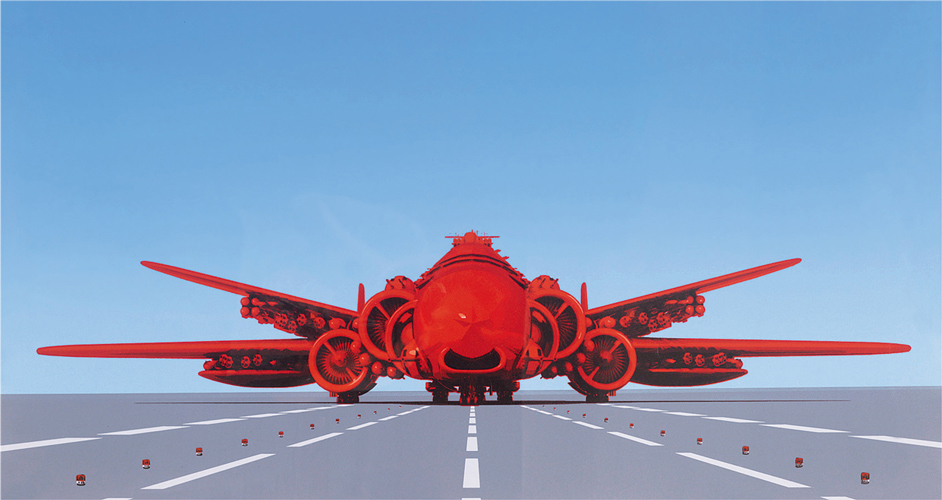
In the St. Petersburg Center for Manezh, the Chinese Army exhibition is held, formed by the rector of the Academy of Arts by Semen Mikhailovsky from the works provided by the Institute of Arts of the PLA (the People's Liberation Army of China). If you get rid of the impression that the nearby future, shown by Leningrad, is recreated in the Manege , then the painting signed by Zheng Minyan, Jan Daway, Colonel, will seem quite tolerant.
This is the first large -scale exhibition of the PLA artists outside China. Founded in 1960, the Institute of Arts, like all communist China, adopted a lot from the USSR. In the Union, by that time , a studio of military artists named after Grekov , imprisoned for the conservation of Russian realism as a method of Repin and Surikov, actively worked. The “official” domestic military painting has long become a reduced branch of academism, which does not absorb from the outside. In the Middle Kingdom, they also adhere to the traditional Chinese technology of Gochua (painting with water paints). The curator of the exhibition Semen Mikhailovsky is ready to name the art of Chinese military marginal because of its closeness. Confidently controlled by the state, the artist in uniform gives out the work of a given tone and level. No worse than the prescribed and no better than permissible. Although “this is inevitably reflected in the works of artists with a civil position,” stylistically the Creators of the PLA are not tied to Repin and Surikov, realism is not a paradigm. At the exhibition, for example, there is an installation of the “deck” of the “paper genius” Lee Hunbo: a wooden stump in the hands of volunteers suddenly spreads with a long paper accordion. Hunsbo is a recognized master with a background in the form of a personal exhibition in New York. The soldier cuts the paper, the service is coming.
Mikhailovsky gathered an exhibition since he saw the catalog of the works of military artists of the PRC, brought to the Academy by a delegation of art defenders from China. That is, the brothers in the brush were originally aimed at showing work outside the PLA and even outside China. According to the curator, looking at the book, he realized that "we must take." Mikhailovsky does not hide a purely political motive. “We tried to make a project that corresponds to the level of two great powers. The strategic partnership of Russia and China ensures security not only to our countries, but to the whole world, ”he said at the opening of the exhibition. Once, it seems, we already wanted to turn the whole world together to communism together. By the way, the first lady of China, the wife of Xi Jinping, the performer of the folk songs, Peng Liuan, is at the head of the Institute of Arts of the LEAK. The release creators must create a new image of China, and the state is purchased by the work of military artists for museums and galleries.
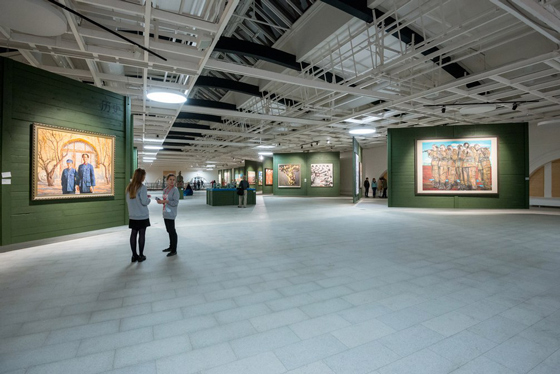 © Central Exhibition Hall "Manege" View of the exhibition exhibition
Lee Hunbo is rather an exception to the rules: most artists are unknown to the connoisseurs of contemporary art, and therefore the exhibition seems especially monolithic. The shadow of the child of the camouflage color, the girl on the pointer and in camouflage, a teenager with an adult face of a copper color. In general, the theme of childhood is carefully cultivated - like the most devoted to the idea, Soviet artists tenderly wrote pioneers for whom, building communism, the older generation, and Chinese artists admire their youth. If we recall the novel “The Country of Wine” (1992) of the Nobel laureate from the PRC MO YANY (quite “Official” writer, who listened to the Code of Arts in the 1980s), fixed to eat Chinese elite children, then in the intersection of the Cannibal motive with the enthusiasm of artists, you can find a bouquet of fradist contradictions. Raised the theme of cannibalism and the ancestor of all the literature of the new China Lu Sin. But the artist, of course, does not mean anything like that. People are a crowd, against which a portrait of an aircraft carrier is written. Heroes, like artists, are walled up in a camouflage color, and you, the audience, will not distinguish who is who. Unless the “terracotta army”, standing along the red wall, allows itself to differ in color. A good move is to tie the militancy of modern China to the qin dynasty, the Great Wall and the 3rd century BC.
Mikhailovsky, being the commissar of the Russian pavilion on the Venetian Biennale (architectural and contemporary art), not the first time forms a militaristic agenda. At the XV architectural Biennale in Venice on the topic “Reporting from the Front”, our curators were in their elements. Russia introduced an exposition dedicated to VDNH . Against the background of colleagues who have comprehended the problems of migration and other social phenomena, the 3D copy of the Vuchetich relief and the panoramas of the forum looked like a monumental manifesto. Both in the works of Chinese artists, and in the glorification of the Soviet forum on the “front line”, the state’s need, who has been eared in relatively peacetime, is felt if the military power is not spilled out, then at least test it pointily.
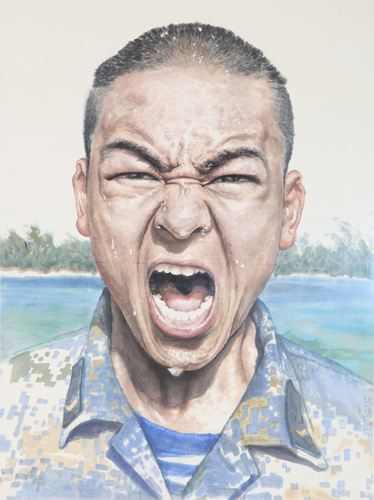 Lee Xiang. For the South China Sea! Gohua technique
It is worth mentioning another curator’s position: Semyon Ilyich is the rector of the St. Petersburg Academy of Arts named after Repin. When you come to the Academy and especially to the Republic of Vasilyevsky 2nd line, one cannot but notice the scale of the influx of Chinese students. At all faculties, except for Fia (theory and history of arts), immigrants from the PRC are massively studying. At Fia, you need to write and speak Russian, but the study of the language "Brotherly people" does not bother. But in general, Chinese students are condescending - nevertheless, foreigners pay a lot of money for training; However, in terms of creative achievements, the Academy still holds on students from the Russian Federation. In the hostel of the Academy, for the sake of guests, at one time there were even ping-pong tables, and methodological publications on drawing and painting are released in Chinese. So the arrival of the delegation from the PRC to the rector of the Academy and the joint organization of the exhibition cannot be called an accidental episode - the university has long had its own special relations with China. The site with the blessing of the city authorities was chosen by the Manege Center, and it worked perfectly. In Mikhailovsky, the obvious talent is to master monumental spaces (many remember the vivid exhibition of socialist realism from the Academy’s funds in the Academic Museum, where it was clearly closely), moreover, it is clearly enthusiastic and fascinated by painting, with relatively close starting positions so different from the work of the Greek.
Under the pretext of admiring a military uniform, Chinese artists level the depth of the meanings of work and the psychology of the model. An exception confirming the rule is an unbearably beautiful and lonely girl in uniform (“The number does not answer”, Juan Mainyan, Senior Lieutenant, 2010). Mikhailovsky assures that he himself chose more than a hundred objects from thousands of works for five years, which eventually got to the exhibition. Moreover, many works were completed just in 2009-2016, which indicates the constant activity of the Chinese side in the formation of the exposition. Whether this is the release of propaganda to a new level or an exotic thirst for recognition is definitely difficult to say. After all, there is hardly any other artist that is so dulled in personal vanity as a military man.
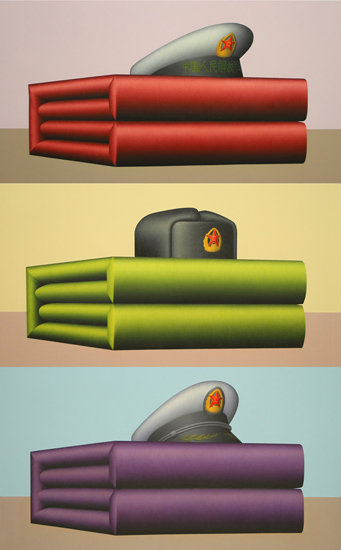 Juan Xiaonin. Red stars. Acrylic painting
We often perceive the artist (writer, musician) as a person outside the system or (more often) opposition to her. The military is the backbone of this system. This is the marginality of another variety. Military artists are strangers among their own, fragments of a shell that the system threw into a delicate body of art. As they are creative, they romantic the war, without betraying other emotions. The simplicity of the message, emphasized by monosyllabic names in the spirit of the Lyube group and uncomplicated, in places indecent naive technique of execution, not only forms the monolithic front of Chinese military art, but also does not allow the thoughtful viewer to perceive it seriously. And to the one who is not used to getting to the truth and meanings, the exhibition will not seem to be the most successful advertising of the army service. The Institute of Arts of the PLA issues writers, poets, media workers, dancers, artists who should “serve art” in every sense. The competition, according to rumors, is huge. And competitiveness in world art is still doubtful.
In St. Petersburg (and indeed in Russia), the exhibition seems to be due to the political "turn to the east." A surge of feelings to the “fraternal people”, announced at the time of the peak of the national currency and crowned by the contract for the supply of gas in the PRC, which was not particularly profitable for Russia, was also necessary to capture culturally. And the landing of the “Chinese army” right through the “window in Europe” is as suitable for this purpose. Chinese camouflage brothers against the backdrop of a TV new for many personify the illusory Russian-Chinese alliance. In the arena, one might say, a laboratory experiment. We are shown uncomplicated propaganda, as if by appealing to fashion for Soviet posters and the aesthetics of the USSR as a whole (it is enough to look at Russian academicism, still grazing in the territory of the “harsh style”, and budget films in the spirit of the Remey of the Caucasian captive and the Irony of Fate-2). The difference is that the art of the LLC openly glorifies the military power of the Chinese (that is, still alien to us) the army. This means that the average viewer must experience either a peppy proletarian joy, or frank fear and misunderstanding - depending on faith or unbelief in the old fairy tale “Russian with the Chinese - brothers forever”. So it turns out that, under the zealous chants of the friendship of the peoples, the Chinese Army, unlike super -popular Serov and Aivazovsky, is more likely to split up Russian society.
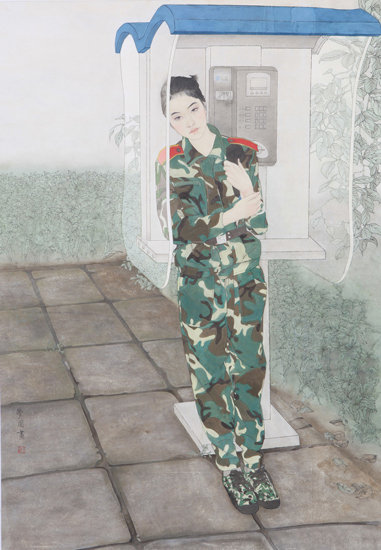 Juan Manjuan. The number does not answer. Gohua technique
In 2010, the Winzavod already showed the art of a closed country. The exhibition “Water flows under the ice” introduced the works of North Korean artists from the Mansude association, a kind of union of artists, between whose members all significant state orders are distributed. The atmosphere of frozen socialist realism with the positive and attention to all types of art - here you have watercolor, traditional techniques, and applied art - created a relatively harmless picture of the life of art (artist and society) in an absolutely closed country. It was rather an analogue of the pavilion at a certain planetary exhibition than the manifesto of the military.
The organizers of the exhibition in the arena do not get tired of reminding that the Chinese army is the largest in the world, it can mobilize 400 million people. At the stage of formation, the PLA had adopted so much from the Soviet army that one cannot help but look at the "brothers" as a crooked mirror. We understand the sense of community, depersonalizing each individual artist to the military rank and averages the overall level of work. We are horrified by delight on young faces waiting for the team to rush into battle. This was “lucky”-we had a generation of Frontovik artists who raised the ethical bar of a military theme to the height of such humanism that it has not been possible to knock it down for many years by official and “Ura-patriotism”. Military art carries a rod - a memory, for which to stamp the same and frankly glorifying war on work, it seems that it is not a shame.
The huge Chinese army is by minimal allusions. “Turn on the TV, clips with special effects are constantly twisting there: armored vehicles rumble with caterpillars, bombers are landing - this is an advertisement for the China of the PRC. China’s military budget is twice as much as Russian, ”commented in 2014 a military analyst from Hong Kong Michael Shi in an ambiguous material about the Chinese army. - On TV, everything looks gorgeous, but ... one point should be taken into account: the Middle Kingdom soldiers have not fought with anyone for 60 years. In the last unsuccessful war in Korea in 1950-1953, 400 000 Chinese were killed, the people's Library Army were defeated on the island of Daman, and in 1979 China was bogged down in the battles in Vietnam: in a month of heavy battles, having lost tens of thousands of killed, the Chinese were able to take only one border town. The military PRC does not have combat experience. ” Therefore, it is so strange to look at the picture soldiers, and I would like to hope that the teams will not wait.
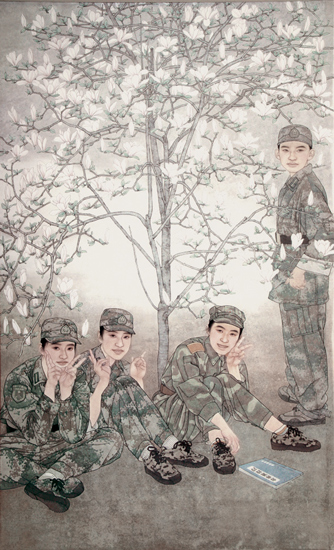 Liu Zuani. Flowering time. Gohua technique
Speaking about military conflicts, one cannot but notice the title work of the exhibition-"For the South China Sea!" (made using the GOHUA technique, the author - Lee Xiang, vice -rector of the institute). One of the most noticeable and eccentric work in the exposition, it clearly denotes the horizons of Chinese expansion and the struggle of the PRC with the USA and the Philippines (and now with the Hague) for the deserted islands in the region. And declares the readiness of the Chinese people very necessary for the official Russian culture to rally and challenge the external enemy. How to recall numerous projects with Crimean themes after the “Russian Spring” and the notorious “competition” of Moscow with Kiev on the topic, whose monument to Prince Vladimir is more.
Exhibitions of military art today are perceived in the same way as children, dressed in camouflage from head to toe. That is, not the most obvious piece of clothing (or art). But still they do it. What is now exhibited in the St. Petersburg Center is intended for domestic consumption, this is made by the military for the military and sympathizers. With all the curiosity and otherness of such an art for our eye, the popularity of the exhibition is a symptom of the same order as the fashion for children's camouflage. The artists of the PLA perform state orders around the world, but still this is a strange supranational art in vacuum packaging. A vacuum means lack of air.