
Translated material
Star-striped swings
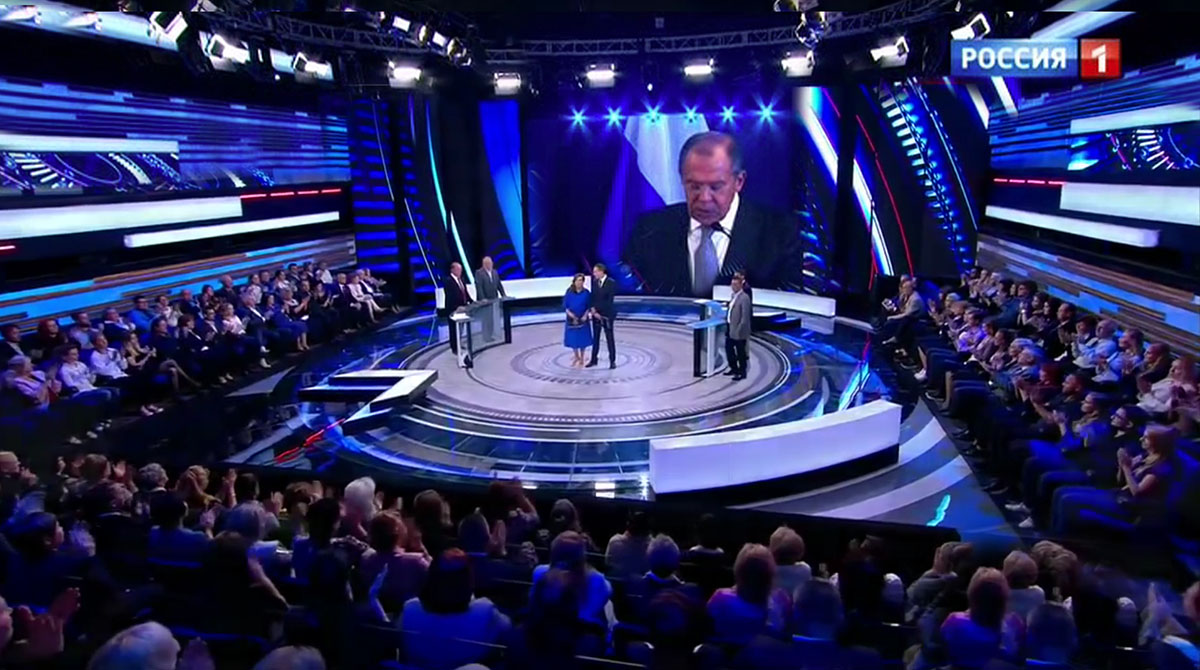
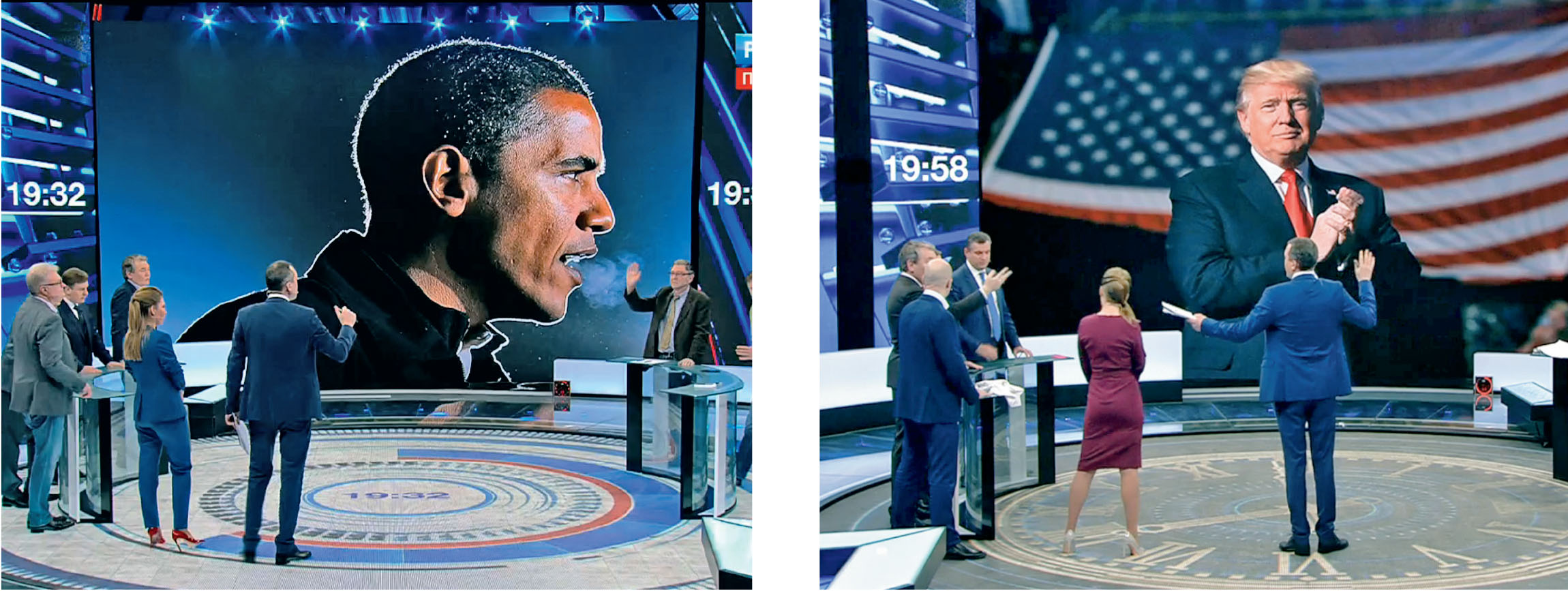
With Barack Obama, Russian television said goodbye for a long time - but never said goodbye finally. As the US presidential elections approached, TV presenters painted Obama's more and more demonic image. “Black period” was the name of the plot in one of the issues of “Vesti of the Week”. Obama exclusively “shits”, “makes nasty things”, “it climbs out of the skin” - in general, a small demon.
The case was not limited in a demonic way: the commentators remembered the most sparkling jokes from Twitter to use them as headers like “The Year of the Monkey slapped the door” (Life.ru). Dmitry Kiselev, the host of the “Vesti of the Week” on the Russia 1 TV channel, describing the first meeting of the then current president of the United States with the elect, Donald Trump, said that Obama, “waving his arms, as if he were in a jungle, touched Trump.” Then, however, this piece was re -sounded: in the new edition, Obama waved his hands, "as if he were on the open air."
The finally propaganda position was formulated by the same Kiselev. In one of the latest issues, the “news of the week” said without abysses: “Trump is anti-Obama.” Good can’t be good without antithesis. Therefore, the unfortunate Obama was not released even after all farewell curses. Now he plays the role of Manichaean evil under Trump - eternal and irremovable, against which our new friend Donald should be shining with good and wisdom. Or is it the role of Emmanuel Goldstein from Orwell’s 1984, at which the daily “five-minute hatred” is directed (although in Russian reality, if you calculate the timing of all news and political current issues on the central channels, it is more appropriate to talk not about five-minute, but about “five-hour”).
Until 2012, according to the Public Opinion of the Foundation, the vast majority of Russians - 66% - were "in no way", that is, indifferently
At the end of January, after the first telephone conversation of Putin and Trump, the phrase that did not allow free interpretations appeared on the Kremlin’s website: “He (Putin) recalled that our country for more than two centuries supported America, was its ally in two world wars and now considers the United States as the most important partner in the fight against international terrorism.” The true content of this conversation, apparently, will forever remain a secret: the other day the next insider from the American White House (sensational leaks from the employees shocked by the new administration - this is a new genre of political analytics) said that during the negotiations of Trump with Putin, the recording equipment was disconnected. Therefore, this line, written by an unknown employee of the Kremlin press service, is all that we are supposed to know about the official end of the American campaign in Russia.
Americanophobia in numbers
In fact, even before America with the highest sanction became the best friend and long -standing ally, the Russians clearly demonstrated how sociological vectors obediently unfold after the general line voiced on TV. Until 2012, according to the Public Opinion of the Foundation, the vast majority of Russians - 66% - related to America “no”, that is, indifferent, and only 15% - bad. In December 2011, elections to the State Duma were held, after which Russians with an unprecedented after the fat oil decade began to protest against rather arrogant falsifications. In the world in which Putin lives, a simple person is denied: he is nothing more than an object in someone's powerful games. Therefore, Putin said quite expectedly that the then Secretary of State Hillary Clinton “set the tone for some of our figures within the country and gave a signal. This signal was heard and, with the support of the US State Department, began to work actively. ”
As a result, by the beginning of 2013 - after all rallies in Bolotnaya and court cases, but before the Crimea and the war in Ukraine - the dislike of Russians to the United States jumped up to 18% (according to FOM). “Levada” gives a more visual schedule-from the end of 2011 to mid-2013, the dislike of Russians jumped two times-more than 20 percent to almost 50. This corresponds to the first jump in the propaganda hysteria on television and in other channels and other channels, exposure films in the spirit of “Anatomy of Protest” are released, in which they are expanded. Oppositionists and their connection with the Demonic State Department of the United States.
The deterioration of relations between the two countries and the accompanying propaganda intensity reached the peak by mid -2015 - America became unequivocal, without half -tones, the enemy
The deterioration of relations between the two countries and the accompanying propaganda intensity reached a peak by mid-2015-America became unequivocal, without half-tones, an enemy, to which more than 80 percent of Russians (“Levada Center”) badly or very badly. Propaganda began to concentrate on individual anti -heroes and choose allies in the West, who so diligently cursed and ridiculed. The antiheroom became, for example, the former speaker of the same State Department Jennifer Saki, in whose last name they decided to voice the deaf “P” to sound more offensive. Member of the Russian Pen-Center Poetess Yunna Moritz devoted poetry to her with lines “Every Psaki is a secret, // He will overheat it!” The fact that the unfortunate Jennifer was an ordinary employee of the press service, on whom nothing but the intonation of the reader of press releases on daily briefings depends, neither the propaganda nor the Russian Russians confused her. The psaki was personified all the most hated that is in America. As a result, the Russian page on Wikipedia is twice as long as English -speaking.
Strange allies
The allies also got people often random or some very comic characters. Headings of the “American officer: Putin was the best that happened to Russia over the past hundred years”, and then it turned out that he was an American American, but not an officer, but a crook with a mania of greatness, who served several years for fraud and just went out. There were very petty techniques: the state news agency RIA Novosti (or rather, its remnants, which were part of the Russia today, under the directorship of the same Dmitry Kiselev), reported that "96% of the Americans, Putin’s speech at the UN General Assembly liked more than Obama's speech." It was about a survey on the website of one American newspaper, twisted up to 96% for Putin, the forces of visitors to one of the popular entertainment sites in Russia. Or: “The question of Putin angered Obama” - and in a note not a word about what, in fact, was Obama’s answer.
It should be noted that propaganda prudently left itself a space for a compromise: they say that not all the Americans against Russia, but only disgusting Obama. Simple people for us vote for Putin in surveys of their newspapers, and even influential experts and journalists advocate for improving relations (experts and journalists in fact turned out to be authors of conspiracy sites describing the horror of the chemical war of the American government against their people). In fact, in the United States there was a parallel process: the number of Americans who positively respond to Russia, according to the Pew Research survey, fell to a historical minimum: 22% in 2015 compared to 49% in 2010.
Friend Donald
And then Donald Trump appeared on the horizon - and the crooked graphs crawled in the opposite direction. The first swallow of the new propaganda course was the manifesto of the former State Duma deputy, Putin’s trustee and the talented media manipulator Konstantin Rykov on the pages of the Internet publication in July 2015, when Trump had just officially announced his participation in the presidential race, and the bookmakers received rates for his victory 150 to 1. A fairly accurate prediction, in the historical perspective, the adopted conclusions of most respected analysts: no “labels that hung on Trump liberal propagandists” such as “Trump - racist, tramp, Trump hate women, Trump - dummy puppet, Trump will not only have influence on its electorate, but also play it. on his hand.
From this moment on, Donald Trump's election campaign began to go both in the USA and in Russia. Moreover, if at home, almost all the main national media against Trump were in earnest, then in Russia, on the contrary, the entire state of state propaganda as a united front was supported by his support. At first, Trump, then not yet becoming an official candidate from the Republican Party, acted as one of the terms in the equation “the enemy of my enemy is my friend” (the enemy, of course, Hillary Clinton). He is a fighter against the "establishment", the "neocons" want to kill him (this thought was repeatedly repeated by Dmitry Kiselev in the "Vesti of the Week" and the guests of the show Vladimir Solovyov, traditionally following the "Vesti"). “Trump is really different, understands what a matter and work, people and land are. Non -playing ”(it is interesting that in relation to Russia the word“ non -systemic ”, used by Dmitry Kiselev addressed to Trump, has a shade extremely negative).
At the same time, television commentators were so sure of Clinton’s victory that they were preparing to announce the elections in the United States illegitimate (after all, Trump said that Clinton would be brought by buses for fake voters!). And not just illegitimate, but as false as in Russia - this was said in almost direct text. Others, like Valery Fadeev, leading the final news release on Channel One, argued that "for Russia both are worse, nothing would change." Doubts disappeared after Trump’s victory in the elections - but they returned, as soon as he got down to business. When the Rex Tillerson, chosen as a candidate for Secretary of State, underwent the procedure for approval by Congress, he spoke different unpleasant words like the fact that Russia seized Crimea, and the sanctions could be harder for this. People who roam from one Ostankino studio to another with a show on the show, in the program of Evgenia Popov and Olga Skabeeva “60 minutes” at “Russia 1” thought: how is it, he is “ours”, they gave him the Order of Friendship? But they were immediately orientated: everything is fine, he is still ours, he understands everything, it is just that it is necessary to let the “Russophobes” in the eyes to be approved.
Television commentators were so sure of Clinton’s victory that they were preparing to announce the elections in the United States illegitimate
All this serves as a clear example of how quickly and radically, public opinion in Russia under the influence of massive television processing can change. From the Nadir of 2015, the attitude of Russians towards the United States for a year with a little jumped into Zenit: according to the latest polls of the Levada Center, the number of US well-wishers in January 2017 almost reached 50%. The side effect was that the president of a stranger country became more familiar than his own: not only is the Russians the composition of the Trump’s cabinet is better than the composition of the Russian government, but also Donald Trump himself, according to the note of Interfax, became the most mentioned public figure in the media, who squeezed the permanent Vladimir Putin from the first place.
Photo: screenshot of the program "Russia 1"