
Translated material
The upcoming nature
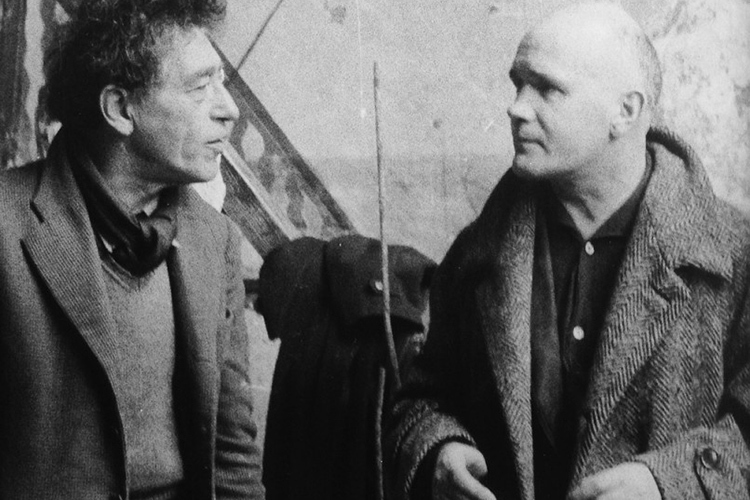
Jean's wife about Alberto Jacketti (1957) is a playwright about an artist who least wanted to be dramatic. This is a collection of records that the poet from the time of acquaintance in 1954 has been called the genre of diary, chronicle or conversations with a great person - rather, a collection of tasks: how to describe a form, how to determine emotion or memory, how to understand the boundaries of the mind. The game of associations, fast and dexterous poetic speech is subordinated to a strict consideration of concepts: the wife does not leave a conversation until it finds out exactly how tension is related to desire, speech with impression or a thought with a guess. Concepts in household communication mixing, and in scientific use too far diluted, are connected, moreover, in a special way: not by the common goals, not as different aspects of one experience, but rather as one aspect, but an experience that only remains to unfold. This is not a system of alluring expectations: rather, this is the initial experience of a biologist who sees the plant and restores the ecosystem in the mind, sees the skeleton and thinks about the body, and seeing the body, thinks about biological behavior. We cannot say that the biologist at the same time attracts additional materials; Rather, we will say that this is how the mind of his science itself works, which thinks precisely these things. Only if a biologist can rely on various real and conceivable museums, then Alberto Jacketti's workshop for Jean Zhenya is a museum that is created as soon as a person straightened as soon as he captures himself to his present to the world.
Sartre introduced both of them, both thought of contrasts, thinking about color and blindness, shape and traction, passion and height. Both got rid of the usual contrasts that constrain art in separate genres, when one genre raises customs and the other - vision. For Jean, Jacquiti's Wife Jacketti is not a place of reality in the sense of evaluating things, but in the sense that things themselves appear in reality, are embarrassed by their incompleteness or when they look complete, then they accommodate all the persistence of nature. Jacketti's art for his wife overcomes the gap between the evolution of wildlife and the severity of the moral demand: it used to seem that evolution itself competes with itself, and moral requirements stop any competition. But the sculpture of Jacketti, says to his wife, is a special memory of nature about himself: not a memory of examples for imitation, not a memory of omissions and mistakes, but a memory that turns out to be more direct than even the current thirst for life. As soon as nature stops simply hiding life, follow the spring of one's own passion and begins to remember its directness, its own enmity to any hasty oppositions, then Jacketti appears.
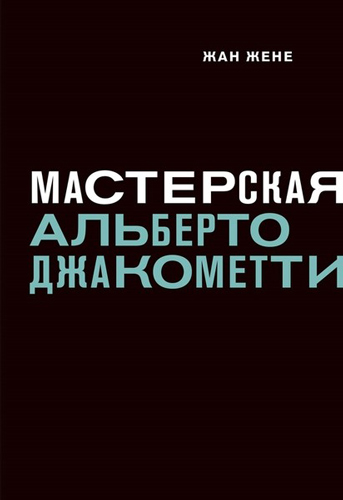 © Ad marginem; Garage, 2017
The meeting of his wife and Jacketti is a meeting of two aesthetic hermits, whom the distance between the cells, not the community of interests, is not the power of prayer. All these images of an ascetic life are already in the past. But there is another image: a look that does not deceive itself with its acuteness, but knows how to take the structure of the world too sharply. If the old ascetic was thinking about cleansing the mind of passions, then here the mind is obviously acute, obviously alarmed, and only understanding how the world burns his anxiety, returns the artist to create a form. This is no longer an artist who skillfully creates images that lay us with the world, but an artist who will not create an image before, what the world will reconcile with him. Hence, such attention to the wife to the ancient cults, to the world of the dead, to Osiris and Isis, to a secret, which is not a secret of knowledge, but the secret of reconciliation.
The book of Jean to Zhenya restores a special time: not the time of the myth, not the time of science, not the time of art, but the time of high -quality, the time that remains to complete the important business. The old art was too reliable that there was enough time for everything, so it could easily take either psychology, then physiology as material and an occasion for new artistic statements. The new art proceeds from the fact that there is not enough time, so the only thing that can be taken is the moral attitude to the events that have already occurred. These events turn out to be bad, terrible, you can’t look at them, but you might think what to say about them for the remaining time.
Jacketti’s art is figuratively in the special sense: these are not figures of speech, not a figure of silence, but what can be called “approaches” if you free this word from too much connection with the methods and tools of work. If you call the approach a way to talk about something else so that the matter itself will become a conversation with another; If you call the approach a way to see nature so that nature itself will say how its moral resistance evolves; If you call the approach a way to portray a person so that a person will say about his tasks that you can not be afraid, this is an approach in the full sense. The approach as an opportunity to affect the instinct of self -preservation of salvation - this is the approach of Jacketti. Jean to his wife reveals this approach with a subtle game of memories, but the bets in this game have already been made by everyone. Everyone seems to know what modernity is and how to do. But this conversation is about how already at the stage of the project you can soften the customs of people.
Jean to his wife. Alberto Jacketti's workshop. - M.: Ad Marginem; Garage, 2017. 96 p. Translation from French Elena Bakhtina.