
Translated material
Pig with human DNA
This news is retold in two ways. The option is simpler - scientists crossed a person and a pig. The option is more complicated - genetics learned to grow organs for transplanting people in the body of a pig. Both are not true
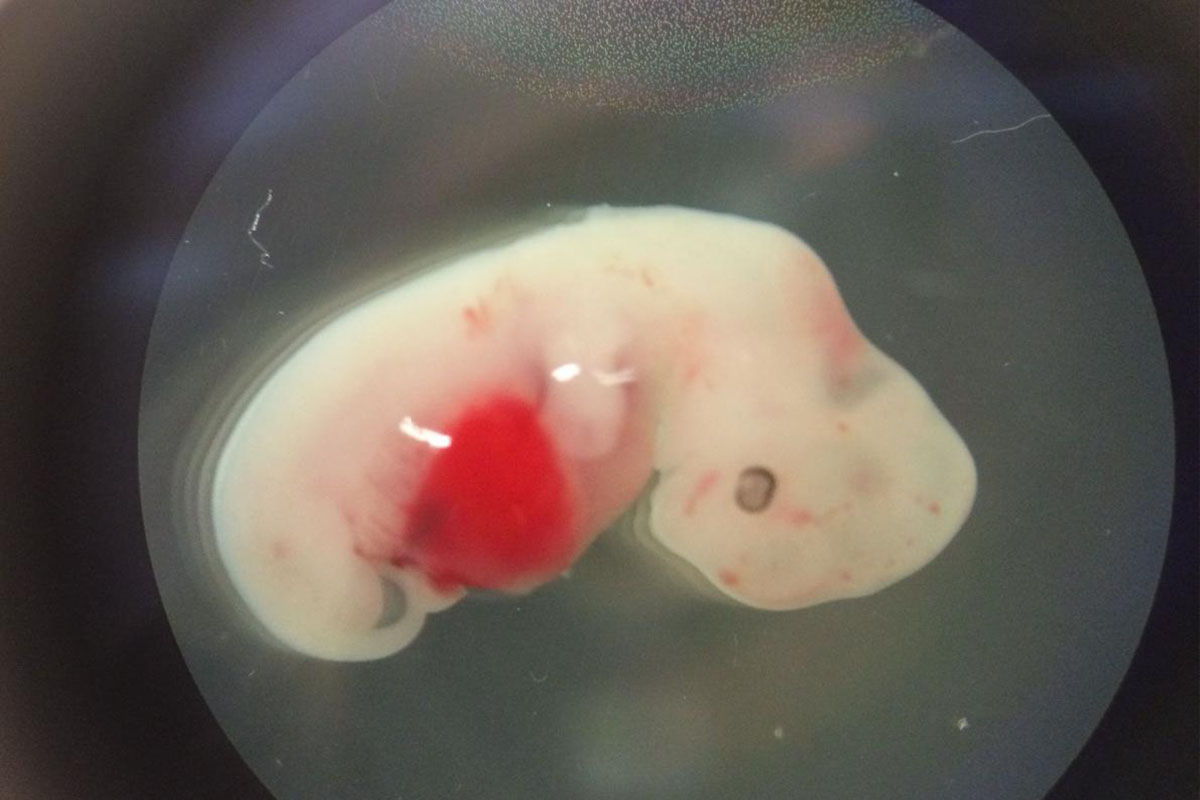
However, something similar to a revolution in medical science really happened. At the end of January, the scientific journal Cell published an article by the molecular biologist Juan Carlos Praisisua Belmont, which leads the laboratory at the California Institute of Solol (USA), and 38 of its co -authors. The article tells how scientists managed to create viable embryos consisting of a mixture of pork and human cells.
Who are they
If these creatures were given to be born (and biologists did not do this, not least for ethical reasons), they could not formally attribute to any biological appearance. Such organisms are called chimeras. At the chimera, which we know from medieval miniatures, eagle wings are attached to the lion's body, and a snake sting to the goat hooves. Whoever remembers the mouse with the human ear sink on the back is the result of a loud experiment of 20 years ago, will easily allow that it is not like that from biologists. But in this sense, new creatures from the laboratory of Belmont were unlikely to have a chance to surprise anyone: after birth they would look like the most ordinary pigs. Just some cells of their bodies - about one thousandth of a percent - would contain pure human DNA. And the piglets would distinguish the piglets from the eared mouse of 1997, which was rather an experiment on plastic surgery and had no human cell.
According to fresh estimates, a person has 30–40 trillion cells, and about the same in the pig. A thousand percent of such an astronomical figure is a lot or a little? To conceive a child, just one cell is enough. Therefore, in the theory of a pig-chimer could become a parent of a human baby.
Donor without a motorcycle
Doctors see in pigs not potential relatives, but potential donors - for transplantation of their organs to people. In the United States alone, 27 thousand kidneys, lungs, hearts and intestines are transplanted in a year. And in all 27 thousand cases, surgeons are dealing with the organs of living or dead people. But who, in his right mind, decides to ask him to be transplanted from his own refusing heart, when the procedure with ordinary, human, is debugged and works fine? Those who will not reach the turn for a transplant: 118 thousand people are recorded in the USA in the so -called waiting sheet. According to statistics, about 22 of them will die today (and the same - tomorrow, and the same - on the nearly Sunday), without waiting for their transplantation.
There are too few donors-people-and the point is not even that volunteers are very rare. (Unlike the United States in Russia, by law, anyone who has not forbidden to remove their bodies clearly is considered to be a potential donor. The law does not require consent from relatives.) Only three people out of a thousand, cites the British data of the New Scientist magazine, and die in the circumstances that their bodies make fit for transplantation. The numbers are obviously changing from the country to the country - they depend on how quickly the ambulance comes to the place of accidents or shootings, as a result of which the most promising donors appear, and from how many transplantation centers are nearby, where the authorities will be able to dispose of correctly. Finally, in a few hours you need to find and prepare for the patient’s operation a “waiting sheet” - there are much more stringent compatibility rules than for blood transfusion with its four different groups.
Donor animals could bring a little predictability to this chaos. The French surgeon Mathieul tried to sew the kidneys of goats, sheep and monkeys back in 1906 - half a century before the first successful kidney transplantation from man to man. Patients died on the same day. In 1932, the kidney of the lamb was transplanted to the patient with acute mercury poisoning - and he lived a record for nine days. With primates, the closest relatives of a person, it also somehow did not set. Stefani Fay Bocleire Typhagan was born in 1984 with a fatal heart defect, which the surgeons decided to replace Babuin with the heart. It gave the newborn 21 an additional day of life - but the result was the same as in all other cases of transplantation from animals to people. It is not enough for the heart or kidney to have the same shape and the same muscles: from the point of view of the immune system, cell cells transplanted from the animal-the same foreign body as a dysentery amoeba or a parasite worm. And they are supposed to attack immediately.
Cells that are least susceptible to rejection are our own. What if you use animals as incubators for kidneys and pancreas grown from human cells (and ideally - from the cells of exactly the patient to whom the organ will be transplanted)? The same problem with the rejection prevents solving the problem in the forehead: for a ready -made immune system of an adult pig of a person, a person’s cage is no less than for us than for us - pork.
So, you must act somehow differently.
Close and glue
Imagine that in front of your eyes two people were simultaneously cut in half - say, a military laser from poor fantastic cinema. Then they connected the half of one with the half of the other, and the glued halves would then live a whole life as if nothing had happened. The option is even more paradoxical: they took two thin ones, pressed each other - and received one fat man. If both people have not yet turned four days from the moment of conception, nothing is impossible here. At this stage, the future organism is a ball of identical cells. “Remove the outer protective layer of inanimate matter and physically connect the embryos,” Professor of Colombian University (USA) Virginia Papaioanna explained in an interview as scientists have been into the world of mice with a full set of genes of two individuals at the same time. Having contacted, two embryos simply form a new ball more - almost like soap bubbles encountered in the air. The immune system that could interfere with this has no cells from cells - as, indeed, all other systems: they will develop much later.
A more subtle intervention is to add someone else's biomaterial to the embryo when its cells are already divided into different varieties. At the stage of blastocysts, the embryo - that in the mouse, that in humans - is a hollow ball with a small portion of cells locked inside. Only this inner portion has to become future lungs, liver, kidneys, brain, skin and other details of an adult organism, and the entire external will turn into a placenta that does not survive childbirth. Biologists prefer to introduce other people's cells at this stage.
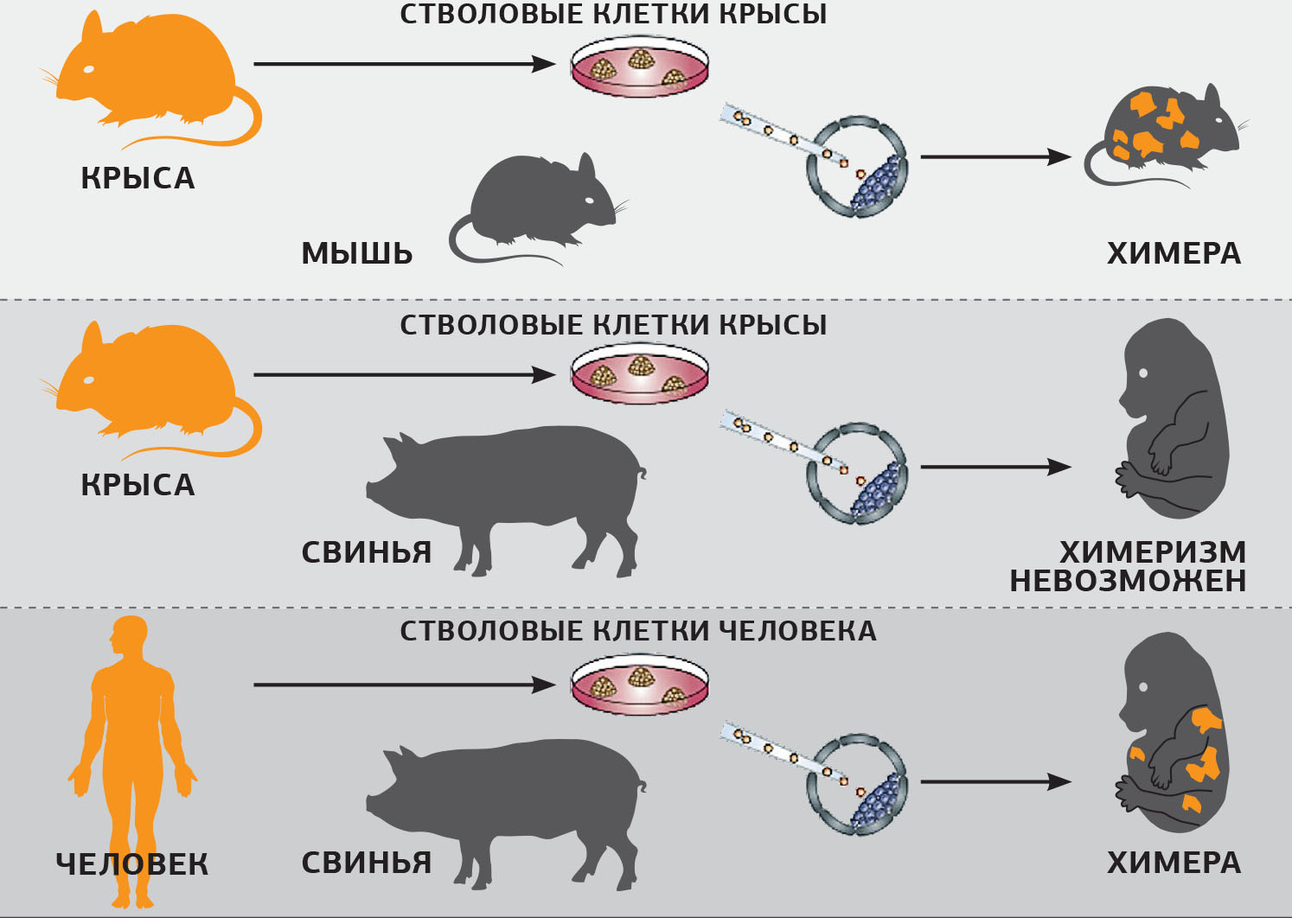
This is not to say that this scenario in its pure form opens exciting opportunities for transplantologists. The need for donor organs usually arises later - when a person from the age of the embryo has already left. How to cross it with another embryo? Take such cells of an adult organism that have not acquired a clear mission (like brain or liver cells) and have not lost the ability to turn into anything characteristic of cells. They are called stem cells, but in the body they are very rare. In 2012, the Nobel Prize in Medicine was awarded to the Japanese scientist Sinya Yamanak because he came up with a way to turn ordinary body cells into stem - forget his background and “fall into childhood”. The full name is induced (because it forced them to change) pluripotent (that is, “capable of everything” - for any transformation) stem cells. The researchers of the chimera use them.
Is it possible to combine the embryos of different types - for example, rats and mice? This was the first to do with the help of stem cells in 2010 by the Tosikhiro Kobayashi team from Tokyo University - and the American group, which published its results after seven years, brought the method to perfection. How to make sure that you actually brought the chimera? Take as a basis the embryos doomed to death with specially spoiled DNA. With the help of the recently invented “genetic scalpel” CRISPR-CAS9, the method of point editing DNA, scientists disabled genes responsible for the growth of the pancreas or heart. With such a defect, there is no chance to survive (and even be born alive). But then the stem cells of the rat were introduced into the embryo. And if the mouse-chimer was still born-scientists could be sure that a rat heart beats inside him.
But the most amazing result concerned the gallbladder. Rats do not have it, but mice has it. But the chimeras, in which mouse genes responsible for this organ were disabled, were still born with a working gall bladder - from rat cells. Mouse cells somehow prompted the correct context with rat cells, and those, succumbing to influence, formed an organ impossible in the rat.
Closer to pigs than to rats
It was not possible to cross the pig and the rat in this way - because these organisms are too much unlike each other. Different pregnancy duration and different sizes of organs suggest that cells are programmed to share at different pace. Finally, can the tiny rat heart of the chimera can drive blood through a huge pork liver?
But with people there is no such difficulty: we are much closer to pigs - primarily in terms of organs. Therefore, pigs (and mini-pies as a separate option) have always been candidates No. 1 for xenotransplantation. In parallel with the cultivation of human cells in the Pig body, biologists consider other opportunities - for example, just take and hide from human immunity those proteins on the surface of pork cells, which cause the most acute reaction. Such studies have been conducted for a long time, so the pig as a candidate for transplanting bodies is not news.
The new experiment showed that there is an opportunity, and it is not speculative - and not even an incredible accident. 2075 embryos were planted pigs, and 186 of them reached sufficient, according to scientists, maturity. Human cells were about a special label in DNA, which forces them to produce fluorescent protein - and 17 mature, healthy embryos confidently glowed in an ultravioletus, proving to scientists that they were absolutely chimera.
From this moment to the organs in a living incubator - years, the researchers say. And the point is not only that the proportion of human cells in the body of chimeras is too small. To see how they grow and what is happening with cells in an adult organism, scientists would be difficult in any case.
We are much closer to pigs - primarily in terms of organs. Therefore, pigs have always been candidates No. 1 for xenotransplantation
The chimeras of the mouse and the rats bred earlier lived in a full -fledged mouse life in two years. There is no reason to think that the chimera of man and pigs would have serious health problems that prevent the maturity. They were prevented not by biological problems, but ethical. Moreover, the team from the Institute of Solol was forced to conduct a study for private money, because the rules of the US National Institute of Health, an analogue of the Ministry of Health, which finances most of the Biomedical Research in the country, forbid to spend money on any experiments with the introduction of human stem cells into animal embryos.
What is unethical in the birth of a pig with a human spleen? Our uncertainty in the results of such an experiment. Cell proportions in the adult embryo are not the ones that the embryo had. And if the pork cells prevail in the ratio of a million to one - this is not as scary as if human ones prevail. And a creature that is more similar to a person will be born than a pig, with the human brain, but with the death caused by the circumstances of the experiment. In order for doctors to save people, it seems, including a more accurate definition of a person - and a more accurate answer to the question of where people come from.