
Translated material
Lithuania: Crimean syndrome
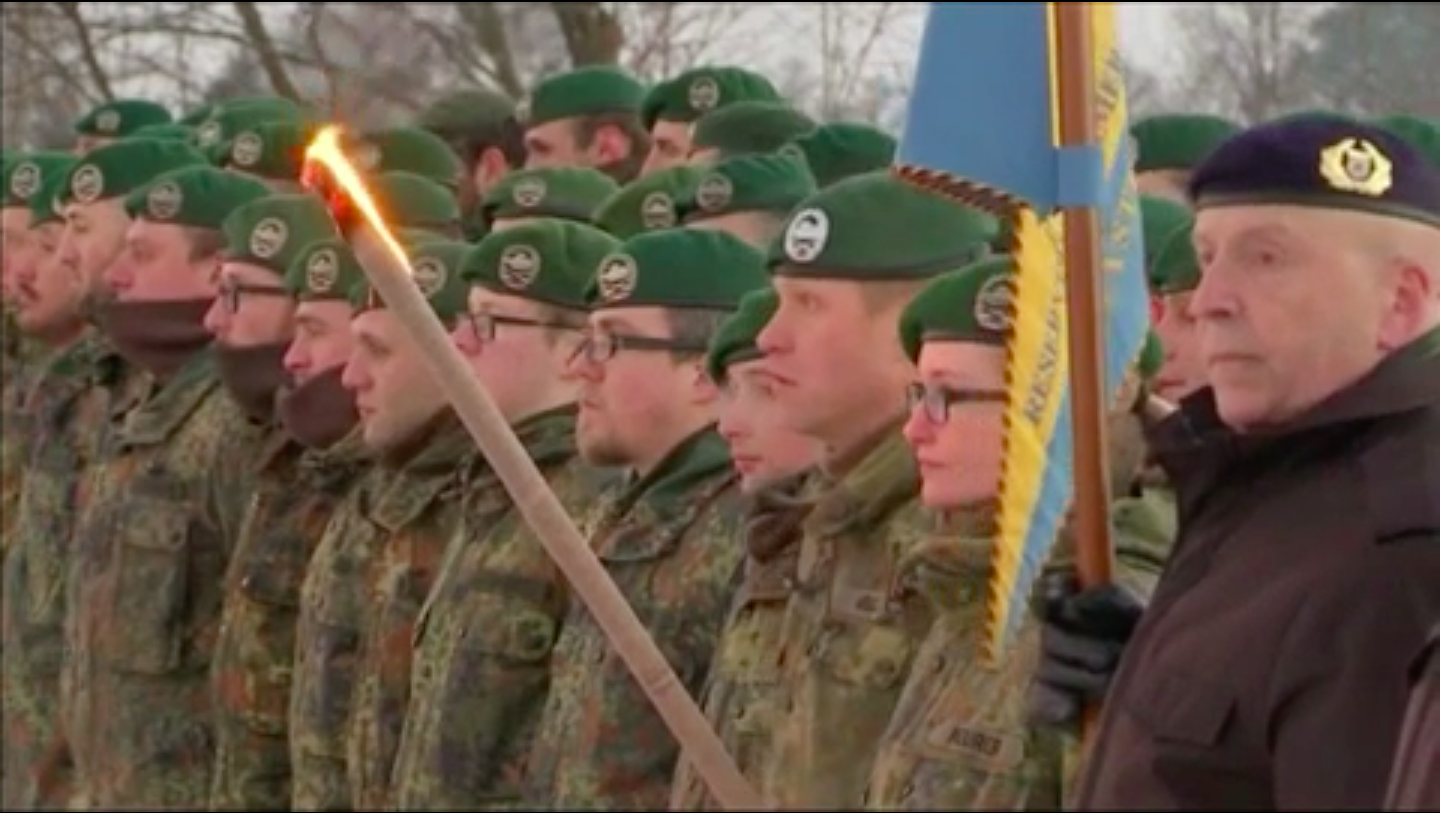
The first military personnel of the NATO advanced base battalion arrived in Lithuania, whose mission was to reflect in the case of the development of events according to the worst scenario “The threat from the East”. It will be equipped mainly by military personnel of the Bundeswehr of Germany. Meanwhile, “in the East” is not asleep: in the Kaliningrad region of the Russian Federation military exercises were conducted using anti-aircraft missile systems (SPRK) S-400. After the Ukrainian crisis erupted, military preparations in the Baltic region are going on an increase in
“The validity of Kalinigrad has expired,” Linas Balkisis, deputy of the Lithuanian Sejm, said the other day. According to him, Russia, having annexed Crimea in 2014, destroyed the order in the world that developed after 1945, which means that the status of the enclave must be discussed again. The official Vilnius from the statement of the parliamentarian dissolved. “Thank God, otherwise we have already been scared,” the Deputy Prime Minister of the Russian government Dmitry Rogozin, commenting on the statement of the Lithuanian Foreign Ministry, noted on his Facebook page. The Ministry, meanwhile, explained that Lithuania does not dispute the status of the Kalinigrad region, Lithuania, they say, have no territorial claims to any of its neighbors. “However, Lithuania will continue to recognize unilateral changes in the border, as does not recognize the occupation and annexation of Crimea by Russia,” the document says.
The fence is like a sign
Meanwhile, Vilnius perceives the “threat from the East” as a very real one and tries to fence away from it in all possible ways. Including literally - with the help of a regular fence, which will appear on the border between the Kaliningrad region and Lithuania in the spring. It will grow on a area of 135 km long - from the point where the borders of Russia, Poland and Lithuania in the area of the Vishtynsky Lake converge, to the place where the state game rests on the Neman, and then it is already going along the river to the Kurshsky Gulf. (So far, the land border is a regular control and next strip and a path for border guards). According to the Minister of Internal Affairs of Lithuania Aimutis Misunas, in the near future Vilnius will announce a competition for the construction of a fence through the public procurement system, and work will begin as soon as it warms. Misunas also promised that when there are additional funds, a modern video surveillance system is also mounted along the fence. € 3.6 million was allocated for the construction of a fence from Goskazza. Also, according to the Lithuanian press, € 25 million for improving the observation system on borders with Russia and Belarus will receive the country from the internal security of the European Union (ISF), which in the period from 2014 to 2020 plans to issue states strengthening external borders, almost € 1.3 billion. With these means, it will also be able to use these means. And neighboring Baltic countries - Latvia and Estonia. The first of them, for example, outlined in the coming years to put a fence at 90 out of 270 km of a common border with the eastern neighbor. And the Estonians will close from Russia a fence 2.5 meters high and 108 km long in 2018. Border posts and a control strip will remain only in a swampy area. Thus, the project acquires a pan -European scale.
Both the head of the Ministry of Internal Affairs and the new Prime Minister of Lithuania Saulus Sprinkalis said that the fence is primarily needed for economic purposes-to stop the flow of smugglers. “Most Lithuania suffers from the illegal import of cigarettes. Several million euros spent on the installation of a fence will definitely pay for themselves, ”said Arvidas Anushauskas, a member of the Seima Committee on National Security and Defense. However, the data of the State Border Security Service of Lithuania is indicated by a decrease in the number of violations without any fence: if in 2015 of such cases 215 were registered, then in 2016 - only 127.
Aimutis Misunas did not hide the fact that Lithuania prompted not only economic reasons, but also a tense geopolitical situation in terms of protecting the state border, Lithuania. And if the fence does not stop the tank, then at least it will help prevent incidents, like what happened in September 2014: Russian specials then abducted the Estonian intelligence officer Eston Kochver from the border zone in Estonia. “A fence is a kind of sign that we consider the neighboring country a possible aggressor,” Misunas emphasized.
The fence will not stop the tank, but at least it will help prevent incidents, like what happened in September 2014: Russian specials then abducted the Estonian intelligence officer Eston Kokhver from the border zone in Estonia
NATO - 2%
The construction of the fence against the backdrop of the general militarization of Lithuania really looks like a symbolic gesture. Since 2014 - since the annexation of Crimea and the beginning of hostilities in the east of Ukraine - Lithuania had to seriously revise her military strategy. “Then the fear that Russia will attack is deeply entered into society - a fear naked by painful memories of the Soviet occupation,” recalls the political observer, doctor of sociological sciences Viktor Denisenko. The threat from the foreign policy of Russia is 60% of Lithuanians, a survey of the survey conducted by order of the Center for Research of Eastern Europe (Lithuania) was also seen two years later-in April 2016. But it was in 2014 that the society had changed the view of the army: the understanding that the army should not only participate in NATO operations somewhere in Afghanistan or Iraq, but also be ready to protect its own territory.
“After the annecation of Crimea into society, the fear that Russia will attack is deeply entered, is a fear naked by painful memories of the Soviet occupation”
From this moment, the article of military expenses in the state budget has grown from € 314 million to 725 million planned for 2017. Thus, in the coming year, the military budget will be 1.9% of GDP. And these are almost those cherished 2%that are required according to NATO standards. According to the statement of the Minister of Defense of Raimundas Karoblis, the country will reach this bar in 2018, and then “depending on the level of risk” - the military budget can grow to 2.4% of GDP.
The main costs go to the modernization of the army - mainly the purchase of new military equipment. In the near future, according to the Minister of War, the funds will be allocated for the purchase of infantry combat vehicles, self -propelled howitzers, medium -range anti -aircraft guns and anti -tank defense equipment, and updating the helicopter park.
In addition, almost € 6 million was spent on expanding the military infrastructure. New military facilities are needed to place the allies - in Lithuania, as was decided at the NATO summit in Warsaw last July, the first military personnel of the NATO advanced base battalion, led by Germany. By June, the international battalion - about 1,200 people - should already be completely deployed.
The army is cool
The new Lithuanian government promises to raise the salary of the military not by 20, as planned, but as much as 30% - "you want - if you do not want, we must attract specialists who are very missing."
The number of professional military personnel in recent years has really grown slightly: from 7775 in 2013 to the current 8661 people ( data from the website of the Ministry of Defense of Lithuania. - NT). But with conscripts I had to start all over again. In 2008, the general draft in the army was canceled. And only in 2015, due to the threat proceeding about Russia, President Dalya Grybauskaite announced the temporary - for five years - the return of the call. Already the first appeal was completely satisfied with the need of the army with a stream of almost 4 thousand people who appeared without any agenda. “Against the backdrop of universal fear and fears, young people showed their willingness to protect their country,” says Viktor Denisenko. The influx was so powerful that the military enlistment offices were even forced to refuse delayed volunteers. Until 2019, Lithuania hopes to completely restore the general call system and bring the number of conscripts to 6-7 thousand.
According to Vladas Gaidis, the director of the Center for Study of the Market and the public opinion of Vilmorus, the army confidently reached the first place in the ranking of public confidence: “It managed to get rid of the image of a backward organization, which it was considered in the 1990s. And only after the recent corruption scandal with the so -called “golden spoons” ( see the article on the NT website of November 24, 2016 ), the army lost to the palm of the police and the Catholic Church. ”
Active reserve
In the new conditions, the ranks of the military defense organizations - the “Union of Lithuania shooters” and the “volunteer forces of protecting the region” were replenished. The first is rooted in the interwar period, after the Soviet occupation, many of its members went to the "forest brothers." According to 2015 data, about eight thousand people were listed in the Union - most often men aged 40-50 years. “Volunteer forces of protection of the region”, created in 1991, are part of the Ground Forces of the Lithuanian Army. This organization, which now has about 4.5 thousand volunteers and fifty of professional military, serves as the basis for the preparation of the active reserve of the army. The service in these forces can be combined with work or study - on average, the exercises occupy thirty days a year. In peacetime, their main task is to help the population in the case of technogenic and natural disasters, and in the military to defend the country along with allied forces. It is precisely the volunteers that are ready to join those who are completely far from the army in ordinary life. “I am a former officer of the Soviet Army, I remember how to handle weapons. If Russia attacks, I will take a gun and go to fight, ”the Gintautas Galvanauskas assured the correspondent NT, the correspondent NT. There is no doubt in his sporting form - in his almost 60, until late autumn he rises to work on a bicycle and regularly participates in the races.
“I am a former officer of the Soviet Army, I remember how to handle weapons. If Russia attacks, I will take a gun and go fight "
If a few years ago the state neglected both arrows and reservists, now the Ministry of Defense is trying in every possible way to raise their status. In addition to additional financial support, Raymondas Karoblis literally on the eve of the new year promised to achieve permission for self -defense forces to keep weapons at home. The minister referred to the experience of Estonia, where members of military -nosed organizations are allowed to store at home not only automatic weapons, but also machine guns and grenade launchers.
Do not stand, steam locomotive!
Thinking over various options for possible provocations on the part of Russia, experts agree that the most vulnerable places in Lithuania are a “Suvalka corridor” (the border with Poland between the Kalinigrad region and Belarus, through which a land communication with the alliance is maintained) and the railway along which the Riddle Railways “Moscow -Kaliningrad -Moscow” passes through Vilnius and Kaunas. Last year, Lithuanian border guards even conducted exercises at Kyan station - the first stop of a transit train in Lithuania after the border with Belarus. According to legend, it is quite possible in the conditions of a hybrid war, a group of Russian military rode on the train, one of which was put on a wanted list in Lithuania. During the verification of documents, passengers behaved aggressively, did not obey the requirements of the border guards and fled from the train.
In addition to this script right on the border, Lithuanians are trying to prepare for other options. Therefore, now the speed with which the Russian train is moving through the territory of Lithuania is constantly monitored. If the composition suddenly slows down the speed of up to 20 km/h, the border guards immediately receive an alarm, inform the nearest police commissariat and carefully monitor the train until it leaves for the Kalinigrad region through the Kibartai -Nesterov crossing.
Experts agree that the most vulnerable places in Lithuania are the “Suvalka corridor” (the border with Poland between the Kalinigrad region and Belarus, through which the land communications with the Alliance are maintained) and the railway along which a train “Moscow -Kaliningrad -Moscow” train through Vilnius and the surroundings of Kaunas.
Other people's mistakes
“Trust in Russia has been lost. And in this regard, among the main political forces of Lithuania there is absolute consent, ”states the deputy of the Sejm Arvidas Anushauskas. The NT correspondent often has to hear from the Lithuanians that they would be happy to live in the neighborhood of democratic Russia, but a sober assessment of the situation pushes them to strengthen the defense. “The painful lesson of Crimea - and it is better to study on other people's mistakes - showed that the Ukrainian army was absolutely not ready,” Victor Denisenko recalls.
“Trust in Russia has been lost. And in this regard, among the main political forces of Lithuania there is absolute consent "
The Lithuanians are counting on themselves, but to a large extent on foreign forces, which, in one form or another since 2004 - the moment the country's entry into NATO - are constantly present in the country. The only concern is whether the 5th article of the North Atlantic Treaty, which provides for collective protection, will immediately enter into force. “Suddenly they will forget about her, as after the annexation of Crimea they forgot about the 1994 Budapest memorandum, in which Ukraine guaranteed territorial integrity?” - Viktor Denisenko asks a question. And he himself answers: “The placement of the NATO battalion near Vilnius shows that in the case - God forbid - Russian aggression will automatically stand up for Lithuania.”
For a small Baltic country, this has not only practical, but also symbolic significance. As, however, the installation of a fence on a granting with Russia.
Photo: YouTube.com