
Translated material
The Last Hero Givi
Why are the legendary field commanders of Novorossiya one after another die not in the trench, but in the deep rear
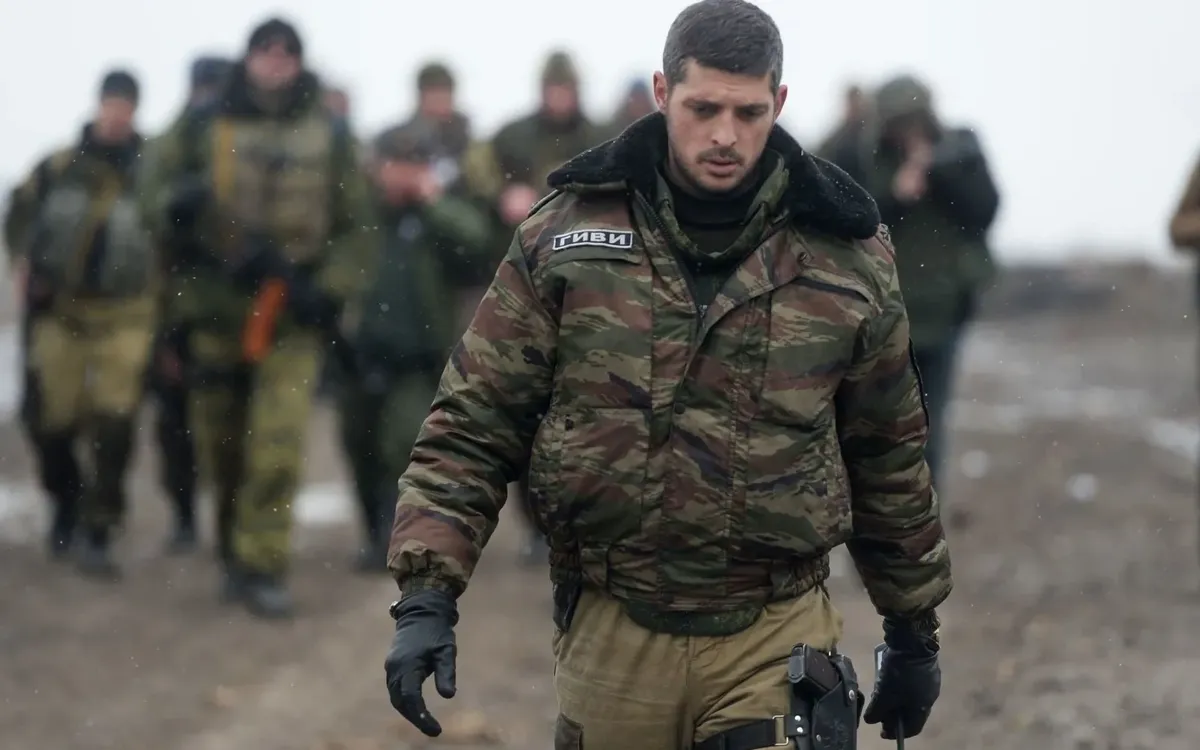
In the Donbass, under strange circumstances, the next “people's commander” was killed, one of the most famous characters in the war in the southeast of Ukraine-Colonel Givi. The attempt on the 36-year-old Mikhail Tolstoy (the real name of “Colonel of the DPR”) was completely in his own office in Makeevka-early on the morning of February 8, Givi attacked with the help of the flamethrower “Bumblebee”. In involvement in his murder, the DPR leaders expectedly accused the Ukrainian special services, and the prosecutor's office of the republic’s separatist already stated that she had come out in hot pursuit of the alleged performers.
"Folk commanders"
After the murder of Motorola in the elevator four months ago, Givi remained the last living commander of Novorossia from the people. Both-both Givi and Motorola-ended up in the Ukrainian war in the group of fighters of the retired FSB officer, the writer-director Strelkov-Girkin, who captured Slavyansk in April 2014. After Girkin left Slavyansk, they settled in Donetsk, where they found a personal hot point for themselves - this place was the Donetsk airport. Givi and Motorola called themselves authorized for his liberation. The former carrier from Komi Arseniy Pavlov by that time already had his own detachment of two hundred fighters - Sparta, and the driver of the diesel loader from Ilovaysk Mikhail Tolstoy organized the Somali battalion.
For the first time, they started talking about Tolstoy in October 2014, after the appearance of a video on YouTube, where he in high colors talks on the phone with the commander of a detachment of Ukrainian “cyborgs” defending the airport. Givi asks the Ukrainian why, despite the agreement on a truce, the Armed Forces shells of his position. A minute before this, the camera shows one of the fighters of Somalia, which drives the shell into the gun and shoots towards the terminal. Then Givi says:
- Who shot now? ... Is we?! Of course you know nothing! Or are the Poles with the French French who help you there? ... My battalion is the strongest! I will let all the tanks, all artillery [on you], I warn you!
Another well -known video, which brought Givi numerous likes is the frames of the mortar firing of the somali positions by the Armed Forces of Ukraine. In the plot taken by one of the journalists, it can be seen how pieces of land fly right under the feet of the thick ones, while he continues to calmly smoke a cigarette. Behind the scenes, however, the surrounding situation remained - from shelling Givi was protected by a residential nine -story building, under which he was during the filming. It was Her Givi and Motorola who used for several months as a shelter, their combat positions were also located here, and nearby the headquarters was located. Givi’s neighbors were somewhat distraught from constant shelling of pensioners who remained to live on a nine -story building. After shelling, Givi with me decided to throw one of them to the store.
- Why is your house used as a military facility? I asked her then.
-The militias? Yes, they are defense, and they feed us, ”the woman answered, plunging into Givi's car.
The choice of the airport as a place of work of Givi and Motorola was unknown. Of all the hot spots at that time, the airport was the most convenient place for filming war. From the center of Donetsk to a nine -story building, journalists (Russian and foreign) could get in 20 minutes. Often to their arrival, Givi and Motorola began to shell the airport to warm up the cyborgs for more convincing filming.
I must say, both loved the attention of the press. At first, both Pavlov and Tolstoy could even come to the hotel for an interview with foreign journalists and brought them to the airport themselves. Later, the "People's Commanders" began to ask for the crew of a fee. Givi and Motorola established favorable cooperation with the LifeNews channel, which published their videos, giving them out for his own.
"People's Commanders" recorded almost all the events related to the airport for YouTube. Both took part in the exchange of prisoners. Journalists who worked in 2015 in Donetsk remember the dramatic break in the relationship of the combat couple, when during one of the exchanges of Motorola it shook the hand of the Ukrainian officer who arrived behind his soldiers, and Givi found this act with treason and betrayal. But much more scandal was caused by videos on which Givi beats and humiliates prisoners, and Motorola declares that he personally shot 15 APU soldiers. Famous Ukrainian commanders publicly promised to take revenge on Pavlov and Tolstoy.
Filming in the plots and videos of their own production made from Givi and Motorols the most famous "militias" of the DPR. Actually, they were the main media persons of this war. With the only difference being that Motorola embodied the image of a Russian volunteer who quit the work of a car owner in Russia to fight against the Nazis, and Givi was a guy from the locals - those whom Vladimir Putin called "tractor drivers and miners."
However, neither one nor the other were heroes of fateful battles and were not remembered by glorious combat exploits. Givi’s stories about how he and other militias took Ilovaysk, looked unconvincing after the memories of Ukrainian prisoners about Russian tank formations that stormed the city. Givi did not very convincingly explain to us where his battalion got sealed boxes with ammunition with fresh factory labeling: “Yes, they squeezed with a hunta,” Givi said.
The real war did not obviously enter their main tasks. The task was another - to be covered by another army and the face of other people's victories. For six months of filming an endless battle for the Donetsk airport, a picture of a folk war of a car owner and a driver of a loader with the Nazis was fixed in the eyes of the viewer. Then, in January 2015, “vacationers” came to the airport and in two weeks they knocked out the Armed Forces from its territory. However, the official winners in the battle for the airport are all the same motorlae with Givi.
Of all the field commanders, Colonel Givi had minimal career ambitions and almost did not participate in internecine squabbles inside the DPR.
After the epic around the airport is completed, it almost disappeared from the screens. A wave of patriotic glee has come to naught. After the murder of Motorola in the elevator, Givi remained the last “commander from the people” with his own battalion. At the same time, permanent military formations formed by Russian advisers from “vacationers” and local residents were already operating in the self -proclaimed republics. Givi's departure marks the final final of the “popular war” in the Donbass and the establishment of a complete military monopoly in the republics.
The heroes of the "hybrid war" were no longer needed.
Who remained
The murder of “Colonel Givi” was another event in a series of mysterious deaths of the “people's commanders” of Donbass, who die not in the trench, but in the deep rear. After the death of Motorola in October and the recent death of the infarction in the dacha of the first chapter of the “LPR” of Bolotov, only a few people remained of Bolotov Living Leaders of the “Russian Spring in the Donbass”.
Almost all field commanders of Novorossiya left ingloriously - for the last two years they died as a result of attempts, under unclear circumstances or disappeared without a trace in Russia. Such field commanders as Pavel Dremov, Alexei Mozgova (Ghost battalion), Armen Bagiryan (Baggi) and Alexander Bednov (Batman), the People’s Mayor Evgeny Ishchenko were killed and found dead.
In addition to Ishchenko, all the killed are citizens of Ukraine. Only a few people agreed to leave voluntarily and survived-the “head of the army” of Novorossiya Igor Strelkov-Girkin, the first head of the DPR Alexander Borodai, the chieftain and the leader of the “Cossack People’s Republic”, organized in 2014 inside the LPR, Nikolai Kozitsyn, the “People’s mayor” Gorlovka Igor Bezler, the leader of the Vostok battalion Alexander Khodakovsky. In addition to Khodakovsky, everything is Russian citizens.
“The first heroes of New Russia”, they spent in sight only a few months, but earned tremendous glory among the public excited by propaganda. In the spring of 2014, some, Strelkova-Girkin, Brain or Bezler-rushed to the levels of federal Russian politicians of the first order. Ataman Kozitsyn and the same Girkin began to openly polemize about the decisions of the Russian leadership. The young “republics” themselves, which appeared on the territory of the Donetsk and Lugansk regions, was overwhelmed by a wave of redistribution, armed attacks, abductions committed on behalf of “New Russia”, and a banal racketeering.
As a result of the walking leaders of the Russian Spring, Moscow began to actively pull out from Donbass in the summer of 2014. Strelkov, Bolotov and Beard found themselves in Moscow, Bezler - in Crimea, Kozitsyn - in Novocherskask, Khodakovsky remained in Donetsk, but lost all posts and resources.
By agreeing to peaceful resignation, they still remained active commentators of events in the southeast of Ukraine; As a rule, they criticized their shifters in the DPR and LPR and often Moscow curators.
The opposition activity of “veterans”, however, did not hurt anyone. Before the death of Bolotov, the security of voluntarily eliminated leaders of the “Russian spring” also had no doubt. Now the question of the fate of these "veterans" seems open.