
Translated material
The number of orphans are significantly reduced
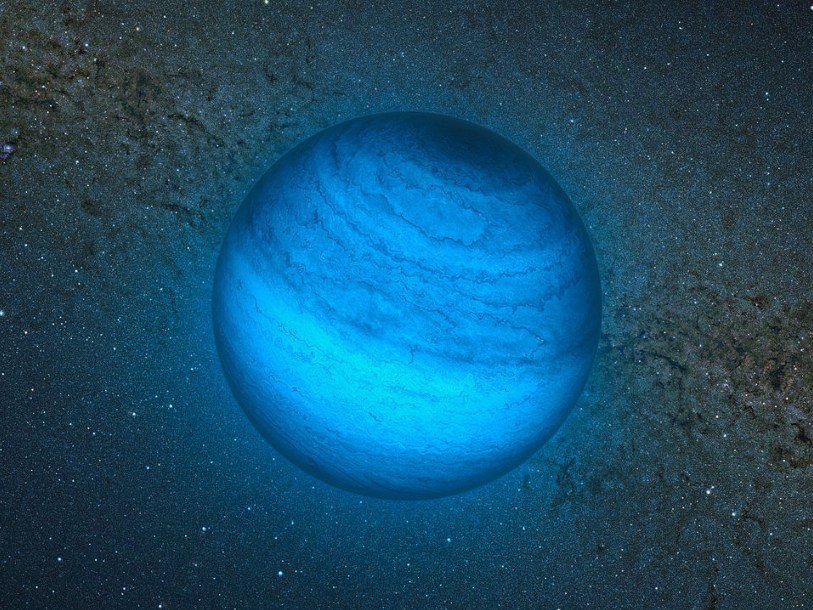
Two groups of researchers who presented their work at an astronomical conference in Pasaden, independently, came to the conclusion that the number of so-called “scheduled planets” in our galaxy was half as before.
Planets are called planets that are not related to any star or brown dwarf. For their designation, the terms “planets-stripes”, “interstellar planets”, “plano”, “single planets” or “freely flying planets” are also used. The reasons for their appearance are unclear. Many astronomers believe that planets can only be formed as part of the star system, and the emergence of planets-zirot is possible only because of their giving from orbit after some kind of catastrophic event. It was previously believed that the galaxy contains about 200 billion of such planets. New studies show that there are no more than one hundred billion.
You can detect orphans planets only by observations of microlysising. During such an event, the planet passes between the Earth and the distant star and, under the influence of its gravity, the light coming from the star is twisted. For an earthly observer, this looks like a short -term increase in the brightness of the star. The previous assessment of the number of orphans was given in 2011 on the basis of ten events of microlysis. New data are based on 2600 cases of microlysisism and statistical analysis. Scientists now believe that most of the events of microlysisism are caused by exoplanets that are part of the star systems.