
Translated material
What will happen to Dadin further? Lawyers answer
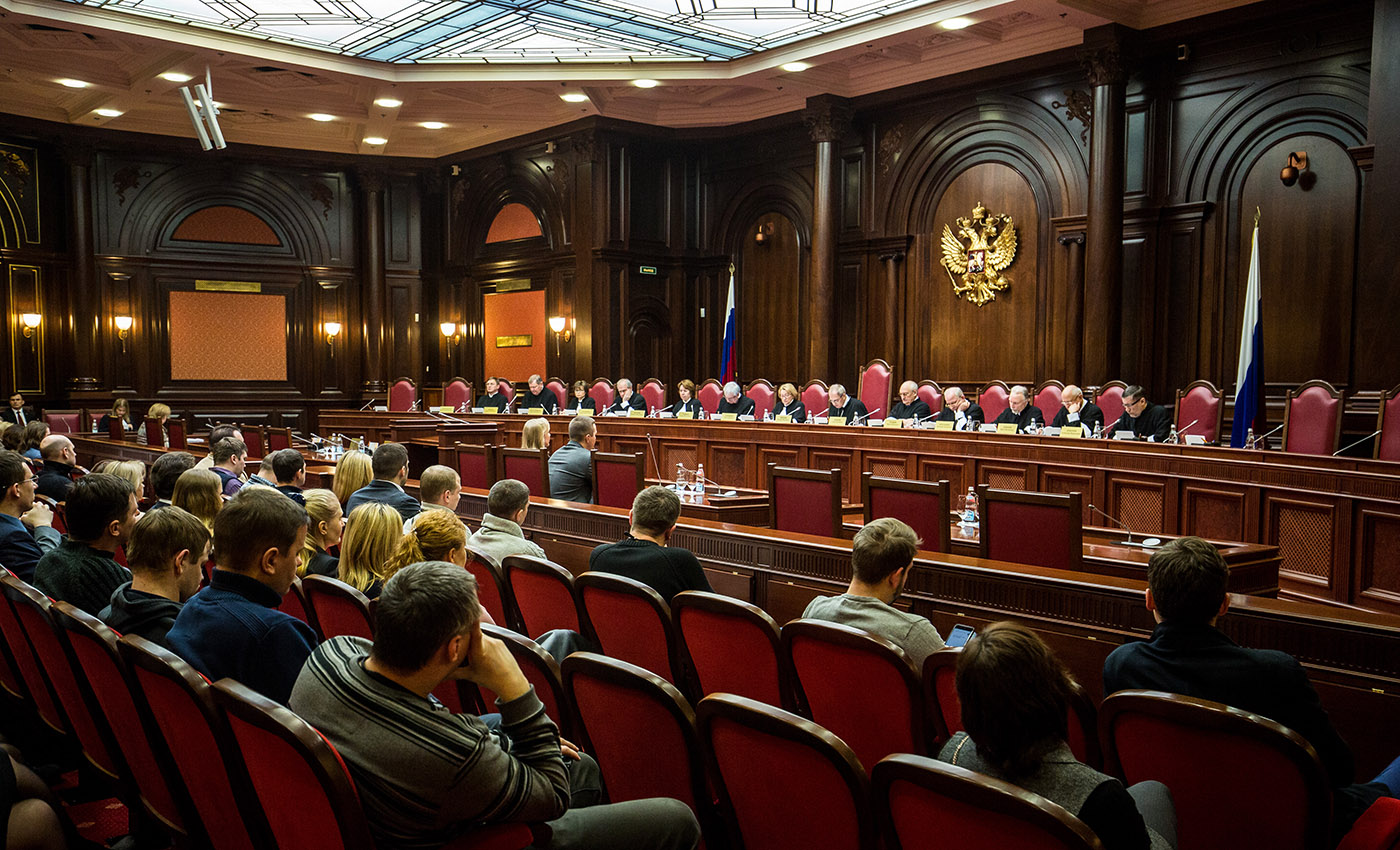
A meeting of the Constitutional Court on February 10, 2017. Photo: David Frenkel / Mediazone
The Constitutional Court decided to revise the sentence to Ildar Dadin, who was convicted in Russia under article 212.1 of the Criminal Code (repeated violation of the established procedure for organizing or conducting a meeting, rally, demonstration, processing or picket). The article itself does not contradict the Constitution, the court decided. "Mediazona" asked the lawyers what Dadina is expecting now.
The meeting on the constitutionality of Article 212.1 of the Criminal Code was on January 24, and today the Constitutional Court has published its decision. Commenting on the case of Ildar Dadin, the court explained: a prerequisite for initiating the case under Article 212.1 of the Criminal Code is the presence of three administrative offenses, the decisions of which have already entered into force. But this formality should not become the basis for criminal punishment: the court must prove the “presence of intent to violate” the rules of the mass event. By the time of the initiation of a criminal case against Dadin, a decision on three administrative offenses had not yet entered into force; The defense indicated this earlier, but these arguments were not accepted by the courts.
In December 2015, the Basmanny Court of Moscow sentenced Dadin to three years in prison, later the Moscow City Court reduced the sentence of six months. Now the convicted opposition is located in IK-5 in the Altai Territory. According to the estimates of his wife Anastasia Zotova, 172 days were left until the end of the term of Dadin.
"Mediazona" asked the lawyers how the decision of the Constitutional Court will affect his fate.
What do lawyers intend to do?
Having received the text of the decision of the Constitutional Court, lawyers will turn to the chairman of the Supreme Court Vyacheslav Lebedev, says lawyer Dadina Ksenia Kostrina. In the petition, they will ask Lebedev to submit to the Presidium of the Armed Forces a decision to initiate supervisory proceedings to revise the Dadin case in connection with a new circumstance - the decision of the Constitutional Court.
What will the Presidium do?
This cannot be predicted for sure. There are two main options: the presidium can either decide on the termination of the criminal case, or send it for a review to the court of first instance.
Kostromin explains: the position of the Constitutional Court is that the criminal case against Dadin could not be instituted, since at that time two decisions on administrative offenses have not yet entered into legal force. Based on this, the lawyer believes, the Presidium will decide to terminate the case.
“Of course, I don’t know how this will happen in the Supreme Court, but if they send it to the court for a new consideration, in my opinion, this will be complete nonsense,” the lawyer believes. According to a lawyer, a meeting of the Presidium may take place in a month and a half.
Lawyer Ilya Novikov notes that if the presidium closes the case, Dadina will have to immediately release.
What will happen if the case is sent for a new consideration?
This option was most laconic by the chairman of the Agora international human rights group Pavel Chikov: “In February, lawyers will appeal the verdict in the Armed Forces. In March, the court will destroy the case. In April, he will cancel, directs to the new [consideration]. In June they will begin [to consider the case]. In July, Ildar will come out [from the colony]. It will come out and they will be judged like Navalny . But they will appoint a convention. "
Lawyer Novikov suggests that thanks to the decision of the KS Dadin will still be free a little earlier. The lawyer explains: the Presidium would definitely send the case to the court of first instance in case the case revealed the ineffective violations, for example, the refusal to interrogate the witness who would violate the right to defense.
“It is impossible to fix this mistake except in the court of first instance, since it is impossible to interrogate witnesses on the Presidium of the Armed Forces, there is simply no such procedure. Then the case goes down with a high probability, ”he explains. In the case of Dadin’s case, both options are procedurally possible, a lawyer concludes.
What position can the prosecutor's office take?
One of the “mediazona” lawyers, asking not to call his name, volunteered to predict the position of the prosecution in the event that Dadin’s case would nevertheless re-consider in the court of first instance.
“The problem, from the point of view of the Constitutional Court, was that when a decision on initiation of the case was issued, only one of the decisions of administrative punishment entered into force,” the lawyer explains, emphasizing: the rest of the rest at that time had not yet entered into force, “as I understand this plot, by the time the verdict was issued according to Dadin, there was already more than one violation [the decision in which it entered into legal force]. I mean-the prosecutor will get up and say: “Well, of course, perhaps the investigation anticipated several events, but the court made a decision legally when it was all already,” the lawyer believes.