
Translated material
Russia - Belarus: Friendship on the verge of war
What is actually happening in the relationship of Moscow and Minsk
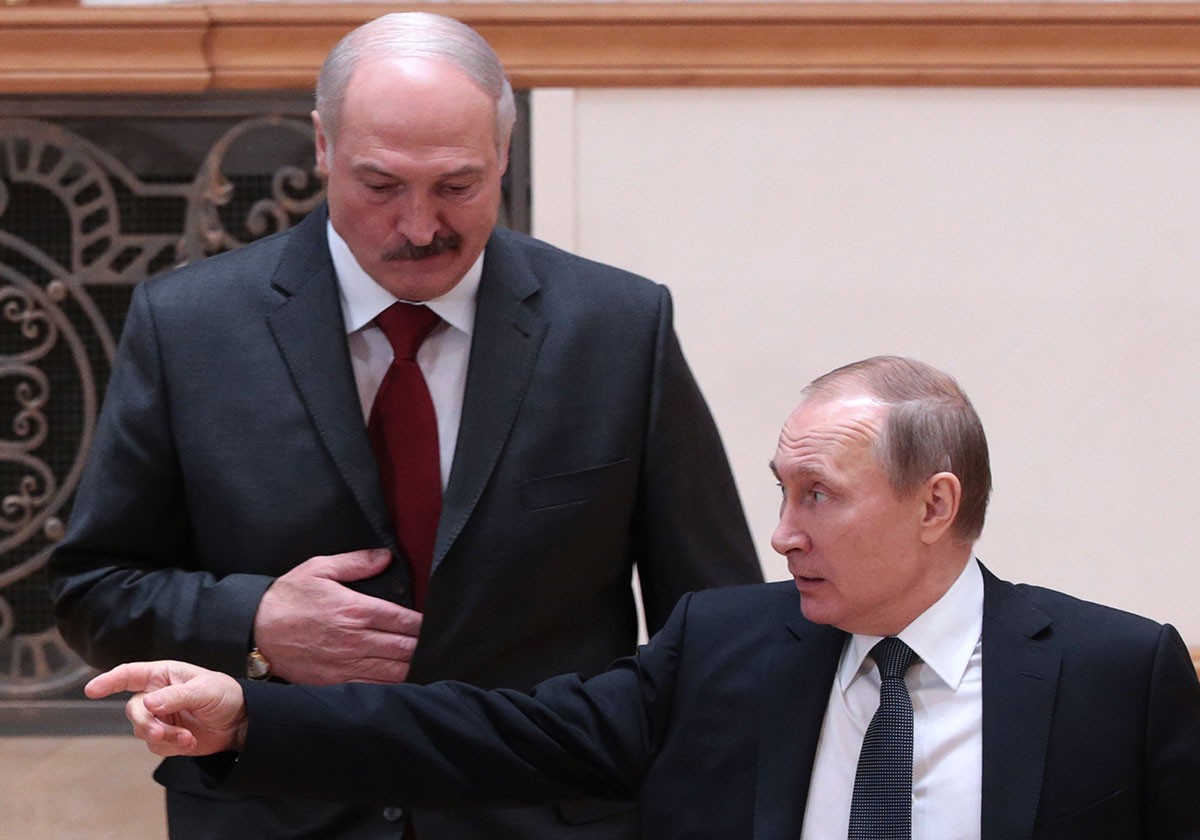
The sharp disagreements between Lukashenko and Putin often went outside (in the picture: during a meeting in Minsk in February 2016), but now, it seems, we are talking about a long -term disgrace. Photo: Mikhail Metzel/TASS
Alexander Lukashenko again did not meet with Vladimir Putin: a meeting of the Supreme Council of the Union State of Russia and Belarus in Moscow was postponed indefinitely. At the end of last year, Lukashenko was not on the CSTO and the EAEU** in St. Petersburg, and at the beginning of the current Minsk rumors creeped: Russia prepares a military invasion and weaves a conspiracy against the Old Man.
* CSTO - organization of a collective security agreement; EAEU is the Eurasian Economic Union.
The Moscow meeting of Lukashenko and Putin was scheduled for February 9. It was supposed to be discussed first of all about the price of Russian gas for Belarus (now it is $ 107 per thousand cubic meters, but Lukashenko insists on an additional 20 percent discount) and installment by the paying by Belarusians of the debt (in the amount of $ 550 million) for its delivery. In addition, Lukashenko is concerned that Moscow consistently reduces oil supplies: in 2016, instead of the promised 23–24 million tons of Minsk, he received 18 million, and in 2017, apparently, he will receive even less - 12-14 million.
However, on February 7 and 8, the press secretary of the President of the Russian Federation Dmitry Peskov unexpectedly announced the postponement of the meeting-due to the fact that "it was not possible to coordinate the schedule of the two presidents."
The glove of Moscow
Meanwhile, the Belarusian officialdom did not transmit a message about the cancellation of the Moscow meeting. This means only one thing: Lukashenko wanted to know in Minsk that he was not going to Moscow at all.
The government source in Minsk, Putin’s press secretary’s motivation for “disagreement of graphs” considers the artificial one: “It was the Kremlin on February 9, and this was on February 2, and, as far as I know, Lukashenko did not object, although he did not give official consent.” But then, according to the interlocutor of NT in the Government of Belarus, events began to develop in the “key that did not suit both sides”: “The Kremlin released the agenda of the meeting through his media to the dissatisfaction, without really agreeing on its details with Minsk,” the interlocutor of the magazine explained. “In Moscow, someone, it seems, did not like much that Lukashenko said about Russia at his seven-hour press conference in Minsk on February 3.”
The diplomatic source of NT in Moscow generally agrees with such a motivation for the transfer of the meeting: “When the president of a friendly country in a blue eye states that in Russia everything can be controlled for a bribe - this is a stone in whose garden? It is clear in whose. The Kremlin was very unhappy, and Lukashenko was said about it. " At least in the relationship of Moscow and Minsk, it is ended with the formula “oil in exchange for kisses”, the Belarusian publicist Artem Shreibman is ironic. But the considerations are much more radical in Belarus: the Kremlin is no longer needed Lukashenko - they will “blame it”.
Wagons for "green men"
The fact that Belarus could become the next victim of Russian strategists of the “hybrid war” in the country was spoke immediately after the annexation of the Crimea to Russia and the beginning of the conflict in eastern Ukraine. Moreover, the threat felt mainly the highest leadership of the republic - and immediately responded: the concept of “hybrid war” and protection against it appeared in the military doctrine of Belarus.
“We had the whole of 2016, under particularly close attention, those senior officers (from Lieutenant Colonel and above), who came from Russia or studied there. And there are a lot of such, ”a source in the Belarusian General Staff told NT. “Until 2014, they were in Favor and actually determined the entire policy of military construction.”
According to the source, after Ukrainian events, communication with the Russian Federation became, if not defamable, then undesirable, and if they had, the security council did not give good, for example, to raise an officer in his position or rank. “At the end of 2016,“ Russian ”was definitely made to understand that they would not have careers. Although officially Russia is still our main ally, ”the General Staff employee added.
“After Ukrainian events, communications with the Russian Federation became, if not defamatory, then undesirable, and if they had, the Belorusa Council did not give good, for example, to raise an officer in his position or rank”
Under the curtain last year, conversations about the Russian “hybrid threat” broke out with renewed vigor. The detonator was the news that in 2017, the Russian Ministry of Defense plans to send 4162 cars with soldiers and military cargoes to Belarus. Belarusian journalists found this figure in the documentation of competitive trading on military international railway transportation for the needs of the Ministry of Defense of the Russian Federation and compared with past data. It turned out that in 2015 and 2016, only 125 and 50 wagons, respectively, were enough for such transportation. Local analysts calculated: more than four thousand wagons can deliver “green men” in an amount equal to half of the Belarusian army. But Russia still has transport aircraft.
Between the devil and the deep sea
The head of the Belarusian Foreign Ministry, Vladimir Makei, has repeatedly stated: Minsk does not see a threat in the placement of NATO contingents in neighboring countries. Russia has a exact opposite opinion. “Now the Kremlin can raise the question with an edge: either Belarus voluntarily places the Russian military air base (and possibly a military contingent), or the Russian military appear in the country, regardless of the desire of Alexander Grigoryevich,” the Belarusian oppositionist Olga Karach believes. And experts Arseniy Sivitsky and Yuri Tsarik published a report in which it is concluded that Russia is a threat to its Western neighbor. However, Moscow, Sivitsky and Tsarik, specify, wants to obtain military-political control over Belarus not “at any cost”, but on a “legitimate basis”: “This may be the consent of the Belarusian leadership to such control or the scenario of the legitimate entry of Russian troops.” In the latter version, events can develop as follows: “pro -Western”, “nationalist” or “Russophobic” opposition, which Moscow will actually control, will try to seize power in the country. The putsch will either be suppressed with the “support” of Russia, or the Lukashenko regime will be overthrown, and the troops of the Russian Federation will enter the country under the pretext of fulfilling the allied duty and restore the constitutional order.
It is possible, however, that the script with the Belarusian putsch was already played out, but the attempt failed.
Analysts calculated: more than four thousand wagons can deliver “green men” in an amount equal to half of the Belarusian army. But Russia still has transport aviation
So that "do not bite the leash"
Before the New Year, the opposition Belarusian media and social networks reported: Lukashenko at the last moment prevented the Palace Revolution initiated by the Kremlin. Thus, the popular opposition resource “Hartia'97” published an interview with the coordinator of the Civil Civil Civil Civil Belarus campaign Dmitry Bondarenko: “The special services of Belarus put him ( Lukashenko. - NT) on the table certain documents that confirm the implementation of this plan ( removal of the president of Belarus from the authorities. - NT) and the availability of NT) and the availability of NT) conspirators inside Belarus, ”the oppositionist said. In his opinion, Putin decided to merge Lukashenko, not only because he, speaking the language of the headlines, “gnaws at the Moscow leash,” but also because the Belarusian leader became too popular in Russia. “Lukashenko is strangely the second most popular politician in the domestic Russian market with a confidence rating of 65%,” Bondarenko said in an interview, referring to the data of the polls **. “This cannot but annoy Putin, because <...> groups may appear among security forces and politicians who could try to use the Lukashenko map in Russia.”
** Apparently, this refers to the VTsIOM survey, conducted in December 2016 by the 25th anniversary of the CIS: among the leaders of the countries in the ranking of trust of Russians, Lukashenko took the first place with 65%.
In favor of the version of the coup, unexpected personnel cleaning in the highest and middle echelons of the Belarusian government indirectly testifies. So, at the end of 2016, the head of the presidential administration and his first deputy, deputy heads of the General Staff of the Armed Forces and the Ministry of Internal Affairs, the head of the border committee, as well as many small officials were resigned. All of them either share the ideology of the “Russian world”, or are somehow connected with Russia. The NT source in the personnel department of the administration Lukashenko commented on New Year's resignation briefly: “We had no relation to this, we were confronted with fact. And they made it clear that the initiator of the permutation is the Belarusian KGB. Moreover, the committees acted past the Security Council, although this is not accepted. "
However, the famous Belarusian politician and economist Yaroslav Romanchuk is convinced that rumors about the coup attempt to intentionally dissolve the encirclement of Lukashenko himself with his approval: “The people are afraid of coups. Therefore, everything is done upstairs so that people continue to believe Lukashenko: they say, only he is able to defeat the enemy and provide a peaceful sky over the country. And to invent the enemy is a trifling matter. ” There is no serious threat to Russian-Belarusian relations, Romanchuk insists, does not exist: “All these refusals Lukashkenko to meet with Putin is a tactical ditch. For example, Lukashenko did not specifically go to the EAEU summit in St. Petersburg, so as not to sign the Customs Code of the Union ( in addition to Russia and Belarusians, Armenia, Kazakhstan, Kyrgyzstan. - NT), in which Russia did not take into account his comments, is also included in the Customs Union . Problems of this kind before arose, and they were solved. ” But the Russian market, Romanchuk emphasizes, is now more valuable for Lukashenko: the share of Belarusian exports has grown from 39% in 2015, to 46% in 2016. 58% of Belarusian imports are also from Russia: “Do you think Lukashenko will leave the EAEU? From the CSTO? From the Union state? It won't work! Well, perhaps threatening ... "
Marina Gulyaeva, Boris Unanov took part in the preparation of the material