
Translated material
Notre Dame d'olland
The French authorities decided to rebuild the center of Paris
At the entrance to Prison, the concierge was established by the presidential tribune, with whom Francois Hollande announced the city and the world about the reconstruction of the island of Sita on the evening of February 14. A large -scale operation will stretch for 23 years, but this is a trifle on a history of history - even if you take only a short history of the island on which Paris was born 2300 years ago.
Why restructure is needed
Of course, one of the reasons why the island should be rebuilt is the desire of the current president of France to leave an architectural mark on the map of his beloved country. In this, he hardly wants to lag behind his predecessors: for example, from Shirak, who “built” the museum of primitive art on the embankment of Branly (last summer the museum has already received the name of the “creator”); Or from Mitteran, who “erected” the Louvre pyramid and four giant “books” of the National Library (BNF). By the way, BNF was designed by the architect Dominic Perro, whom Olland now entrusted to the reconstruction of the island of City. The intermediary between the architect and the president was the Olland friend Philip Belawal, the President of the Center for National Monuments. Belaval and Perrault worked together in the construction of BNF.
But the declared occasion for surgery on the “heart of Paris” is a desire to make a sieve “more attractive for tourists and local residents”.
Because so far both are not delayed on the island: the Parisians use it as a transit point for transporting from one shore to another, well, and tourists, mostly, go only to Notre Dame and then run away to absorb sights on the “mainland”.

For evidence, Hollande cited this fact: 10 million tourists annually visit Notre Dame and only 1 million-a “casket” located side by side for the “thorny crown of Christ” by Basilica Saint-Shapel with its magic stained-glass windows.
In the neighboring castle of the concierge - the first address of the Parisian residence of the kings of France and the main arena of revolutionary tribunals - even fewer people come in.
It is assumed that the “new logistics” of the island will unobtrusively push tourists to a more attentive study of the sieve. Well, to increase the island population, the “housing fund” will expand here.
Now on an island in the size of 22 hectares there are 1,100 people (and basically these are tourists renting apartments). At the beginning of the 19th century there were 16 thousand inhabitants. Then the dirty and cramped island was overpopulated, now it has turned into an administrative-tourist transit yard. Thousands of people work in state institutions (in the police, courts, prosecutors), hundreds - in restaurants and souvenir shops, but everything is dying out in the evening. At 18.45, the last “mass institution” of the island is closed-the Notre Dame Cathedral. Except for the large half-paralyzed hospital, which miraculously escaped from eviction, and accepts rare patients.
What will be rebuilt
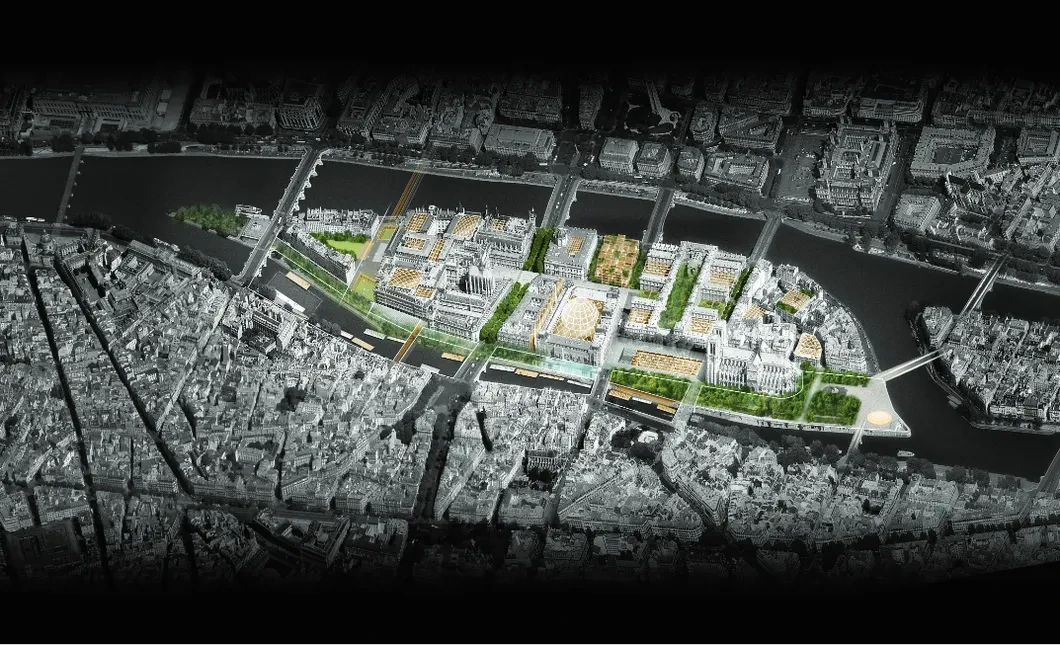
The basic principles of the project, which has already received the approval of both the president of Hollande and the mayor of Idalgo, look like this: to remove the “interference” for the movement of tourist flows, cover everything that is possible, with glass roofs and use the underground space to the maximum. It will be possible to move from one attraction to another on the ground and underground.
It is planned to “cut down” and through the through ground passage from the eastern part of the island where nototre-dah is located, to its western tip. For this, for example, they will remove the gates of the Palace of Justice, which occupies almost a quarter of the island. The palace will become open to a general visit - after most judges, prosecutors and investigators will move to a new skyscraper to the outskirts of the city in the next couple of years.
Without a gate, a pearl hidden on the territory of the palace complex will be better visible.
Well, and it will be possible to reach the tiny green triangle of the Dauphin Square on the underground path through the palace of justice on the underground path. And there is already a new bridge and the sharp "nose" of the island-brown Sita.
When you get tired of walking on the island, it will be easier to leave with it: for this it is planned to throw two new pedestrian bridges: one - to the left (Rive Gauche) and one to the right bank.
In addition, on the SITA, which is still inaccessible to the south bank (i.e., on the shore closest to Rive Gauche), will open a continuous pedestrian road. Nearby will erect new platforms - to stop the steamboats and water taxis.
The underground part of the area before the Casting of Notre Dame is completely “exposed”-i.e. They will cover the whole space of the archaeological museum, demonstrating the ancient city ruins.
Glasses, according to the architect’s idea, there should be many on the updated island of Sita: and it is this idea that causes the hottest objections of different defenders of antiquity. If the project is carried out without significant changes, several glass domes will appear over the island, changing its “heavenly perspective”.
For example, the courtyards in the Palace of Justice, the quadrangle of the buildings of the Police Prefecture, still open the internal space of the hospital hotel and even (!) Clusted the famous flower market, along with the entrance to the metro station, will be covered with glass.
But still, the defenders of the “antiquity” may not fall into an agitation: the Perrault architect with Hollande is not going to do the same with the island as in the second half of the 19th century Baron Osman with Napoleon III. Giant administrative buildings built under the dictation of Osman have already gone in history, and so, most likely, they will remain in it. For the time being.
The architect promises not to destroy anything and “build nothing new” (except for underground spaces, bridges, surface platforms and glass domes).
At the same time, one of the stated goals is the appearance of 100 thousand m2 of new areas in the very center of Paris.
Part of the huge complex of buildings of the Police Prefecture and Hospital Hotel-Dyo should turn into housing. Supermarkets will open in underground spaces (which are no longer on the island) and other retail spaces.
So “improving the appearance” of the Paris Center, the initiators of this procedure plan to combine useful with pleasant.
In the meantime, the developers of the project submit it under the slogan: "Make the city’s heart to beat again."
For a lot of money, you can beat, of course.
PS
The project will be available for the viewing of Parisians and tourists in the concierge until mid -April. Those who wish can also see it on the site. Theoretically, the project can still change. The developers urge those who want to show the initiative and promise to consider all the proposals.