
Translated material
"On the other side of hope"
On Berlinal shown a new film by Aki Kaurismaki. Says Larisa Malyukova
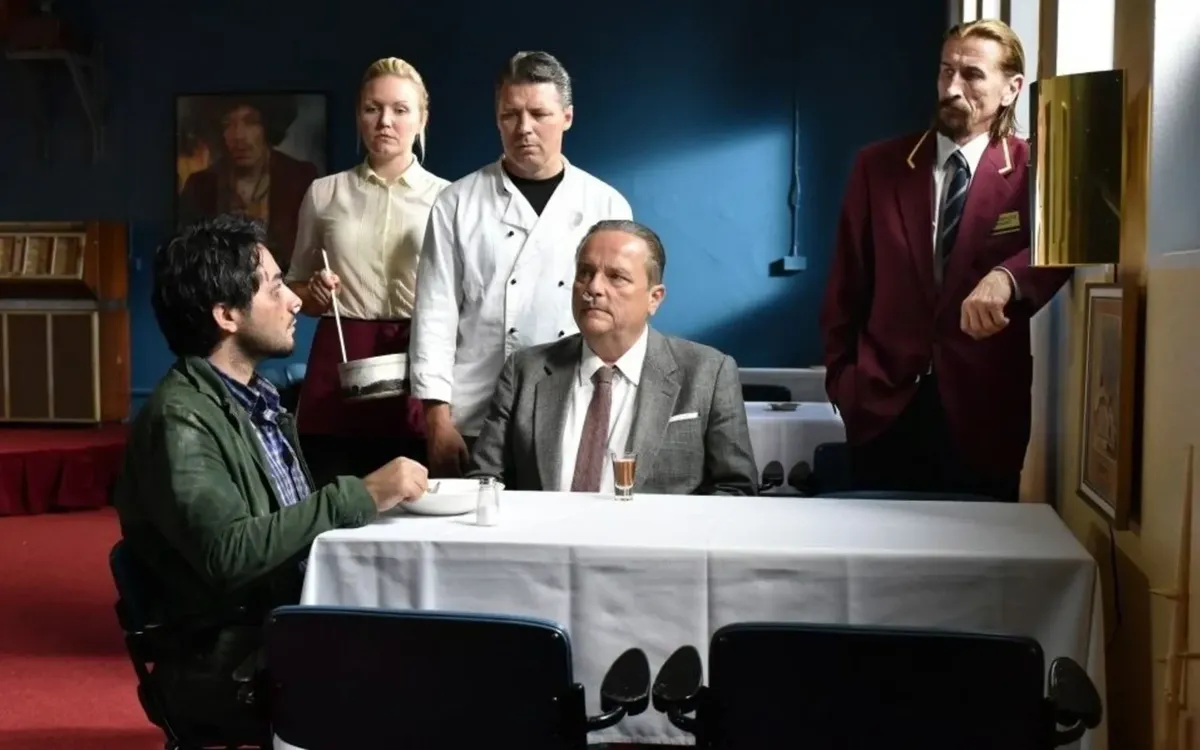
In Berlin, a show of the best film program was shown. Regardless of how the jury appreciates it. Although, I think, to Pop Pokhwan, who led judges, comedy drama or another optimistic tragedy of Aka Kaurismai will have to beloved. In it, light and harmony in the absence of sweetness, humanism - without pathos, and hope in a paradoxical way is formed from the bitterness of understanding of the disharmonious structure of modern Europe.
To the joy of the Sinefils, the gloomy Finn with Russian roots after a rather impressive break removed the second part of his port-emigrant trilogy.
In “On the other side of hope” he tells us in his melancholic style, combining soft humor, poetry and philosophy of relationships - not many Europeans and emigrants. An elderly Finnish commander Vikstrem - leaves his wife (curlers, a glass of vodka on the table next to the “head” of the cactus, and the wedding ring of her husband - in an ashtray with cigarette butts). For money won into cards, he begins a new business - restaurant. A young refugee from Syrian Aleppo Haled will appear on the screen literally from a mountain of coal. “Seventy meter,” they measure him in a police station. He is a mechanic, and plans to legalize: the house is bombed, the whole family, with the exception of the missing sister, is killed. But his petition will be rejected. Instead of deportation, with false documents he will turn out to be a handy in the same restaurant.
Again, as in the “Gavra” - the first part of the trilogy - good people save one individual immigrant. The whole French quarter was engaged in the salvation of the child in Havra. Here, good -hearted restaurant employees are trying to save a person running from: war, local fascists and xenophobes, Molokh of the state machine.
Outwardly, the picture is extremely simple, and for film acquaintances it is stolen by quotes, primarily with ironic references to Kaurisma himself. “Golden Pint”-a fish restaurant (sprats from a can + beer) will turn into sushi bar (local herring with Mount Vasabi), then into a musical retro club. The unhurried Finnish rock and roll groups will raise the temperature degree of action. And the branded absurd microsaris will cause laughter. There will be a dear, the dog, which will be adopted by the small commune “Golden Pinta”, united by adversity, a common difficult fate and the ability to remain people. And from all this "movie game" in the final will be a heart.
If you are not afraid of loud words, then the film Kaurismaki is a call for mercy by artistic means. But the naivety of this call stems from the human wisdom of the author.
"What to do with emigrants?" - ask the director. “We are all people,” he answers, “today some are forced to run, tomorrow - we can become refugees.”
The journalists met Kaurismaki at a press conference with a standing ovation. He looked like a lazy bear. I joked a lot. So far, they did not ask him that he was thinking about the danger of Islamization of Europe.
“In Europe 60 years ago, there were about 60 million refugees. We represent those to whom we help today are exclusively as enemies. So, hell has not left humanity? Europe did so much to comprehend the crimes of the past, to master a democratic way. And now we see the decomposition of this system. Because we ourselves are not good. Where the hell will this humanity be without humanity? " He admits that Merkel respects as the only politician who, at least, shows interest in the problem. He would very much like to change the attitude of the Finns to 20,000 Iraqis who came to Finland: “Many of my compatriots took this as an invasion. I am very modest in my desire to change the audience ... I want the whole world to change. But first we should change Europe, then we move to Asia. ”
Of course, the social fairy tale "Gavr" was more optimistic. However, over these six years and the world has changed significantly. Therefore, tragic motifs leaked into comedy. However, one of the last romantics of world cinema is still faithful to the now not poor traditions of humanism, the protection of weak and disenfranchised. Kaurismaki does not look back at all in fashion, "trends." And when stupidity, evil and intolerance actually rules - art calls for hope for the hope that is scarce today.
Journalists poured recipes from Kaurisma, the possible solution to the papa situation in Europe. And he did not pretend that he knew answers to all questions. He does not know. He just does what he can. And that means we will wait for the final part of the trilogy about refugees.