
Translated material
Aesthetics of presence
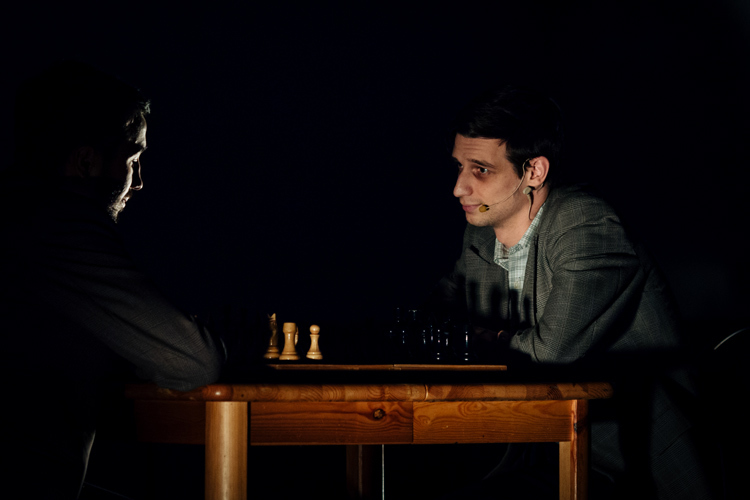
At what point did the focus of the interests of Dmitry Volkostroelov shift? At the time when he launched his first experiments with music as a matter of the performance, with silence, with nothing? It seems that there was still a template about literary centratism, when the director included in his field completely different categories associated with the study and objectification of time (through music, through nothing, through the silence ...). The structure of the time began to come to the fore, and in the last works of the Volkrostilov ceased to be a person from the theater, responsible for the perfect, sterile presentation of the text. On the contrary: he is increasingly interested in reduction, leveling, removal; Semantics of pure shape. And a logical, witty step along this path is the setting of the text of your own. It is much more difficult for your own text to experience. Own text is much more difficult to strive to solve, strive to present ... He is on completely different roles, he is an instrument, he has an applied function. Moreover, the text is so compiling as Rosencrantz and Guildenster, including numerical codes and newspaper articles, consisting of forty -eight episodes that crushing the time of action. Yes, to crush and mean time is the task of words almost polished from meaning.
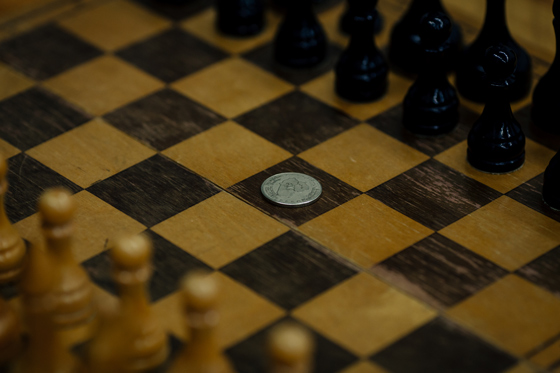
Of course, the play inherits Stoppard, replicas from Stoppard begins and thematically (and partly structurally) correlates with Stoppard. A temporary trap, into which the heroes, a small collapse and a paradox, were stuck, where two are stuck and are to death. In the version of the English postmodernist-somewhere in the center of the dislocated joint of the Shakespeare world (it is well known that Hamlet classmates are not the top on the cap of fortune, but also not the bottom of its soles). In Volkostroelov - in an even more wild and claustrophobic chronotope. In the viscous time of the chess tournament between Kasparov and Karpov, which lasted five months in 1984-1985, interrupted after forty drawing.
 © TSAZ named after Bryantseva
The program does not indicate who Rosencrantz, who Guildenstern would be even strange. Andrei Slepukhin and Ivan Stryuk are sitting behind a chessboard under the low ceiling of the white narrow space of the New Scene of the Youth Theater, bleached, stunned voices washed from intonations, pronounce what is defined, which is clearly predetermined. There is an episode where they - according to Stoppard - play questions that are allowed to answer only questions, and these constant: “What is your name? “And yours?” ... When the very concept of the role is reduced, they can be perceived as the question “who are you now?”. Screw or character? Ivan or Rosencrantz? Meaning? Meaning? What is your way of presence? Where is the border?
The days of the tournament are counted, and episodes are leafed through. Soviet jokes, Soviet hair care advice, listing distances from Moscow to the capitals of the Soviet republics (Soviet means static - this is into the hands). The time of sunrise and sunset, the length of the day are fixed ... Randomness, external arbitrariness becomes structurally forming and meaning -forming technique (in the “field” there was also a game of optional parts). And in a strange way typologically this resembles the “implicit influences” of Vsevolod Lisovsky in the “Theater. DOC ” - a performance where artists wandering around the city falls out to pronounce diverse texts at the specified points. Only there everything is by chance, as in the lottery, but here it is fixed. But it is more difficult to count (or construct for yourself) the law. The search for connections between the texts is delegated to the audience.
All this, of course, is a game.
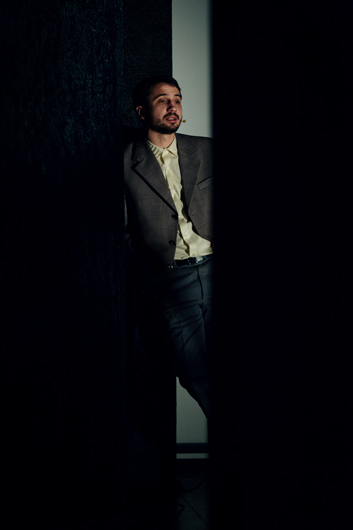
This is not a numbering room even, but a facet structure - since the scenes are programmatically the same type and are built according to the laws of macroplanes, where the smallest change of pose becomes a visual event and changes the frame. Where the change often occurs at the expense of the light: the mechanical yellow Sun of the spotlight crawls, the pattern of shadows changes - a new episode, a new date. Where the action and text are not self -charged, where it is important to get through time. We know: the party will end, the paradox is exhausted, the mousetrap will be revealed - with a particular outcome - we are patient, we go to the finale. We are focused. We go through.
They say words. In this case, the game with memorization is manifested. It is clear that the problem of the fresh birth of a word fixed in the text here and now is one of the key, especially in this type of theater, where a search for the ultimate authenticity of existence is underway. In this performance (in most of its episodes), it is shot. Because the information is shown obviously. The number of residents of millionaire cities, moves, numbers, measures ... A certain nomenclature of texts gives a head start. If we talk about action in the classical sense, then, say, in the scene where one calls the city, and the other is the distance to it from the capital, and the artist, and the hero recall. And the lecture in the hucks of the Leninsky and the artist playing the guide, and the character speaks as written. “What is your name? - And yours? "..." Who are you now? " That is, the clearance is minimized, the contractor is equated with the character.
All this, of course, is a game.
 © TSAZ named after Bryantseva
The discreteness of time - as in the paradox of Achilles and the turtle - contributes to its sensation. It shows the correlation of the audience time with the time of the performance. All this gives a certain awareness of the presence.
Strange, a similar (for all opposite) task was set by Brecht, achieving a conscious stay from the viewer instead of dissolution in action. Achieving thoughts (the opposite lies here, because the performances of Volkostroelov, of course, are deprived of a messenger and any invective; the awareness that he claims is in a completely different plane).
It is strange, the opposite task sets himself with a hypnotic, poetic theater, striving to drown the viewer in images, to shave time so that it ceases to be felt (hence the longitude of such performances).
There are strange tasks. In this laconic action, in which the actor does not require the entry into role relations, but the presence, similar inalition, insoluration is also proposed to the viewer. Inclusion, but not empathy, coexistence, but not following. Co-being, but not immersion, sliding, synchronization, docking of temporary segments.