
Translated material
Leonid Tennikov: "I have not changed in any way"
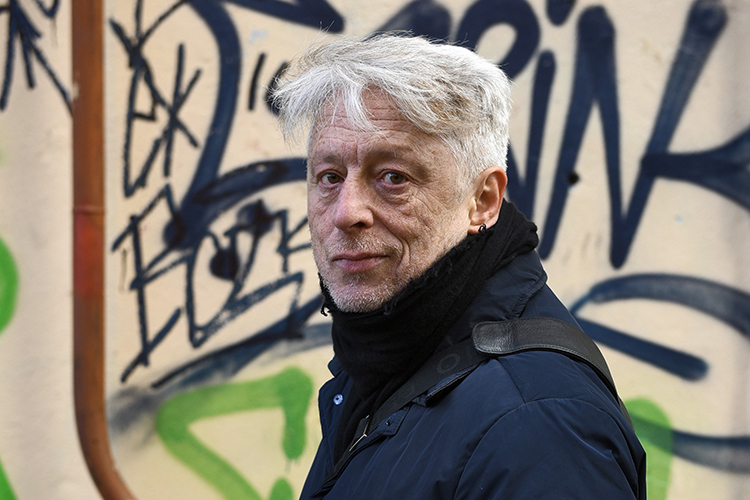
Last week, the 418 intellectual club introduced the new album of the violinist of Roman Mints in Moscow, at which he plays the works of composer Leonid Testnikov “Sketches for Sunset” and “Russian Seasons”. On this occasion, in the October Hall of the House of Unions, Roman Mints, Yana Ivanilova and the QueSta Musica ensemble performed “Russian Seasons” , before which the composer was heard from the composer. After the concert, Denis Boyarinov managed to talk with Leonid Netellikov about his biography, the morality of “Russian Seasons” and the new essay “Bukovinsky Songs”.
- Preparing for the conversation, I read a lot of your interviews related to different times. I noticed that interviewers prefer to talk about your works, but they talk little about life, about the origins of your music. Don't you like to talk about yourself?
- I just answer the questions that they ask me.
- The part of the questions that I am going to ask you today was already answered by one famous composer.
“I hope this is not a Proust questionnaire.”
- These are questions from the book “Dialogs” of Stravinsky. Here is the first: what do you remember about childhood - about the family, relatives, about the first friends, school impressions, about the first music you heard and remembered?
“I'm from a non -recuscular family.” The mother did not have any tendency to music, but his father had a good natural hearing and as an amateur played on Mandolin.
- An unexpected tool.
- No, on the contrary, quite common in everyday life - at least in Ukraine, where I come from.
I do not remember the first music I heard at all. After all, she was poured out of a radio stream in a continuous stream, a little later - from the TV. That is, the music was not aware of me for a long time as something extra -headed.
At some point (I was six years old) my parents noticed musical abilities in me and gave me to learn music.
- To the Kharkov music school?
- First, I studied in a music studio at a comprehensive school. There was no piano in the house. A little later, parents still managed to buy it - for the savings of her grandmother, who put off her pension for two years. It was a piano "Ukraine" of the Chernihiv factory of musical instruments, I loved him very much.
- In the "dialogs" Robert Kraft notes that Stravinsky has a habit that has survived from childhood, "sleep in the light." Do you have the habits that you carried through your whole life?
- No, perhaps not.
- Do you know the story of your last name?
- Surely - no. There is a hypothesis according to which my surname is somehow connected with the recruitment of Jews in the twenties of the XIX century, but I have no complete confidence. In addition, the surname of tenkov is found in both the Russians and the Jews.
It was a piano "Ukraine" of the Chernihiv factory of musical instruments, I loved him very much.
“Do you know what your great -grandfathers did?”
- No.
- Do you have relatives in Ukraine?
- No.
- Did the tense relations of recent years have influenced your relations with relatives?
-My relatives withdrew from their own places long before the Russian-Ukrainian conflict. The collapse of the Soviet Union, of course, influenced their departure. But everyone left at different times and for various reasons.
My cousin lives in Kirov. The cousin and his family are in Vladikavkaz. Quite numerous relatives - both on the part of the father and on the part of the mother - live in Israel. The closest are in Germany. There is a cousin in Seattle.
- Does the topic of Kharkov arise in your music?
- Well, I would not have a question so directly. From time to time in my works, the Ukrainian language arises (as in the opera “Children of Rosental”) and Ukrainian intonation (for example, in “Russian seasons”). But the Ukrainian melos always lived in me, all his life. After all, in childhood, I heard a lot of folk (but mostly pseudo -people) songs, which were, as in other union republics, part of the Soviet agitprop. It is difficult to say to what extent these songs are authentic. Was there something from the soil, deep, rustic folklore in them? There are probably special research on this topic.
The other day, flipping through Facebook tape, I heard the Georgian girl sings the song “Rushnik”. This, by the way, is the author’s thing of the fifties, the composer Plato Mayboroda, but the song, so to speak, is emblemically Ukrainian. It was very touching, she sang miraculously, in a distinct Georgian manner, in beautiful Ukrainian, no accent. Strange: I remembered a song that, perhaps, I did not remember more than forty years and never thought about it at all. Marvelous beauty is a thing.
- And you could sing a Ukrainian song?
- (sings.) "... I rushnik inking on the hobby, gave a share." (Laughs.) I don’t remember the text, but I could probably.
- Did your parents receive your talent?
- My father died rather early - he was not 63 years old, he was not witnessed by my so -called success. And my mother lived to the old age and from afar, from Germany, watched a series of scandals that unfolded around the opera “Children of Rosental”. Using a common -use cliche, I would say that she was proud of me and I met her parental expectations.
“Did she love any of your compositions more than others?”
- I think no. She actually was not a sophisticated person in music, in particular, in what I do.
- Who was your mother by profession?
- Accountant.
Brave me like Russophobe, please.
- Tell us about your first music teachers.
- The teacher in the music studio was called Elizaveta Moiseevna Virn. She was a rather strict lady. I did not study for long, because she considered that I had to go to the district music school-this is still a step higher. There I had a wonderful teacher with whom I maintained a very warm relationship until the end of her days. Her name was Fanya Abramovna Yarho. She loved me very much, I became practically a member of the family. She very soon realized that I would not be a pianist. But she treated me with extraordinary warmth, for which I am infinitely grateful to her. She was friends with my mother, they had their own, separate relations.
- Why did you decide to continue your studies in Leningrad?
- Partly on the advice of Fani Abramovna. For the last four Kharkov years, I studied at another school - a musical ten -year -old (this is still a step above), but she continued to patronize me. The fact is that her son, opera director Leonid Kukolev, studied precisely what at the Leningrad Conservatory. On his tip, I went to Leningrad and met with composer Yuri Alexandrovich Falik. After listening to a number of my children's opuses, he said that, they say, yes, you have the opportunity to do.
- Have you done easily?
- At the entrance exams, I received triples in the Russian language and literature. It seemed that there was no chance. But for some reason, in history (and in this subject I was not strong) they put me five. So in the sum of the points everything was Okay.
- What feelings are you now experiencing your professor at the composition Boris Arapov?
-I did not have such warm relations with Boris Arapov as, for example, Stravinsky with Rimsky-Korsakov. He had students whom he identified, but I did not belong to them. Of course, it never occurred to me to blame him for this.
- You did not have the opportunity to choose a mentor for yourself?
-The fact is that the aforementioned Yuri Falik was just a student of Arapov (he himself did not teach the composition at that time), he advised me to go to Arapov. So in the winter of 1972/1973 I came twice at a consultation in Leningrad: once to the phalyk, and the second - to Arapov. Arapov also had no disgust for my early things, so it implied a certain preliminary agreement that I was coming to him.
- What was then, so to speak, the alignment of forces in the composer workshop of Leningrad?
- At that time (I entered the conservatory in 1973), the most relevant composers were Sergey Mikhailovich Slonim and now late Boris Ivanovich Tishchenko. By the way, they were in a quarrel and did not communicate with each other-just like Stanislavsky and Nemirovich-Danchenko! The student community, respectively, was also divided in half, but of course, the case did not reach the assault. I was on the side of Tishchenko, as I knew and loved his music, still living in Kharkov. But during the first semester, my elderly professor was in the hospital. And I was temporarily redistributed to Slonimsky; I spent six months in his class.
Once I dreamed that I was considering a large format for the score, written in small calligraphic handwriting.
- Personal contact with Slonimsky changed your attitude towards him?
-It cannot be said that we had some special contact. He already had a huge class, a certain number of students that he did not need was added ...
From the second year, I began to come to the Tishchenko class for group classes. He gathered all the composers who studied from him - there were few of them - and just listened to what he was shown.
- What music did the students of Boris Tishchenko prefer?
- Everyone had their own preferences. Tishchenko is believed to be one of Shostakovich’s favorite students, but this did not mean that his students followed the same tradition. There were various kinds of poet. Suddenly, for some reason, everyone began to write music to the verses of Akhmatova and Tsvetaeva. Probably, a light dissident breeze even believed in the walls of such an autonomous institution as the Leningrad Order of Lenin, the State Conservatory named after Nikolai Andreyevich Rimsky-Korsakov.
-This is the mid-70s, in America, minimalism has already declared itself.
-In the USSR, it seems, no more than two or three people knew about this. I heard the music of Steve Reich only in the first half of the eighties. And Glass seemed to be already known, at least, music for Koyaniskatsi (the film was released in 1983). But I was little interested in the voice, but Reich was my idol for some time. However, yes, all this was after the conservatory.
- How progressive academic music was available at that time in Leningrad? Was it difficult to get new information?
- I get an impression (possibly erroneous) that what you call progressive academic music was almost more accessible than now. Say, Schnita’s music was the subject of burning interest. Not that she was given a green light, like the music of Khrennikov or Kabalevsky. Nevertheless, it was performed. And many people came to the premieres of his works in Leningrad. Contrary to the widespread opinion, the works of Schönberg, Stravinsky, Weberna sounded in the Philharmonic, although not as often as Rachmaninov's concerts. In this sense, music was more fortunate than literature, because it, fortunately, is largely extra -ideological.
- What did you read in the conservative years?
- Absolutely everything that came to hand.
I have been living in St. Petersburg for forty -five years - and I do not think about it how I do not think about my hand or leg.
- Did you have your favorite authors?
- I don't remember. I read beautiful books, but also a lot of all kinds of garbage.
- The corps of your works speaks of love for poetry.
- I will not deny.
-Now do you consider to be your hometown of St. Petersburg?
- Yes.
- How did he affect you and your music?
- Don't know; Perhaps he somehow influenced, but how-I do not know. I have been living in St. Petersburg for forty -five years - and I do not think about it how I do not think about my hand or leg.
- How do you compose?
- For the piano.
-In one interview, you said that for your essays you always need some kind of primary principle from which you are repelled.
- Yes, I call it "McGaffin."
- Do you dream of brilliant melodies? Does music not come to you in a dream?
- Once I dreamed that I was considering a large format for the score, written in small calligraphic handwriting. Music sounds simultaneously with reading a score (this is a dream of a pre -computer era) and it seems terribly attractive to me. But in a dream it was Tishchenko’s score, it was called “extrapolation”. Of course, it never occurred to me that I should remember her. And I woke up, of course, remembering anything.
-Once you said that they divide your music into the one that is written to the “children of Rosental”, and the one after. What is it connected with? Have you changed your views on the craft?
- No. This is an external line. After the "children" I have not acquired a new status, but a large number of people learned about my existence. I myself have not changed in any way. (Well, maybe for the worse.)
- “Russian Seasons” that we listened yesterday were written in 2000. When you listen to this essay now, do you find in it signs of that time and echoes of the feelings and thoughts that occupied you in the 2000s?
- No. It is a pity, Denis, that you do not compose music. Otherwise, watching you from the side, you would notice that you are in a state of a trance. Perhaps this is a too loud word ... let's say this: in an altered state of consciousness. You are in a different reality. After you are finishing this or that essay, you get out of this state. This is slightly like a dream that I just told you about.
- Does this mean that in your music it is impossible to find a reflection of the events of the time when it was written?
- This can only be determined by the post -fact. And this is engaged in musical critics and musicologists. It seems to me to understand this to the composer himself, it seems to me.
- How much is the assessment that musical critics give, coincides with your attitude to your music?
- Critics may like or not like what I am doing is not the point, but how talented and inspired they write. It is important that it be literature .
-Once you wrote a lot of music for the cinema. But, preceding yesterday the performance of “Russian seasons”, you said that your film career is almost finished. Was it irony?
- No, not irony. Many times I refused to work in the cinema, and gradually the flow of offers dried up. By the way, recently a director, whose name I will not give you, showed me the material of the picture, which is still at the installation stage. Then he disappeared. Probably changed his mind.
What you call progressive academic music was almost more accessible than now.
- Would you accept a proposal, say, from Fedor Bondarchuk?
-From Fedor Bondarchuk, I would hardly have received an offer, we are still immensely far from each other. To tell the truth, I have not seen a single film. Agree, there is some age chauvinism. The directors are becoming younger and younger - and invite people who are close to them by age, spirit and interests to cooperation. This is fine.
- Do you watch Russian cinema?
- You know, the other day I, as a member of the Nika movie Academy, sent a pile of Russian films equipped with passwords, you can watch, without leaving the house, it is very convenient.
And I began to watch them.
But pretty soon, in horror, he recoiled from the computer. I decided not to vote this year. Several good paintings (I liked the last film by Vladimir Mirzoev) does not save the situation. In general, this is terrible. Brave me like Russophobe, please. It is painful to hear these infinitely false intonations, to see the sea of a poured positive positive.
- What are you working on now?
- I am finishing a great essay for the pianist Alexei Harbool, also dedicated to him. It will be called Bukovinsky Songs. This is a cycle of 24 preludes on the material of folklore of Western Ukraine. So far, 22 are ready. These beautiful melodies, which I dissect in one way or another, are gleaned by me from the textbook published in the Soviet Union back in the 1950s.
- Is there an alleged date of the premiere?
- No, no deadlines. I do this exclusively out of love for pure art.
- The texts and melodies of the songs of “Russian Seasons” are also taken from the textbook of folk songs. The latter especially cut me: “Our hands are rake, our eyes are pits. That the eyes are envied, then the hands will chop. ” Is this an authentic text?
-Yes, this collection was published in the late 1990s. Its compounding author is Elena Nikolaevna Razumovskaya, whom I later met and maintain friendly relations. For many years, maybe even decades, she went to the same region on the border of Russia, Ukraine and Belarus, where she recorded songs, and then published her decoding - texts, musical notes and comments. The text that you mentioned is a spiritual poem, the so -called psam, poetic edification on the border between secular and religious poetry. It is authentic, naive - and very powerful. Yesterday it turned out a kind of Russian folk morality. (Smiles.)