
Translated material
Elections-2018. Project "70

The time has come to predict the results of the 2018 election campaign, says political observer Andrei Shcherbakov. In an interview with Polit.ru, he appreciated her prospects in terms of probable turnout and possible distribution of votes.
“All governors are set aside, all preliminary results are summed up. The time for forecasting the final results comes.
The final results, as you know, will be summed up according to the results of the presidential campaign. Today, it seems to me, it is not time not to predict, but to try to understand how technologically this presidential campaign can pass.
Let's say right away once and for all: all our assumptions are purely hypothetical and proceed from those numbers that walk on the Internet and which are not confirmed by anyone. These numbers are connected with this: supposedly the new leader of the domestic political unit of the AP is either the task or formulated, or it is reflected by himself - the task called “70/70”.
This means that 70% of registered voters should come to future elections, and ultimately a candidate who will personify the current government, a candidate from the party of power (we will not yet give a surname) will have to receive 70% of the vote from the number of people who came to the polls.
What is behind these numbers? Other figures, namely, the absolute number of people who should go to the polls and vote exactly as the heart tells them. And then the stage of juggling in numbers comes.
Unfortunately, we do not know the exact number of voters as of January 1, 2017 - the Central Electoral Commission has not yet hung it. But we have data for July 1, 2016, and the number of voters then amounted to 111 million 624 thousand 248 people.
In order to understand how it should change approximately, we will also see how many voters were January 1, 2016. And we will see: there were 111 million 724 thousand 534 people. That is, the number of voters has decreased by approximately 100 thousand. But the figure as of January 1, 2015 is 111 782 877 voters. For three reconciliations, the number of voters decreased by about 160,000 people.
This means that if the process continues at the same pace, then over the next year the number of voters will be reduced by, say, 150 thousand and amount to approximately 11 million 465 thousand people. Let's come from this.
So, this is the total number of voters who will be included in the voting lists in March 2018.
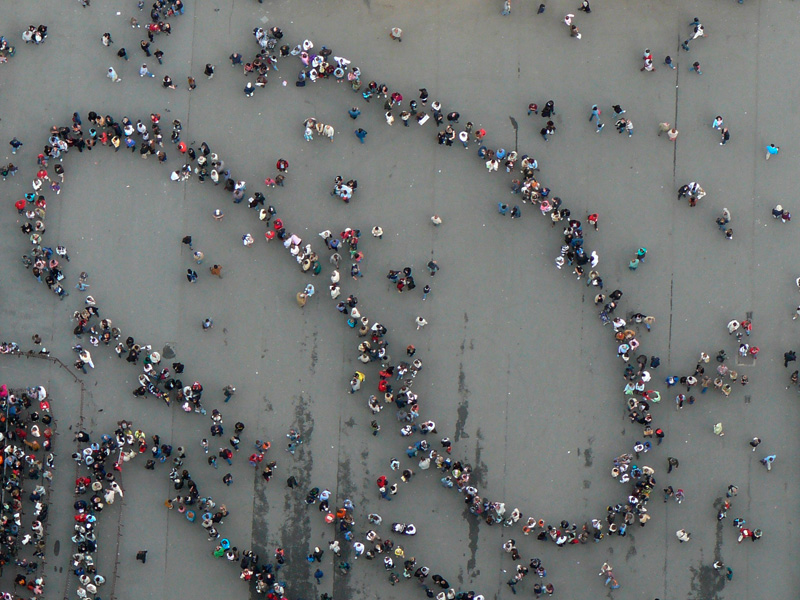 People are in line.
We produce simple arithmetic actions and we get that 80 million 250 thousand people should come to the polling stations. And of them, 56 million 178 thousand 500 people should vote for the candidate of the party in the Party of power, according to the concept of “70/70”. Such numbers can hypothetically be in the minds of election administrators.
Then two understandable questions arise: firstly, how to ensure a turnout; And secondly, how to ensure the result? Again, we are holding purely technological positions here. We do not say how good or bad, who is right and who is wrong - we reason abstractly. And first, we think how many votes we have on other candidates.
Again, arithmetic comes to the rescue: we subtract from 80 million 250 thousand people a certain part of the above - 56 million 178 thousand 500 votes. It turns out 24 million 71 thousand 500 people. This is the number of people who should come to the polls, but give their votes for other candidates.
That is, they should not give, but we will predict that such a number of people will vote for everyone except the candidate from the party in power.
This figure itself is large, but without comparison with how it is today, does not mean anything. However, if we will raise the statistics of the state Duma that have just passed elections, we will see that, according to official statistics (I use RBC numbers), 52,700,922 people took part in them, of which 24,173,094 people did not vote for the party.
This is interesting here. It is clear that the electorate of “United Russia” and the electorate of the candidate from the party in power are not identical. It is clear that a presidential candidate who will personify the current government will gain significantly more votes than United Russia. Therefore, here we are focusing on the number, so to speak, “protesters”, those people who do not vote for power.
In 2016, there are slightly less than 24.2 million people - despite the fact that in our layouts the concept of “70/70” should be a little more than 24.7 million. Everything beats. But then it turns out that almost all the voters who again came to the presidential elections (and they are released nearly 27, 5 million people) should vote for candidate No. 1.
It is clear that such a goal is unattainable. This means that it is necessary to talk about the conversion of the votes of those who, having voted not for the party in power, are able to vote in the presidential election for the one who needs the administrators of the process.
How can you achieve the desired result? An understandable way: for example, using manipulations with an electorate of liberal democrats.
I note: when I say the word "manipulation", I do not put any derogatory or wrong meaning into this.
Zhirinovsky’s rating and rating of the Liberal Democratic Party are not identical, no matter what different people say that the LDPR is the Zhirinovsky party, and its rating is the Zhirinovsky rating. In fact, this is so and not so at the same time. Zhirinovsky himself is good as a politician when it comes to all elections except the presidential.
We look: the LDPR in the State Duma elections in 2016 received almost 7 million votes. Zhirinovsky in the presidential election in 2012 received a little more than 4.5 million votes. The discrepancy of 2.5 million actually gives us the very delta that we talked about earlier. That is, if, relatively speaking, we subtract from the 24.2 million people who voted not for the Party of power those very 2.5 million uninhaled votes that are flowing to Zhirinovsky, then they flow from it, we get 21 million 700 thousand votes, and this is a completely normal figure around which we can talk further.
What does it mean to "conduct a conversation further"? For example, we completely do not imagine how they will vote for a candidate from the Communists. That is, we can’t imagine at all, since the peculiarity of the positioning of communist candidates recently at the non-regional level does not allow any forecast for the numbers that the communist candidate can take.
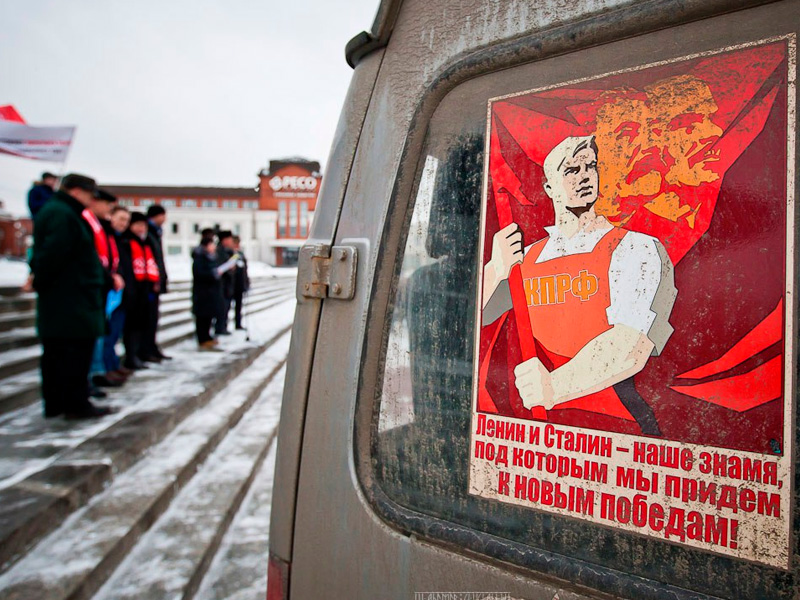 Communist Party of the Communist Party.
Please note: Zyuganov in 2012 takes 12.3 million, even a little more. The Communist Party in 2016 barely gets to 7 million votes. And this is with a mobilized electorate, and this is with their ideology! That is, here we can talk about any behavior of a communist voter. He can, as it can significantly reach those millions that are, and can continue to get bothering - because, in my opinion, Zyuganov is weaker than the Communist Party. Zyuganov is not identical to the Communist Party.
However, in 2011, the Communist Party took almost the same 12.6 million votes in the Duma as Zyuganov himself in six months. Does this mean that the communist electorate has so bored and the number of voting for Zyuganov will be approximately 6.8 million people? If a direct analogy is appropriate, a candidate from the party in power can count on another 0.2-0.4 million ballots.
Thus, we can say that in order to reduce the number of people who have come to the polls, but who voted not for the candidate of the Party of power, the administrators of the process need to work very seriously with the liberal democrats, converting their supporters to supporters of a prolonged candidate, and occupy a flexible and still not very understandable position in relation to the candidate from the Communists. And only then it will be possible to say that the initial 24 million 173 thousand 94 people who voted not for “United Russia” can turn into 24 million 700 thousand voters who voted not for a candidate from the party in power.
To be continued