
Translated material
I want to become a cyborg
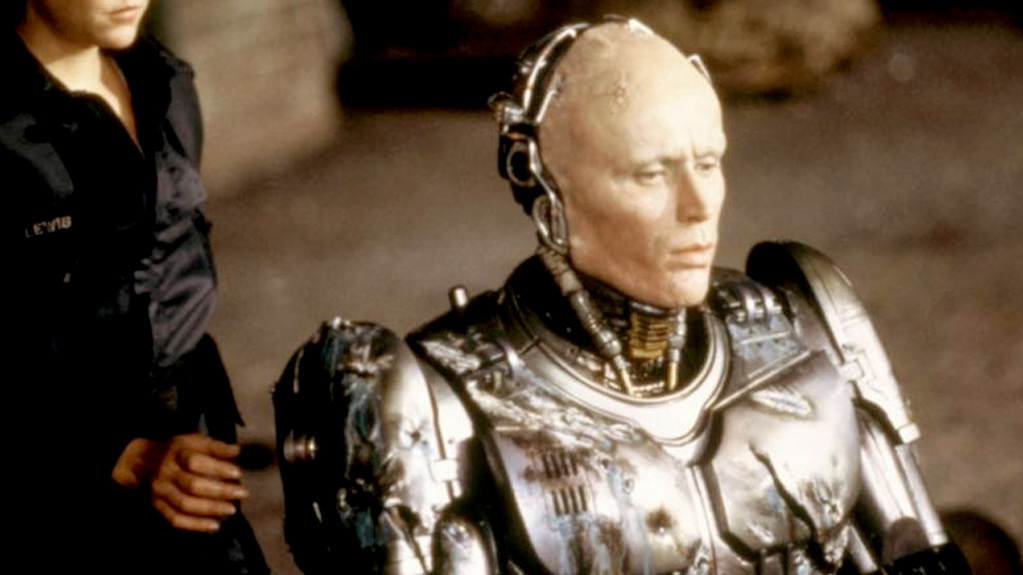
How to make an upgrade of a person
Sergey Medvedev: One of the cuts of the future: recently, Ericsson Consumerlab analysts found that 80% of smartphone owners are ready to expand the possibilities of sensory perception and cognitive abilities using technology. In other words, a person is ready to become a cyborg, to entrust his feelings, and maybe some parts of his body with modern technologies. Is it so? And how to make an upgrade of a person? We are talking about this with Futurologist Peter Levich , who himself will present his titles.
Petr Levich: I am the director of the Department of Interaction between Science, Technology and Society of the Moscow Technological Institute and the founder of the organization Future Foundation .
Sergey Medvedev: On the Internet you write a lot about the phenomenon of cyborgization. Is this a completely distinct trend-exactly some interfaces built into a person? As I understand it, all sorts of sensors that we wear on ourselves are not that.
Peter Levich: In itself, the expansion of the capabilities of a person began for a long time, at the moment when the monkey took a stick. Understanding transgumanism as expanding human capabilities at the expense of technical means ... Our clothes, our glasses (not even google, but diopter glasses) are all the expansion of opportunities.
A person is ready to become a cyborg, to entrust his feelings, and maybe some parts of his body to modern technologies
Sergey Medvedev: They are external towards a person.
Peter Levich: It is important that in this process there is a visible and even tangible border - the surface of human skin. I remember the study that you talked about, I translated into Russian and published its results. It was surprising for me that 80% of people were ready to do this.
It is interesting that my colleagues from the Higher School of Economics conducted a study with similar issues in Russia, and their results were just opposite. The article, generalizing the results of research, was called "My body is my fortress." They investigated a wide range of technologies, by the way, largely intersecting with that study of Ericsson. The Smart House system, autonomous power sources, home robotics scare people much less than that with regard to their own body, that is, cyborgization.
Sergey Medvedev: Russians are not ready to provide their body ...
Peter Levich: Although, as far as I remember, in Ericsson it was among smartphones in large cities, and among others there is Moscow - perhaps these are some different samples. It should be understood that the study of Ericsson cannot be perceived as the opinion of the whole world.
Sergey Medvedev: They may have some of their targeted groups, they carried out this study quite purposefully. Although the number of smartphone users is practically approaching the majority (at least among Western humanity) in relation to a person without a smartphone. In this sense, a smartphone is also a continuation of a person? Purely psychologically, it seems to me that a person no longer thinks himself without a smartphone in his hand, at least most of us.
Smart House system, home robotics scare people much less than cyborgization
Peter Levich: I agree. There were even neuropsychological studies that showed that when a person’s smartphone is broken, he does not experience physical pain, but some processes in the brain occur as if it were physical pain. There are experiments with a mirror perception when two hands are placed, and a mirror between them. Then one hand is removed, you see a reflection of the second hand, and in this place they hit with a knife - a person pulls his hand, his adrenaline is thrown out. Also approximately with a smartphone: we really perceive it as part of our body. If a person who often uses a smartphone has left the house without him, then he, of course, will feel uncertain.
Despite such interesting psychological phenomena, the border of our human body is quite strong. And the intersection of this border ... If we wear a bracelet, which considers steps or pulse, outside the skin or, it would seem, a much more convenient and equal capsule with a chip under the skin, then there is a big difference for people.
Sergey Medvedev: The boundary of their own skin is the boundary of our identity or humanity.
Let's talk about those cases when a person overcame the border of his own skin, and technology entered the skin. First of all, you can talk about already son -in -law prostheses.
We perceive the smartphone as part of our body
Peter Levich: When we are talking about technologies, cyborgization, neurotechnologies, in general about biotechnologies and biomedicine, they are usually divided into two groups - these are those that compensate for the lost function (for example, a person has a hand - it is clear that he is much more likely to agree to put a prosthesis instead of it in order to be equal in terms of capabilities), and raining: for example, if I supply myself The third hand or cutting myself a healthy hand to put a cybernetic one. It is clear that the readiness for replacing cyborgization is much higher than for the improvement. Speaking about cyborgization, about the direction of cyberpunk in science fiction, we subconsciously mean just improving, and this is usually shown in films. After all, it is seriously to discuss whether people need to install prostheses if they have a leg, in general, do not have to, few people will not agree to such an operation if it is done in a good scientific center.
Sergey Medvedev: There may be prostheses that improve human abilities. For example, Pistorius on prostheses runs faster than other runners on natural legs.
Peter Levich: I can definitely take myself to adherents of new technologies, setting a mental experiment: suppose there would be some kind of hand with advanced functions ...
The boundary of your own skin is the boundary of our identity or humanity
Sergey Medvedev: Like a Swiss knife.
Peter Levich: There was a wonderful film: "Man - a Swiss knife" - about such a hand. There would be some free operation or for little money, without side effects to cut off a healthy hand and put such ... I put a mental experiment on myself: under what conditions I would agree. But I realized that if I were offered this tomorrow, I would not agree, despite the fact that I definitely enter those small percentages of the Russians who are ready for this.
I tried to reflect - why, and it turns out that it is largely public opinion. It always seemed to me that I try not to look at him, but we all understand that they were meeting on clothes. It is clear that in the current society, where percent of the percent of people have cyborgized hands, if I come to some place with such a hand, they will perceive me largely through it: and, this is a guy with a prosthesis. I would not want this, I would like to say: Ah, this is the guy who thinks about these things. Probably, this is not what I would like to associate with-with such an outlandish monkey, with something so interesting.
Sergey Medvedev: This is a matter of time: as more people will appear ...
Peter Levich: Then I began to think about what percentage of people should be with such prostheses that they looked at them differently. In fact, this is a small percentage. If we saw at least one such person every day, then it would no longer be such a curiosity. There are already many studies about how many people should have such a sign that they are somehow perceived.
It is important that when such a product appears, its distribution will be an avalanche -like, because as soon as the first barrier is passed, this will become the absolute norm.
Sergey Medvedev: What technologies are we talking about? What functions of the human body can be foreseen in the coming years or decades?
When such a product appears, its distribution will be an avalanche -like, and this will become the absolute norm
Peter Levich: Let's start with what is possible now. Biohackers are such a movement of people who experiment on themselves and other biological buildings, for example, index the plant genome. Already now you can buy your child for a hundred dollars a set of genetic editing, and he will be able to edit the genome of indoor plants. A wonderful option!
For example, they embed a compass, that is, such a chip that begins to vibrate when directed to the north. This may not be a very functional thing, but it is important that it already exists. People can insert themselves an oscillatory circuit that will approach the cards in the metro doorway.
Sergey Medvedev: I read about a Russian engineer who made himself a chip of the Troika card.
Peter Levich: It is interesting that he did this in a tattoo site, because no clinic will take up this, these are huge reputational risks, they are limited by law. Since this is a non -standard procedure, they cannot comply with all the standards, because they are not on such an almost surgical procedure. And in the tattoo salon he was flooded in this chip in a biosilicon, such a swelling turned out. I don’t know how this story ended.
In many works of Cyberpan there are such dark golden cities, and there are underground laboratories where you come, and you will be upheld. It would seem that in the world we do not have a cyberpan, but when a person wanted to do this, he also came to a tattoo salon.
Sergey Medvedev: At the same time, there are, in my opinion, digital tattoos.
Peter Levich: This technology is not yet much developed. Yes, indeed, you can make a simple chip in the form of a tattoo, but not the fact that it will be very functional. It is possible to introduce a finished chip under the skin more reliable. But in terms of development, this is probably terribly promising. After all, tattoos are already normal. Perhaps for many people it will be more difficult to insert something under the skin than to make just a tattoo with some function, except for visual.
The Russian engineer made himself a chip of the Troika card
Sergey Medvedev: It seems to me that in the near future an improvement in vision and hearing should appear, that is, our entire sensory.
Peter Levich: By the way, in the same study, Ericsson was a reservation that most people are ready to improve their function of perception - vision, hearing. There was still memory and consciousness, but this is probably a more distant horizon. When we say a “more distant horizon”, in the world of science and technology it can be, for example, ten years instead of five, that is, it is not a century, because technology develop very quickly. And the near horizon can be a year or two.
Sergey Medvedev: Already in a sense there is an external memory: our memory is taken to a cloud, google, and Wikipedia. It seems to me, it seems to me about a very simple Internet interface, that we can connect, connect ...
Peter Levich: The speed of the interface is fundamentally important here. If we look at the stages of the development of civilization, especially in the last few centuries, then at first the person went to the library for new knowledge and spent on this, suppose, ten hours, then he went to his home computer and spent on this, suppose one hour. Then he walked to his computer for ten minutes, then he dug a minute in his smartphone, and now he asks for Siri for ten seconds. Each next stage leads to a sharp increase ... you need to think about what: I want to say - performance, but, it seems to me, the performance here is not the most important.
Sergey Medvedev: The availability of memory.
Peter Levich: In practice, this is the level of consciousness ...
Already in a sense there is an external memory: our memory is taken to a cloud, google, and Wikipedia
Sergey Medvedev: Maybe consciousness can really quantify in the number of calculations that are made? If we are talking about playing chess or th (a person against a computer), then in its pure form we are talking about performance, and the question is in the number of calculations.
Peter Levich: Just in the case of a game in the GO, this was not entirely true. Not only productivity and amount of memory are important. The computers were quite powerful, they took the game of chess, and the game in the th - no, had to change the logic of work. That is, this is a change in logic from logarithmic, vertical, to evolutionary logic, when the system evolves, pushes itself. Only this allowed them to win. So this can hint to us that an increase in memory, performance is, perhaps, far from the most important.
We are talking about transgumanism, post -humanism and pronounce other beautiful fantastic words. But in fact, a modern person with a smartphone, with access through Siri to knowledge, and a person who, for example, for ten hours went to the library, are different civilizations. Of course, we belong to one biological appearance. It is clear that for a century and a half a person has not genetically evolved, but these are fundamentally different speeds of work with information and levels of consciousness. This shows us that in some fundamental change in humanity there is nothing new, we simply do not notice it when we are inside this stream, and we present the future as something strange. We will not notice how we will become post -member.
Sergey Medvedev: Due to the inevitable appearance of cyborg, ethical issues arise. Where does a person end and where does the technology appear? Does a person with a certain sum of technology within his own body continue to be a person?
We will not notice how we will become post -member
Peter Levich: This is a question of what we mean by a person. There is a wonderful mental experiment. We have a certain number of neurons in our brain. If we will replace them for some transistors, quantum chips, on what day of the month we will cease to consider this creature a person each? The first, probably, is not - only one thirty was replaced. There were cases when people in the war lost part of the brain and continued to function. When replacing the 29 thirties, probably, many people would have considered that this is already some other creature. So this is a very deep philosophical question.
You mentioned identity. The fact is that in the context of new technologies with identity there may be problems. Previously, everything was simple, a person is what is created by God. The new time has offered us another criterion: a person is that which is collected in the Gomo Sapiens genomes. Man is the one who can create, this is creativity and intimate functions of the highest order.
By the way, in one of the programs we said that this can also be taken away. Even if creativity can pick up cars, it is so important how much upgrades and transistors have, still a hundred percent robot can do the same way. So the question is not even in cyborgization. Of course, it is difficult to unequivocally determine such a criterion. Humanity will have to develop some difference.
Man is the one who can create
I already received this question about the new identity of a person and received different answers to him. One of the most interesting is a certain system of values. We can trace the sufficient credibility of this answer. In many works of science fiction, where there are cyborgs and robots, it often turns out that people with some upgrades are bad characters. So, we do not like their value system, their moral guidelines. There is also a completely anthropomorphic robot, and he is a positive character whose values we like. We are much more delegating to him the right to be called a person than these cyborgs who, in percentage ratio, are much more organic than he is. Apparently, the question of a person or not a person will be resolved, based on what values this creature adheres to.
Sergey Medvedev: Humanity from the point of view of the value system, and not from the point of view of biological or technological material ...
Maybe a person is the one who was born a woman? Although, on the other hand, if people from the test tube appear ...
Peter Levich: Recently, in Brazil, they made a child from three parents. And if ten people take off 10% of the genome? I also have no specific answer to this question. If you recall Azimov’s novel “Bipepword” and the corresponding film, then there this criterion was due not to birth, but by death. The robot wanted to officially receive citizenship, become a person, and the local parliament set him the condition that for this he should become mortal. There at the end there is a romantic scene: everyone is crying, he dies, and he is given the right to be called a person a second before his death. This is just criticism of transgumanism: if we make people immortal, we will lose this humanity. It would be hypocritical to agree with this criticism, because I personally do not want to die, and why should I then refuse this right to the rest?
Sergey Medvedev: The dream of immortality is a very human instinct.
Recently in Brazil made a child from three parents
Peter Levich: You can dream of this and strive for this, but if, for example, we will achieve this, imagine what a creature is before us, I think that it is immortal, it will prevent us from calling it a person-at least because it is some kind of God, something above us.
Sergey Medvedev: A qualitative one is a different step. На пути к этому бессмертию, я думаю, будет сделан очень большой шаг, если говорить о киборгах, киборгизации, технологиях внутри человека.
А в медицине: вот эти нанороботы, которые можно запустить в кровоток и которые в постоянном режиме реального времени будут мониторить все наши органы…. Наверное, здесь очень большие перспективы?
Петр Левич: Возможно. Роботы в какой-то момент будущего действительно будут с хорошим технологическим пакетом решений. Сейчас нанотехнологии как-то затормозились. Если мы вспомним информационный фон пятилетней давности, то все говорили о нанотехнологиях, причем не только в России, но и во всем мире, а сейчас – больше про искусственные интеллекты, нейросетки. Есть какой-то барьер сложностей, который пока невозможно пройти в силу технологических ограничений. Учитывая информационный технологический фон, похоже, что более перспективно видится именно не биотехнологическая история, а полностью биоистория, то есть выключение механизмов старения.
Сергей Медведев: Работа с исходным человеческим биологическим материалом, а не внедрение внешних технологий в человека… Если это когда-то произойдет, ведь здесь же встает вопрос о безопасности: человек становится объектом контроля и манипуляций. Грубо говоря, хакер может взять и перепрограммировать вашу руку или ваши мозги.
Петр Левич: Вы будете смеяться, но как раз сегодня мне приснился сон: человеку взломали протез руки, который его убил. Когда-то такие сценарии я прочитал в статье "Киберпреступления будущего". Действительно, если у меня есть киберпротез, то он не только мой. Он может быть не обязательно мой и хакера, он может быть мой и какого-нибудь Гугла, которому мы доверяем и любим. Или мой и какой-нибудь дорогой мне спецслужбы.
Сергей Медведев: Даже если технология Google Glass продвинется, то это будет частично наш глаз, а частично Гугл, и Гугл будет решать, что мы будем в какой-то момент видеть в этом Google Glass.
Сейчас нанотехнологии как-то затормозились
Петр Левич: Про похожую идею была замечательная серия в фильме "Черное зеркало". С одной стороны, мы хотим свободы, а с другой, технологического прогресса. В каком-то смысле они совпадают, технологии, казалось бы, дают нам больше выбора, но с другой стороны, пока что, к сожалению, большие технологические прорывы могут создать именно крупные корпорации. Горизонтальные структуры, биохакеры пока не могут создать явную конкуренцию крупным компаниям, но в будущем, очевидно, смогут, и это будет одним из ответов. Ведь киберанархизм и подобные вещи как раз вырастают в горизонтальных структурах, там больше уважается свобода, приватность и другие ценности.
Сергей Медведев: Могу предположить, что возникнет и некое кибердиссидентство. На фоне тотального распространения технологий киборгов будут такие диссиденты, которые скажут: нет, никаких технологий, только мое голое тело.
Итак, мы наметили очень интересную тему для разговора, особенно с точки зрения философии: что такое человек, где границы нашей человечности… Человечность – это фронтир, наша идентичность – это фронтир. И раньше или позже он пересечет границу киборга, и мы все так или иначе станем частично металлическими или технологическими, как Робокоп.