
Translated material
Suffering to the ruble - 2
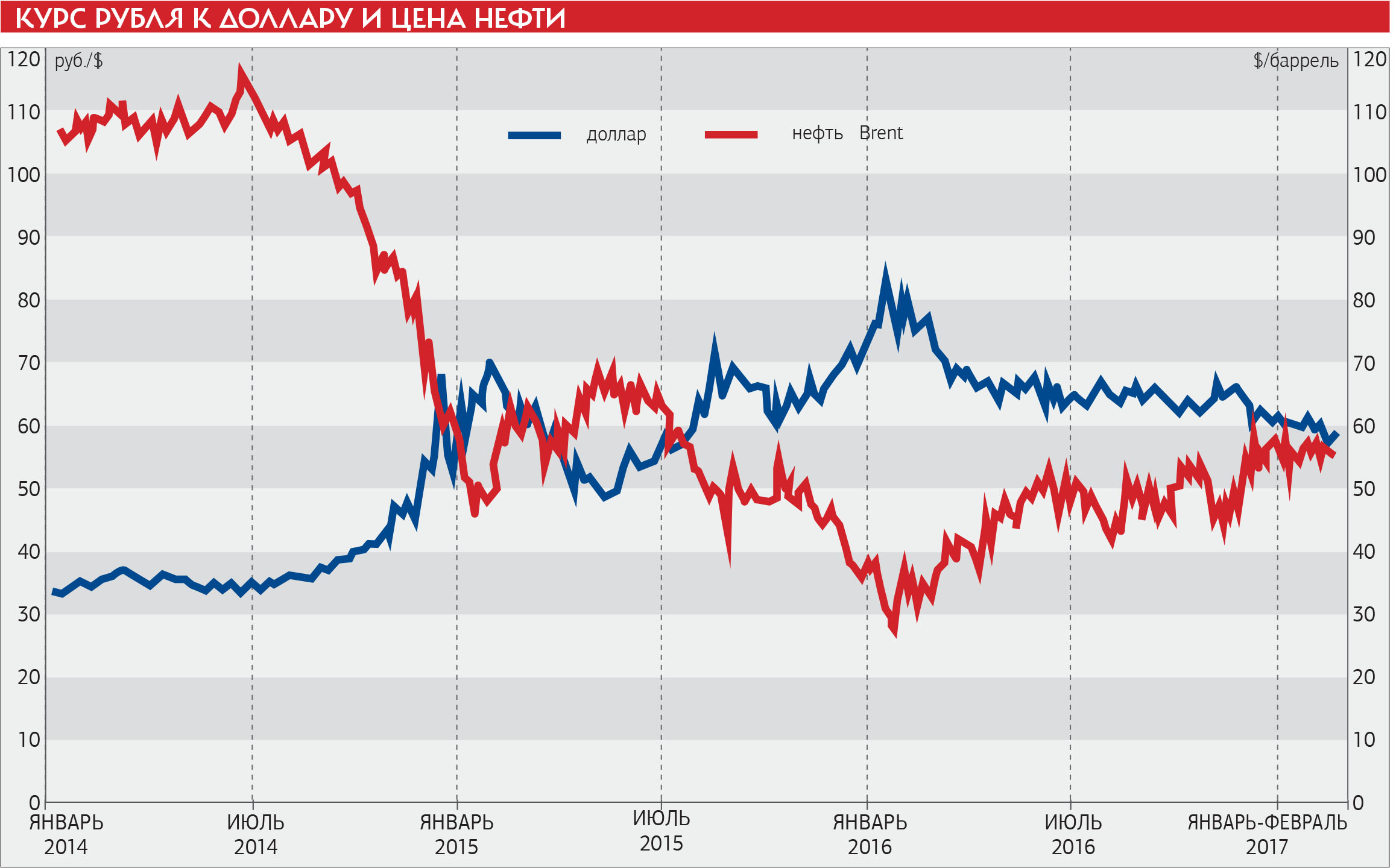
There is no mountainous misfortune in the world than an unexpected surge of unscheduled good luck. The name of the protagonist of the month is the Russian ruble. For the first time, he scared the whole Russian elite and power, first of all, not his weakness, which was tens and hundreds of times in history, unexpected dignity.
Too good
Now the course of the Russian national currency for the currency of the main export goods of the Russian Federation, the US dollar, is almost at the same level as in mid -December 2014. Oil at that moment cost about $ 64 per barrel, the market was in an ideal hysteria, which a year later, in January 2016, when oil fell to a record $ 32 per barrel, brought the ruble price to almost $ 1 (see schedule). We can say that from that moment on the Russian budget began to finally be taken. As NT already wrote ( “ Suffering according to the ruble” , No. 3 of February 6, 2017 ), the January situation of foreign markets quite allowed the Ministry of Finance to hope that the Russian budget, which Minister Anton Siluanov, healed the contracts of government throughout 2016, would be almost childless in 2017.
The calculations of the Ministry of Finance were iron: back in mid -January, no one doubted that his intention to devalue the ruble by 8-10% would be executed. However, by mid -February, when the Ministry of Finance has been implementing its plans for a week, oil cost all the same $ 53–57 per barrel, and the ruble was strengthened to 56.8 per $ 1. It was at this moment that President Vladimir Putin called the head of the Ministry of Economic Development Maxim Oreshkin to talk about what would happen next to the ruble. So far, there was only enough shot from the main caliber to stop the ruble to strengthen, but still had to shoot.
Back in mid -January, no one doubted that the intention of the Ministry of Finance to devalue the ruble by 8-10% would be executed. However, by mid -February, the ruble strengthened to 56.8 per $ 1
The main problem, which has been discussed in all power corridors for a month now, is not a ruble exchange rate itself, but its uncontrollability. “We do not know why the ruble is strengthened,” this phrase is endlessly repeated in closed conversations in the White House: the current difference between the nominal ruble exchange rate and the alleged market balance is 5-10%.
The second youth
Strictly speaking, all this is not that the problem is rather the opposite.
In any case, the status of the cheapest in the world of a large country with educated and qualified personnel Russia for February has not been lost for sure and is unlikely to lose even if the ruble at the same levels of oil prices will rise in price to 50 per $ 1 - this is about the level of May 2015.
Actually, it is these circumstances that investors mean, since the fall of 2016, enthusiastically and growing volumes playing in the Russian market in a game called Carry Trade. The game is as follows: take the currency, convert it into rubles, buy ruble assets for it, such as state bonds of OFZ or Gazprom corporate bonds, and wait until the ruble and high profitability create money from the air, after which you sell rubles and buy currency. The profitability of Russian bonds is correlated with the level of the key rate of the Central Bank - now it is 10%, and taking into account the reducing inflation, it is 7% per annum. This is exactly what you will not lose. If the ruble is strengthened, you, without doing anything, win more: the Russian lottery for the lazy with relatively low risks will give you a quarterly income of 10% (30% per annum).
There is practically no casino with such a generous croupier in the world now. The Indian market is much less predictable, Brazil in 2015-2016 scared away many too sharp devaluation of its national currency, and the prospects for the relations of the United States and Brazil are still non -obvious. In the case of Russia, it is still customary to believe that Donald Trump will not be equally implacable enemy of Vladimir Putin, which Barack Obama was considered. In general, for players who value high risk, Russia in January was the main point on the map. The presence of economic sanctions against her was taken into account in bets: no one is going to strengthen the sanctions anyway, but they can be weakened. The non-determination of the situation in Europe (elections with the threat of the victory of nationalist populist, unreasonable Greek crisis, an incomprehensible surge in inflation at the end of 2016, Brexit, finally) and the incomprehensibility of Trump’s future economic program in the United States only strengthen interest in the small but revenue market of Russia.
One could temporarily believe in it, and they believed in it.
Who is returning
Who specifically plays Carry Trade? First of all, this is a game not so much of Western money as the owners of rubles well, in 2011-2015, actively leaving the country, and now returning in the form of a speculative influx of capital. In any case, the assessments of the Central Bank of the state of the payment balance in the IV quarter of 2016 suggested that even taking into account the Rosneft transaction, the balance of support movements for Russia by the end of the year was almost zero or even positive. At the same time, natural gross flow continued in one way or another, although it was lower than the usual for 2010-2012 due to decreasing oil prices. But no one has to evaluate the gross stump for now-presumably, it is large enough. Some confirmation of this hypothesis may be the January assessment of the Central Bank with a wide money supply, taking into account the currency deposits - the M2X unit: it has decreased a little, which may indicate the massive converting of foreign exchange savings in ruble. It can even be assumed that the main object of interest of investors in Carry Trade is, in addition to corporate bonds, the boom in the market of which reached a peak at the end of 2016, and OFZ, also a well -growing stock market of the Russian Federation, and this is not only oil “blue shirts”, but also energy companies, and cans, and telecommunications.
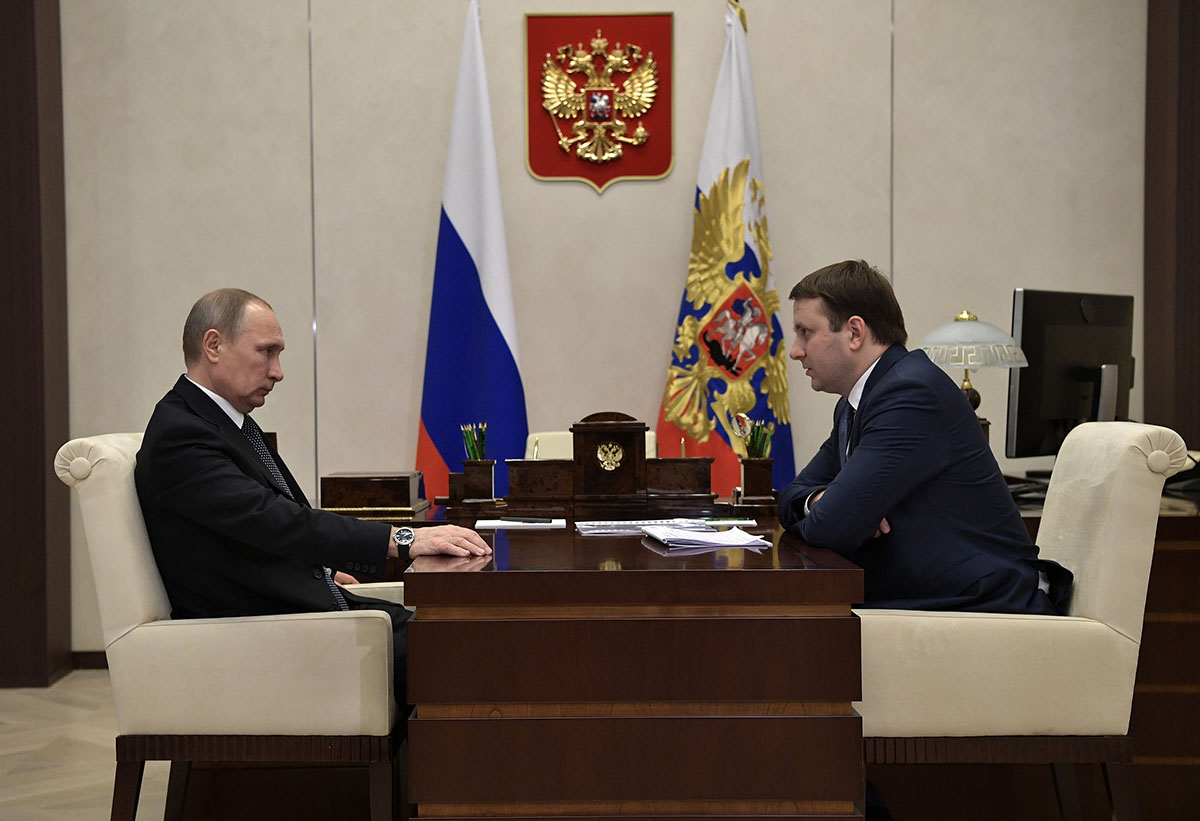
Perhaps this is a rather short game, and it really ended on February 16, when Vladimir Putin talked about the ruble with Maxim Oreshkin.
Hopes and realities
In vain it is said that the Russian White House does not listen to economists: the fact that low oil prices for a long time were believed almost immediately, as in the fact that the cheap ruble is not the intrigues of the United States, but an objective economic reality almost forever. The reduction in demand in the domestic market was accepted by an axiom, and the entire cash of the government immediately rushed to use the devaluation effect - the cost of labor and inaccurate goods in Russia fell significantly, due to this, the country began to look like one of the best export production centers in the world. The “import substitution” itself excited only a few, since this matter is quite long and what is happening, in general, of course. It is much more exciting to negotiate with investors existing in Russia, primarily foreign, about how Russian assembly cars, Krasnodar grain and Samara car rental will conquer world markets. It was the game almost win -win: the comparative advantages of the country of cheap currency when reducing internal demand in one way or another will force investors who have already invested in the country to reorient business - if they were previously interested in 140 million consumers in the last unknown large market of the world, now these are tens of millions of families of workers and employees, in principle, capable of producing goods for almost any of the 7 billion people of the planet.
Of course, not every product. First of all, these are grain and some types of food, part of mechanical engineering products, large chemistry, plastics, forest and pharmaceuticals - in general, about everything that does not require super -circular investments (especially if they are already made earlier than richer Russia), and may quickly pay off. In addition, the demographic situation in Russia does not make it possible to hope for the deployment of assemblies with great employment here - there are no people. And, of course, there were no hopes for the industry 4.0 either. It was about Russia in advance as a slightly improved version of China of the early 2000s-a country of large mass production of the previous generation.
Beat with a ruble
Of course, this perspective is not destroyed by the February strengthening of the ruble - in order for this to happen, both a more significant revaluation of the national currency, and greater mobility of state regulation, and a more dynamic economy are needed. It is not without reason that the main problem, in January discussed by the Economic Bloc of the White House, is the failure of the non -resource export program: the expectations that the cheap ruble will be the main reason for the revival of industry was initially overstated. But by the end of 2016, the government was already proud that the “import substitution programs” were designed and written, some money for stimulating such an increase in GDP has already been reserved, and there are even some successes-in China, they are happy to buy Russian ice cream and Alenka’s chocolates through Alibaba. Everything is just beginning, it was said with hope: a couple more months - and they will try our stew, tractors and plastic film!
And here-a wooden ruble that for several months maintained great hopes, unexpectedly demonstrates disobedience, firmness and even some kind of metallic shine. A great grain harvest, collected in 2016, no one is going to buy at high prices - they also have grain, and they, unlike us, are able to reduce costs. The Russian AutoProm does not demonstrate export miracles. Chemists have achieved success, but this is a consequence of investments in 2007-2015, and development requires technology, money, and people. And, the most offensive, - no Skolkovo, no technological breakthroughs, no interesting startups, but there are many requirements to support the most important undertakings, from software for patriotic education of youth to the construction of a new corps of the digital library at the university. And many promises of an innovative jerk-what is now due to an expensive ruble to rewrite plans?
This is a game of not so much Western money as the owners of rubles who have known Russia who had previously actively left the country, and now returning in the form of speculative capital
Meanwhile, the unprotiped growth occurs in those sectors where he was not expected. For example, in the production of shoes, in agricultural processing, in the Internet trade, in certain sectors of the building materials industry, in the service sector, in sectors adjacent to the oil industry, but the processing is almost not growing, like the military-industrial complex. Everything that is less tied to state support is growing, decentralized and successfully used the moderate tariff inflation of 2016. Everything outside the agricultural sector, which was supported by the White House, is about the same state as before. And this is not surprising - the problems of this business voluntarily took over the budget, in essence, he does not need to grow. And so good.
Apparently, you really have to do something. For example, the ruble exchange rate can be reduced without problems by the Investigative Committee or Prosecutor General. Deputies can develop a bill in the style of the "Spring Law". Finally, there is Vladimir Putin, who does not understand economic intricacies sufficiently in order to give some fairly ridiculous indication of the Central Bank or the Ministry of Finance.
I have, we have ways to struggle with this misfortune.