
Translated material
This is what Anna Teresa de Cersmaker does
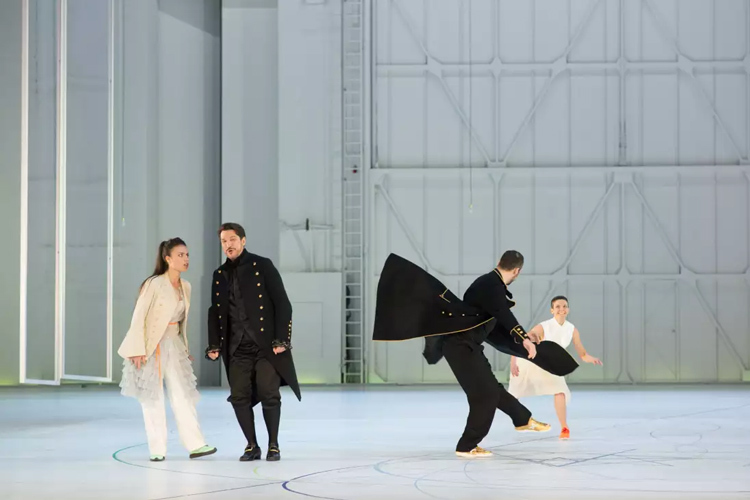
The new production of “All Women do” Mozart in Palais Garnier was announced as the first opera project of the legendary Anna Teresa de Ceersmaker, the Belgian choreographer, the head of the Rosas dance company, the reformer, the dance theorist with the reputation of the genius. Formally correct, this presentation can nevertheless mislead. Keersmaker really has not yet put the opera. However, the Parisian performance is not her first experience with Mozart (for the Avignon festival, she made a project based on arias from Mozart opera). And this is far from the first experience of using speech and verbal text in the production. Moreover, the sound of the word has become almost the main object of the study in its last works.
One way or another, the intrigue was significant. And the Parisian opera took care of the commercial "straw", in parallel with " Cos ì" releasing Opéra on his second scene Bastille blockbuster Wagner "LoEngrin". It was the transfer of a psychoanalytic setting of Claus Gut with a real pond and a stellar composition from La Rock: Jonas Kaufman, Rene Papa, Evelyn Herlitsius. And indeed - if the elderly bourgeoisie was steadily in anticipation of the branded Pianissimo in the story about the Grail on Loellerin, then the more exquisite public “COSì” began to “bake” after the first act.
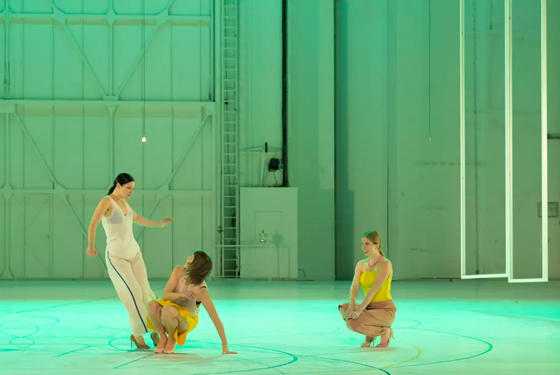
It was clear that such a reaction should be expected after the first fifteen minutes of the performance. The dressed singers and dancers on an empty stage, almost without leaving the place, begin the story about the loyalty test, which a couple of soldiers arranged for their beloved, incriminated to know their life with an elderly Bonvivan in conspiracy with an indefatigable servant. The performance throughout the entire length remains faithful to this aesthetics of minimalism in the spirit of the defile JIL SANDER . The action is unfolding in the whitened space of the scene open to the walls of the scene in the complete absence of decorations - with the exception of the plexiglass “culites”, which do not hide anything, and as if an accidental glass shelf with alcohol on the deep periphery of the audience attention. The artists are dressed in the faceless casual . Unless Don Alfonso gives something pirate. The fundamental monochrome of the scene is interrupted by strictly calculated saturated color spots - lemon, pink, fuchsia color.
 © Anne van aerschot
The white linoleum scene is painted with multi -colored concentric circles torn by centrifugal diagonals. They outline the geometry of the performance, fundamentally deprived of the center - on the stage there are forces that scatter the characters, plot, emotions. Such graphics sometimes dictates the constructions of ensembles, when, for example, all the “tail” line up behind the singing soloist and repeat his movements - most often swaying. Or he introduces into doubt, provokes anxiety that the composition is about to fall apart-when the heroes seem to turn to each other, and the diagonals show another direction of energy.
The orchestra, under the guidance of the expressive star of Paris, Philip Zordan, follows the same transparency of the lines and forms, focusing on rhythmic purity and complexity, on the graphicity of the performance, where each line of musical tissue is displayed to the surface and as if cleansed of all superfluous. Soloists, in the absence of a realistic action, also seem to turn to the universe, which is why any aria turns into a hymn to loneliness. At the same time, the uninterrupted composition of the performers (Jacqueline Wagner-Fjordiliji, Michelle Lozier-Dolabella, Frederick Antun-Ferrando, Philip Sly-Gulelmo, Paulo Shot-Don Alfonso, Ginger Costa-Jackson-Despina) shows acting plasticity and motor equipment. And the abstractness of the production allows the singers to concentrate on rhythm and breathing; Sometimes it seems that they read mantras.
 © Anne van aerschot
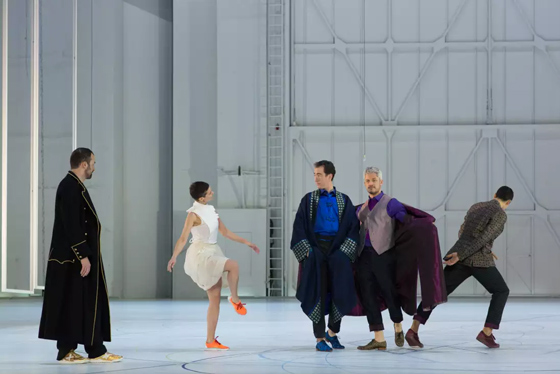
Keersmaker put a double-dancer to each soloist. Such a technique that has taken root in the opera Theater allows you to work in an important paradigm “One note - one step” and find moments of immobility (equal to silence) in the most unexpected situations - for example, during a comedic fuss. The same technique allows her to focus even more a gap between a flat and inconsistent plot and abstract, at times sacred music. Choreography does not illustrate either a word or music, it is another layer that moves away from a literal plot.
Personal features of the characters also seem to be lit up, lose the contour, remain after themselves. The contact on the stage is fundamentally canceled or formulated in the form of symmetrical movements at a great distance from each other. The duet arises only once, among dancers, and produces the effect of an exploding bomb. But only in order to scatter performers around the perimeter again.
Keersmaker canceled in her staging this final “feminist” part of Mozart’s trilogy - yes Ponte all the charms of libertine, psychologism, reliability and what else expects from this anecdote about the deception of lovers. It creates the theater in its most true sense - as a difference from reality.
“COSì” is more like a game - with a drawn field and clear rules. But this is not the liberating game of flirting and sexual (or gender) emancipation of the 18th century. This is the ethics and aesthetics of the sports game. Or laboratories - where logistics and strategies are painted up to a millimeter in order to obtain a result, always expected, always pre -produced. This is a kind of codified form of interaction in which there is no liberation.
 © Anne van aerschot
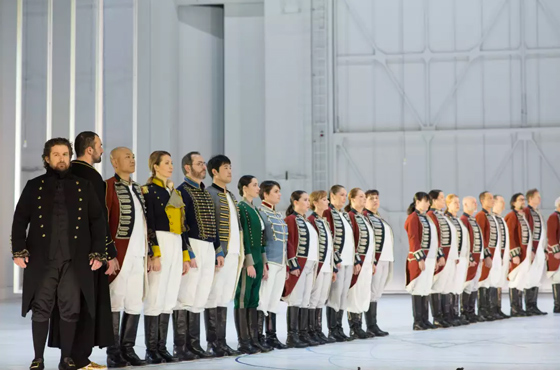
The laboratory does not produce gold. The final of the performance completely copies its beginning, allowing you to hear musical rhymes, which, as a rule, leaves the usual following the ups and downs of the plot. No growth happened, no one became neither wiser, nor tolerant, nor reasonably, nor older. The only thing left is the hell of this day with mutual betrayal or confusion. Everything is permeated with a sense of loss.
Keersmaker created a completely “its” performance, which was another example of assigning the material with this remarkable creative energy. However, he did not become the performance of the master (and therefore causes confidence). The material turned out to be resistant - due to the accumulated tradition, the genius of the author. From the scene, literally fonilo stress - arising not so much between heroes as between text and production. Keersmaker periodically knocked down in Gagi - the most vulgar -looking, with adhesive noses and somersaults through the head. And the performers could not overcome the charm - sentimental, heroic, hysterical - the music that they performed. The symmetry between the dancer and the soloist every now and then slipped away, it seemed that everyone was performing his own dance. And in a paradoxical way, choreography, trying to maintain fidelity to the rules important for Keersmaker, suddenly turned out to be a foreign, rude and too physical in this sterile world.