
Translated material
Why did it rush in February 1917?
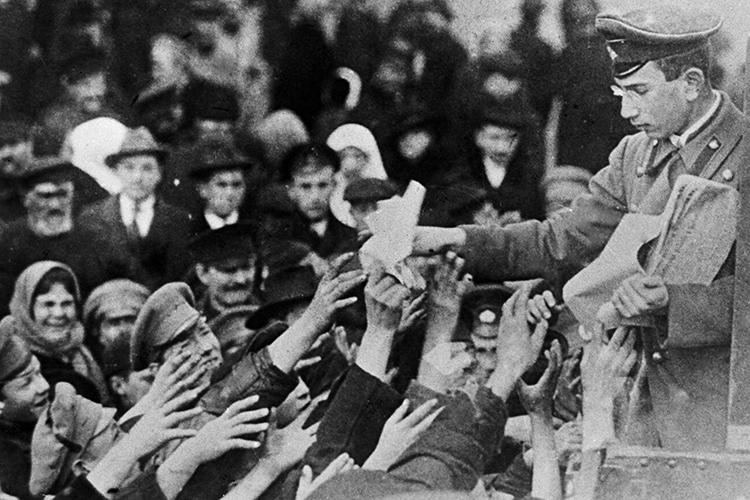
New Russia felt an acute need to sew, tie historical fabric, torn for decades after the collapse of the USSR. We will take a feasible part in these processes on the Colt. The materials associated with this restoration of the lost, we unite in the “Remember All” column.
1917 and 1991-two years, supplanted from public consciousness, which does not know what to do, how to evaluate these two revolutions that determined the past and current century of the country. This was already written on the Colt, for example, Alexei Tsvetkov and Andrei Arkhangelsky . Tatyana Trofimova talked with Professor Rash Andrei Markevich, a specialist in the history of the Russian economy, about why 1917 still happened.
- Rowing out the reasons in retroactively. But, they say, the revolution always happens suddenly. How expected was the 1917 revolution? And what should have developed so that it was so torn?
- At the time of the beginning of the First World War, Russia was a developing, but poor country. As a rule, people, if they are poor and understand that they are poor, unhappy. This is a potential source of fermentation and discontent. And there is also a working question - how much time the workers work and how much they receive for it, there is an agrarian question - to whom the Earth belongs, and there is a national question - whether the Russian outskirts have self -government and what rights the minorities have. Three key issues in the Russian Empire.
But namely In February 1917, everyone - socialists, liberals, Bolsheviks - were in shock. No one expected that unrest in lines for bread would lead to such. If you look at the statistics of strikes and any political unrest for two or even three years of the war - there are very few of them. In addition, at the beginning of the war there was a huge patriotic rise. Everyone went with a banner and supported the king - "together with the monarch we will go to fight with the Germans." In this sense, if we are talking about the exact moment - February 1917 - nothing foreshadowed the political revolution.
“So why did it happen?”
- War. A heavy war, which such a relatively poor country as Russia could not stand it. For the opposition or in order to take power, this is a wonderful premise. The standard of living is falling, a lot of dissatisfied. The soldiers are fighting at the front is not very clear for what. Everyone is unhappy with this - the goal of the war is unclear to many.
Workers are unhappy that they, if they do not work at defense enterprises, are falling salaries (in real terms). The urban population is displeased, because there is nothing. The peasants are unhappy, on the one hand, the war directly - by the fact that they need to be called into the army, go to the front, sit in the trenches, and this is a positional war, there is no movement. On the other hand, the peasants are dissatisfied precisely as peasants and refuse to sell bread to the city. Before the war, they sold their products, due to which they received money to purchase industrial goods. During the war years, industrial goods, interesting to the peasantry, cease to be produced in the same volume. The state is trying to regulate grain prices, but peasants do not want to sell goods at state prices. Tsarist and temporary governments are gradually beginning to invent how to organize the supply of bread to the cities. But they do not dare to use power to the peasants.
In addition, there is a liberal opposition in parliament, and opposition political parties criticize the government, doubt its ability to win the war. In November 1916, Cadad Milyukov pronounces his famous invective against the government - the speech "Stupidity or treason?".
- And what exactly did this war cost Russia? What did you really have to sacrifice to lead it?
- When the war begins, it is necessary to divide the national income in order, on the one hand, to support life, and on the other, to fight. And a richer country can afford to spend a large share of GDP on the war than the poor. The poorer the country, the less money it can pinch to war. And Russia is three times poorer than England, more than twice as poorer than France and Germany and almost one and a half times poorer than Austria-Hungary. But since for Russia this is a war with richer rivals, it is still necessary to pinch more percentage in percentage in order to maintain military parity.
- And at the expense of what spheres did you try to correspond?
- They tried to correspond by falling the standard of living and at the expense of loans. But for this, one must have access to the corresponding market, this market should believe and give money, and Russia occupied to a certain limit from France and allies. Although we still underfunded weapons, and in this sense the German army had superiority.
But here you still need to understand the scale of the First World War. The First World War is not a war of one battle, quick military operations; This is a protracted war of economies. For three years, all economies have been rebuilt to war, and who can spend more, well done. By 1917, the Russian army reached seven million people - before that our government had never contained such an army. And whoever cannot spend a lot is in a situation where there are not enough funds to maintain citizens who do not fight and rebel in the rear.
At the same time, it cannot be said that all three years had a complete series of failures. Still, the task of creating a huge army was solved, the task of creating a united front from the Baltic to the Black Sea was solved. Despite the loss of Poland, parts of the Baltic states and Belarus, where there was up to a third of the industrial potential of the empire, the army continued to fight, many factories were built east, the problem of shell hunger was solved. But the problem of winning the war was not able to resolve the problem of winning the war. So as the war continued, the discontent of those who had to pay for this grew. All this led to the revolution of 1917, which in itself happened seemingly unexpectedly.
In general, if you rank the country who participated in the First World War by the level of welfare at the time of the start of the war, and on the other hand, look at the time of the beginning of revolutions, it turns out that the poorer the country, the earlier the revolution occurred in it. I am not saying that there is an ideal dependence, but some kind of connection is clearly evident: the first is Russia, followed by Austria-Hungary with Germany. France was also very close to the revolution in 1917, but the French government brutally suppressed excitement.
- Is this the specifics of this particular war? And how was it from the Second World War?
- The First World War was generally the first such war - a long, mass, protracted war of economies. In addition, there was very little action there. Everyone both became the front, and stood in one place. In the Second World War, this was not. And it was better to learn how to mobilize the population for the purpose of the war, and there was no standing in the trenches, and the goals of the war were clearer to all participants.
-Well, in February 1917, unrest begins. Why in Russia it was not possible to suppress unrest in the same way as in 1905?
- Well, the authorities tried, even an order was given. But the regiments that were given to him simply did not shoot. The spare regiments in Petrograd did not shoot, because these were not the personnel units, all the personnel troops were already sent to the front. The second or third composition of the spare regiments in this sense is different discipline. In addition, they understood that sooner or later they could also be sent to fight, and they supported the revolution. After that, it was actually adopted that the Petrograd garrison was not sending to the front - these are the only revolutionary troops, and they should defend the revolution in its capital Petrograd. In a situation of peacetime, he coped with all the problems, in a situation of wartime - could not.
- And what in a situation of peacetime did he do a regime with all these discontent and problems?
- The 1917 revolution is not the first - before it was 1905. The 1905 revolution suppressed the regime by force and proposed a new program of political and economic consensus - Stolypin reform. The external facade of the regime is a monarchy with a representative body. But there was a meaningful attempt to find a support in the Russian village, to create, in addition to the landowner, to make it such a small landowner, allowing the land and develop. It was the political task of the Stolypin reform.
There was also an economic task - the fight against poverty. To do this, it was necessary to remove the community as an institute. We know that the community in the 19th century, as in the beginning of the XX, poorly affected the stimuli. The community controls that when and how to sow, because small plots of the Earth and a bit, and if someone wants to try innovation, then he can’t-a general crop rotation. The community led to an ineffective distribution of resources within the country - between the city and the village, between industry and agriculture, between the regions. The elimination of the community or the legal opportunity to get out of it would lead to a more effective distribution of peasants within the country, in particular, to migration to southern Siberia and Northern Kazakhstan, where there were huge empty lands that were not cultivated - and this is during overpopulation in the European part. Due to this, the distribution of labor and land relative to each other improved. In addition to migration to the east, there is a question of distribution between sectors. Productivity in industry was much higher than in agriculture. If you remove all these institutional barriers, the release will grow simply due to the redistribution of labor in a more effective way.
- With all this, at the beginning of the century, there was a serious economic rise in Russia. They say that if not for the revolution, we would be a country of a completely different level.
- Yes, theoretically this could happen, and usually as an example, Finland is given, which was part of the Russian Empire. Russia was a country growing from a low base, so the growth rate should have been relatively high. The dynamics of GDP per capita of the Russian Empire was reconstructed: from the 1880s to 1913-a little less than 2% per year, the highest growth rates in the 1890s. At the beginning of the twentieth century there was a global crisis, it is ordinary cyclicity, but relative to the global trend with some fluctuations in Russia, the growth rate was higher than anywhere else in Europe. Yes, a country with a lack of capital, but before the revolution, these problems were quite successfully solved by attracting foreign loans and investments.
- Russia was so attractive to foreign investors? Did they see stability here?
- Russian loans went well in France and Belgium. Faith in the Russian tsarist government was huge - a reliable regime, a reliable borrower, and he was perfectly given money. In this sense, there was no doubt. State loans, as a rule, took the government - mainly for goals related to railway construction. There were also many direct investments. The mass of foreign companies are the plants of Donbass, the “sickle and the hammer” of the Guzhon, who himself was a Russified Frenchman, but foreigners, Baku oil of the Nobel brothers also participated. There is a St. Petersburg exchange on which promotions are traded. Pure foreign investments made up from 40 to 50 million gold rubles a year - in the amount it was 1.5% of the GDP of the empire. Not so few, about 20% of all investments. If they still resolved institutional issues, the problem of protecting property rights, ensured political stability ... The war in such a scenario would be just one big shock that negatively spoken to GDP and the population, but in the long term we can assume that the successful development of Russia would further go.
- That is, when Stolypin asked for 20 years of internal and external calm, would these 20 years really give a good result?
- At least, I argue that the Stolypin reforms have positively influenced the distribution of resources within the empire and on productivity in agriculture. In this sense, Stolypin was right. They would have given a lot for 20 years - they would allow redistribution to the resources more efficiently and would lead to economic growth. Who we would be in the sense of GDP - no one counted. It would hardly be France, not to mention Germany. Rather, Austria, Sweden or Norway is something like that.
-Where did this whole economic rise go about, which we talked about, and did the Bolsheviks have any economic program of action?
- If there is a vertical, she holds everything. But if the vertical broke, then everything broke. And the royal vertical of power broke specifically. Deserter grew at a huge pace, the local power also fell apart. Railways could not cope with military traffic, because there were few investments in railway construction.
Until 1917, entrepreneurs relied on the power and on the power of the tsarist government in order to push the prices that they considered correct, even if the workers did not agree with them. After February 1917, this power disappeared, and the workers, on the contrary, felt power behind themselves, increased pressure, the entry of workers into production management - as working representatives - and an increase in salaries to themselves. In such conditions, it is unprofitable for entrepreneurs to produce anything. They don’t like it, they are waiting for the political situation to become clearer because they risk their money. The owners became more profitable to close the factory.
When the Bolsheviks took power, they found that there was nothing to feed the same Petrograd. There is no bread, we have already talked about it. Why not? Because against the backdrop of all this mess, the peasants generally stopped selling anything. Paper money is depreciated, the production of peaceful goods by 1917 falls up to 60%, but the production of military goods is doubled. What the peasants need is not. Then why sell it, we’ll better eat it ourselves or postpone the next year. In addition, the peasants slowly began their program of black redistribution and seizure of landowner estates - in the absence of power in the field it was relatively easy to do.
Therefore, the Bolsheviks found themselves in a situation where they had to urgently do something. And they began to act, use emergency measures. It is no coincidence that they created an emergency commission to combat counter -revolution, speculation and sabotage - and the second word, perhaps at first it was more important than the first or third. That is, in December 1917, they interpreted speculation as a counter -revolution.
-And yet, did the Bolsheviks had at least some clear plan-where to move?
- The Bolsheviks did not have the programs for building communism. They took power - and began to experiment. They gradually increased state regulation and nationalized everything - but this is where we are on, we are nationalized there. And it burns because private entrepreneurs sabotage the revolution. The Bolsheviks all the time played on the word “military” - “military communism”, domestic policy in response to the unfolding civil war. A lot of things happened situational. Marx does not have a roadmap - how to take power and then make communism. If there was, perhaps, everything would be different. There was no plan - there was a specific ideology: to arrange a world revolution and start with Russia. In a sense, they successfully solved this problem - the authorities held the power.
- Almost five years of the Civil War?
- Who cares. They won her. They were not interested in the number of dead - but about 13 million people died, including mortality from war, hunger and epidemics. In the world war, Russia had about two million killed. And the fall in the standard of living at the time of 1917 is nothing compared to the fall of the standard of living in 1919 or 1920. If in 1917 it was minus 10-20% and about 1300 dollars of GDP per capita (in 1990 dollars, for the comparability of the results , economists always consider this.-Ed.), Then in 1919-minus 60% and $ 650. And $ 400 is a minimum cost of living. Since 650, of course, were distributed unevenly, a large number of people were behind the cost of living, hence the hunger, and the same 13 million that died during the Civil War - and died mainly from typhoid and hunger. Hunger in the Volga region of 1921-1922 can also be considered as a result of these processes.
“But people still supported the Bolsheviks.” Why not white?
- And what did the white peasants say, 75% of the country's population? Guys, everything will be as before, everything will be decided by the Constituent Assembly, the private property of the landowners is sacred and inviolable. And what did the Bolsheviks say? Guys, the redistribution of land, we confiscate the whole land from the landowners and redistribute between you. The peasants made a completely conscious choice. What they did not like with the Bolsheviks - a surplus. They gave the earth, and in return give bread. Well, the peasants answered the Tambov uprising - but it was not for the whites, but against the Reds. The red year suppressed it with tanks, aviation and regular parts. In this sense, it is more or less clear why the peasantry did not support the whites.
Why the workers did not support the whites - there was nothing to talk about, whom to support. Another question is why the parties that could be in the middle are the cadets, the Socialist -Revolutionaries and the Mensheviks - as it were, have disappeared, but had to choose between two extremes - as between Hillary and Trump. Nobody chose Trump to the left of Hillary to the left of Trump. So they didn’t choose. Everyone in the middle was crushed for various reasons. Отчасти — потому что у них были такие лидеры, которые не смогли ничего предложить, отчасти — потому что большевики по-простому украли земельную программу у эсеров.
— Все, о чем мы говорим сейчас, находилось долгое время как бы за пределами современного общественного интереса. Почему события 1917 года в постсоветской России так плохо осмыслены?
— Если мы посмотрим на профессиональную литературу, сделано много. Например, с источниками — все, что можно, было открыто, прочитано, издано, откомментировано и так далее. Мы хорошо знаем фактуру — с причинно-следственными связями хуже. Например, я бы не сказал, что знаю ответ на вопрос, приблизила ли правительственная программа Столыпина революцию или, наоборот, ее отодвинула. Она была задумана, чтобы отодвинуть, но одновременно увеличила конфликт внутри деревни, между крестьянами.
А почему общество не хочет осмысливать — это другой вопрос. Общество вообще не хочет переосмыслить все, что связано с Советским Союзом. С одной стороны, была четкая советская схема, ее забрали и альтернативу не предложили. Поэтому общество не знает, как воспринимать эти события, как к ним относиться. С другой стороны, всегда проще сказать: все было в нашей истории — и белые, и красные, и эти, и те, и это наша история, которую надо любить и которой надо гордиться. Но если вы хотите гордиться, то вам не надо осмысливать. А чтобы понять, почему 1917 год произошел, осмыслить его нужно.