
Translated material
"Just the purge has subsided ..."
Within the framework of the festival “Thaw: Facial to the Future”, an exposition was opened in the Tretyakov Gallery on the Crimean Val, uniting the official and underground art of the 1960s
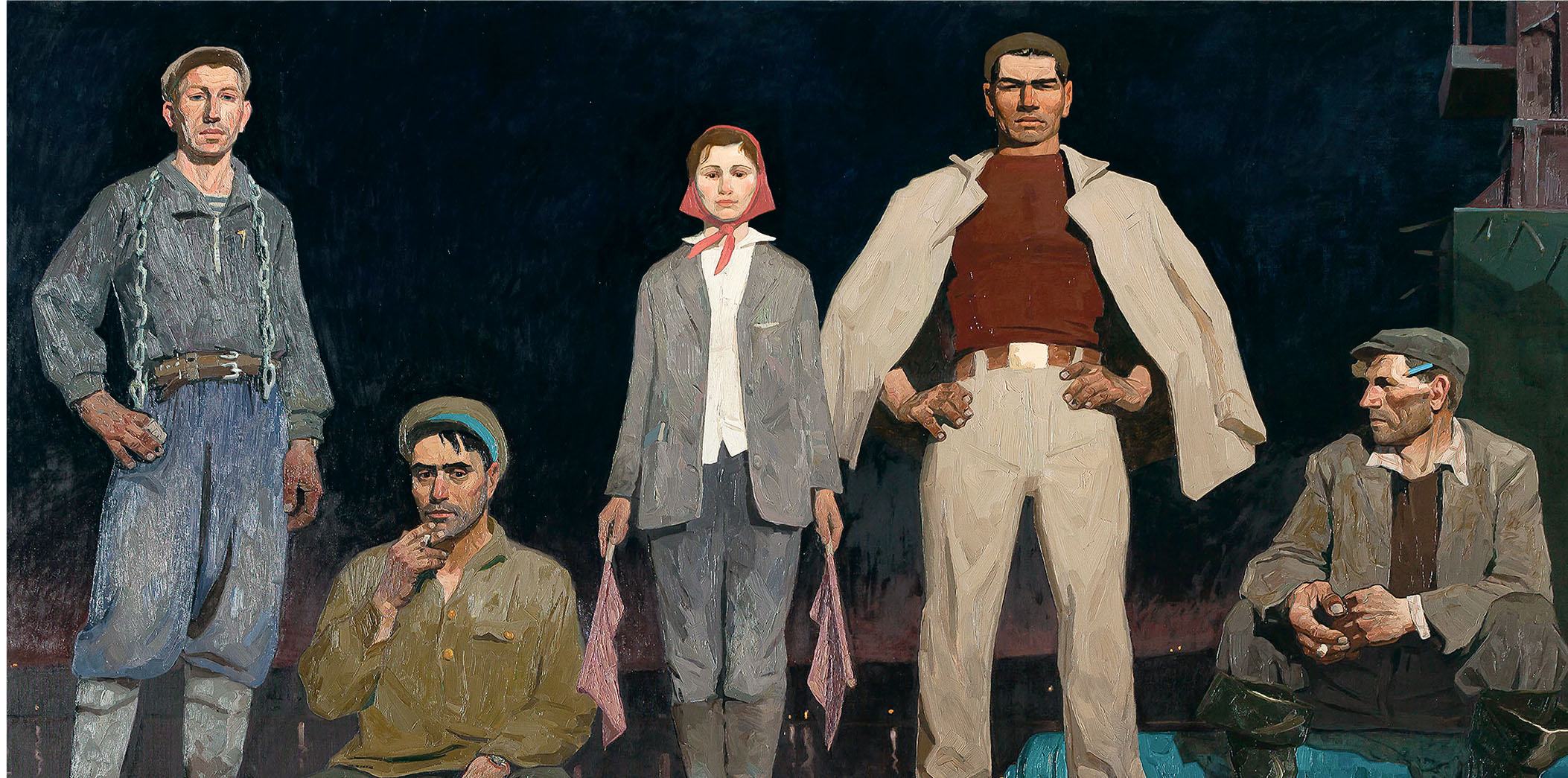
A huge joint project of the Tretyakov Gallery, the Plane named after A.S. Pushkin, Museum of Moscow and Gorky Park is dedicated to the post-war history and culture of the USSR: under the "era of the thaw", curators understand the period from 1953-the year of Stalin's death-until 1968, when Soviet tanks were in Czechoslovakia. Such a fairly expanding interpretation makes it possible to present on the sites of three museums an extensive collection of works of art, artifacts and documents related to this period. In fact, the thaw was shorter and more tragic than it might seem, for example, to a visitor to Gorky Park, where a costumed dance party at the rink will be held at the end of February, and in the spring, experts invited by the magazine “Fashion Theory” will give a course of lectures on the style of the 1960s. So do not forget about the inside of the euphoria.
After a snowstorm
The “thawing” of the country, the return and rehabilitation of the prisoners began immediately after the death of Stalin, when Lavrenty Beria came to power, and the understanding of Stalinism and the struggle with him - in March 1956, after the famous report of Nikita Khrushchev at the closed meeting of the XX Congress of the CPSU (“On the cult of personality and its consequences”. - NT). Khrushchev exposed the Stalinist repressions, which, as you know, was an active participant (Nikita Sergeyevich for a long time headed the party structures of Moscow and the Moscow region, was part of the Moscow Troika, and more than 50 thousand repressed on his conscience - this is only in Moscow). Speaking with an anti -Stalinist report, Khrushchev was guided by good intentions, but also tried to get ahead of his party competitors (Malenkov, Molotov, Kaganovich, Voroshilov).
In one exposition, those who represented unofficial art, who were poisoned and expelled from the country, and those who personified power and officials in art met in one exhibition
The writer Ilya Ehrenburg in 1954 published a rather weak story “The Thaw” (printed in the May issue of the Banner magazine), which raised the question of honesty in art, the need to choose between truth and lies in the May issue of the journal. Like the entire literature of the Soviet period, the story was full of hidden hints and “transparent” metaphors, the main of which was its very name. People began to leave the Stalinist camps, it was already possible to discuss something in the kitchen, however, the attitude towards Stalin was still slurred. This is a chaotic spring mood and Erenburg expressed in his story.
However, the name of the story was borrowed. In 1946, Nikolai Zabolotsky returned to Moscow, arrested in 1938 for anti-Soviet propaganda. In 1948, he wrote the poem "Thaw."
The thaw after the snowstorm.
Just subsided the snowstorm
The snowdrifts settled at once
And the snow darkened
The trees will wake up soon
Soon, having built in a row,
Birds of migratory nomadic
In the pipes of spring will be trimmed.
Poems were heard and heard (although this was still during the life of Stalin) - after the war, the country was waiting for changes and prepared for them.
The story of Ehrenburg caused hot criticism and even rebuilding Konstantin Simonov in two numbers of the Literary Newspaper. “Ehrenburg legally asks: can a person who does not love them leads, a person who blasphemously covers the unwillingness to take care of people with supposedly state interests, that is, which completely does not understand these state interests? And he answers: no, cannot! " Nevertheless, Simonov writes, "ultimately the whole story, despite some good pages, seems to be a grief for our literature by failure of the author."
In the story “Thaw”, it was about the artistic environment - the creative people were the first to feel the relief and proximity of the end of terror, and the wings began to spread. Moreover, there were amazing consonants: in October 1961, the famous almanac “Tarusi pages” was signed (the almanac was released without lifting in censorship, it published Marina Tsvetaeva, Naum Korzhavin, Vladimir Kornilov, Nadezhda Mandelstam, young Bulat Okudzhava and others), and on the night of October 31 to November 1 of that 1961 by decision of the same 1961 years by decision. The XXII Congress of Stalin was carried out of the mausoleum and reburied at the Kremlin wall.
side by side
The exposition in the Tretyakov Gallery covers the entire range of artistic life of the country from the early 1950s to the end of the 1960s. At the same time, already in the early 1960s, the party began to knock on artists with a fist-it is enough to recall Khrushchev’s campaign to the exhibition in the arena and the notorious variety arranged by writers. Therefore, in one exposition there were those who represented unofficial art, who were poisoned and expelled from the country, and those who personified power and officials in art. Two antagonist artists operate in the story of Ehrenburg: a typical adaptor and hacker Pukhov (criticism compared him to Alexander Gerasimov) and a sincere artist Saburov (contemporaries saw the features of Robert Falk), a wonderful landscape painter who was not recognized and “beat the ruble”, accusing, of course, of formalism. The Tretyakov Gallery (completely out of the spirit of Ehrenburg, but quite in the spirit of today) is trying to circumvent the sharp ideological contradictions of that period. In the “thaw”, the exhibition, as it were, conflictly coexist the People’s Artist of the USSR, the laureate of Lenin and Stalinist prizes, the full member of the Academy of Arts Yuri Pimenov; Corresponding member of the AC USSR (1962) and open Stalinist Geliy Korzhev; Academician (1947), People's Artist of the USSR, Leninsky Prize laureate and Hero of Socialist Labor Alexander Deineka - side by side with their antagonists who created the space of new art: Eric Bulatov, Oscar Rabin, Vladimir Nemukhin and actual outsiders in the painting of those years - Anatoly Zverev and Vladimir Yakovlev.
Black, white and gray
The whole exhibition is decorated in black and white-this is a conscious reference to the famous monument on the grave of Khrushchev, made by Ernst, unknown from black and white marble and called to show the combination of the dark and bright beginnings in the historical figure of the Soviet leader. Passing through the dark halls, the audience can see both the Stalinist film about VDNH and three performances associated with the theme of the destruction of the old and inert, taken from Soviet films. On one - the young hero of Oleg Tabakov from the play of Rozov, struggling with philistinism, chopped polished furniture with an ax. On the other - the sculptor, the hero of the actor Anatoly Papanov, destroys his work in the workshop, considering them not sincere enough. The exposition ends in 1968 - tanks, dissidents, emigration. We seem to be invited to conversation, to think. At the same time, the curators divided the exhibition space into seven tendentious sections: “conversation with the father”, “Best City of Earth”, “International Relations”, “New Life”, “Mastering”, “Atom - Cosmos”, “To Communism!” Kirill Svetlyakov, one of the curators of the exhibition, emphasizes that it was important to formulate topics: injury to war and repression; city; Dialogue of generations; new life; A peaceful atom ... “By the number of discoveries,” says Zelfira Tregulova, director of the Tretyakov Gallery, “more legitimate to compare this era with revival.” To comprehend all this diverse material and restore the context of the exhibition visitor will help the lecture cycle entitled “Overcoming the Borders” dedicated to the art of Europe and the USSR after the Second World War: about realism, pop art and kinetic art of the 1960s will be told in the Tretyakov Gallery starting on February 25.
The exhibition is decorated in black and white-this is a conscious reference to the famous monument on the grave of Khrushchev, made by Ernst, unknown from black and white marble and called to show the combination of the dark and bright beginnings in the historical figure of the Soviet leader
Some revival of the USSR - if not within the previous borders, then with the previous ambitions - is now clearly happening in an artistic space. The project curators seem to want to find the general that united once and unites the people today. One of these common beginnings in the Russian culture of recent times was the “thaw”, repeatedly embodied, say, on the television screen and, as it were, stained, smoothed, without distortion into black or white; The “thaw”, in which all on the same wall: laureates and “renegades”, appliances and non -conformers, the vertices of fate and victim. This approach, of course, destroys the simplified “black and white” picture of the world: the main thing is not to mix these two colors to indistinguishable so as not to get continuous grayness.
Photo: press service of the Tretyakov Gallery