
Translated material
Evgeny Simonov: “hydroelectric power plants for Mongolia - priority, they will be engaged there, regardless of the opinion of Russia”
The international coordinator of the coalition of the River without Borders read an interview with the Mongol Foreign Minister, published in the Rossiyskaya Gazeta. And he told the project #Spasibaikal about his impressions, as well as what he saw between the lines.
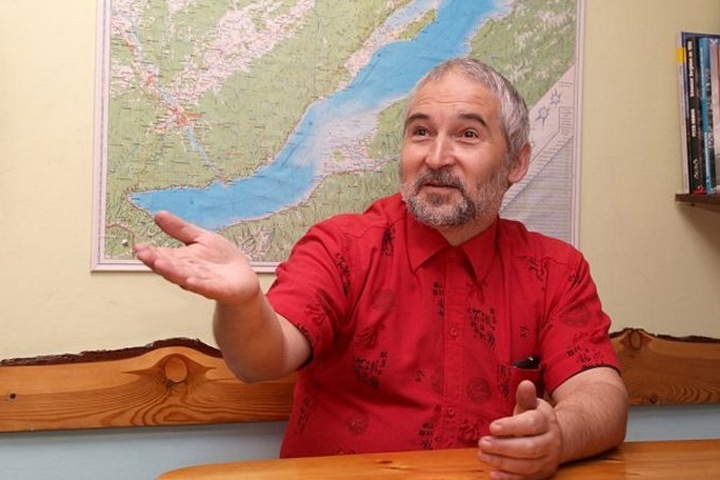
“In an interview with the respected minister Tsandyn Munh-Orgil, I did not find anything encouraging. Despite the default state of the economy of Mongolia, the new government stubbornly pushes the most costly, protracted in time and dangerous for the Baikal ecosystem. The option of solving the country's energy problems. At the same time, as happened earlier, an open attempt is made to attract different groups of Russian society to their side.
Firstly, power engineers and hydraulic buildings promise a contract for the construction of the EGIIN-GOL hydroelectric power station. Munh-Orgil clearly stated that Mongolia was ready to cooperate with Russian partners “to attract Russian investments and introduce Russian technologies for the construction of such a large-scale project as the Egin Gol hydroelectric power station”. That Mongolia “knows and appreciates” Russia's experience in the field of construction of the hydroelectric power station (which the Russian Federation really has), and therefore wants to “jointly study the possibility of Russia's participation in this project”. This statement itself looks strange, given that Mongolia has a loan agreement with a Chinese ecsimbank for $ 1 billion precisely for the construction of this hydroelectric station. And an already concluded contract for the construction itself with the Chinese company Gadzhuba.
Secondly, Russian scientists are beckoning into a bilateral expert group, which over the previous two years did not even provide a full assessment of the environmental impacts of the Estiin-Gol hydroelectric power station. Attempts to get the most complete information about the projects of the hydroelectric power station have been made repeatedly. Munh-Orgil states that Mongolia finally provided Russia with all the necessary documentation on the project of the HPP “Egian-Gol”. If we are talking about the interview with the French engineering company Tractel mentioned by the Minister, then the public hears about its existence without seeing it for three years. But the significant drawbacks of this document are clearly said, for example, in the official conclusion of a special mission of the International Union of Nature Protection, which has been hanging on the UNESCO website since 2015.
Thirdly, the inhabitants of Ulan-Ude convince that the new hydroelectric power stations will protect them from the floods. As far as the hydroelectric power plants are reliable in this situation, we saw a week ago on the example of the Plot of Opubil in California. And several years ago they took place on Russian Amur. Even the RusHydro company has already abandoned the construction of new “anti -flood hydroelectric power stations” in the Amur basin, due to the fact that the flood function competes with energy production and makes the project unprofitable. Therefore, I would not seriously discuss the creation of the “anti -flood hydroelectric power stations”, supposedly useful for Russia, but at the same time working in another country. Which, moreover, completely refuses to present to the neighbors complete information about them.
In places, the statements of the respected minister Munh-Orgil, apparently, were inaccurately recorded by journalists. For example, he talks about "the possibility of regulating the supply of electricity during peak hours, which is possible only with the help of hydroelectric power stations or nuclear power plants." In Mongolia, where politicians did everything so that the technical question of the hydroelectric power station turns into the propaganda symbol of the “struggle for energy independence”, the Foreign Minister, be sure, is perfectly distinguished by non -dominant nuclear power plants from highly maneuverable hydro -accumulating power plants (GAES). And according to the context of the interview, it is clear that Mr. Munh-Orgil had in mind the "hydroelectric power station and the HEPP". Several projects of such stations, by the way, have been skipping for four years - in connection with a purely political decision, at all costs to push the construction of the hydroelectric power station. At the same time, a hydro -accumulating station is a usually significantly cheaper and less destructive method for nature and the population not only to cover peak loads in the energy system, but also to the effective accumulation of “excessive” energy from solar and wind installations (hydroelectric power plants will not be able to do this technically). Personally, I do not lose hope that “for Russian money and Russian hands” Mongolia wants to build precisely the HEPP, and not far from Ulan Bator.
Also, against the background of the assurances that Mongolia will never take steps that, in her opinion, will harm Baikal, in the interview it is immediately said that all steps are already a foregone conclusion. “Projects for the construction of the Estiyan-Gol hydroelectric power station on the tributary of the Selenga River and the HPP“ Sharen ”at the Selenga itself are included in the“ Action Plan of the Mongol government for 2016-2020 ”. It is noteworthy that “Egine-Gol” in thatlist really is (see paragraph 2.100). SHUREN hydroelectric power stations and other stations from the Minis project in this regard will not see. But it’s not interesting to understand this incident, because in an interview in black and white it is written: “Now the activity in this direction is activated, options for concessions on preliminary work are considered.”
In addition, Mongolia included hydroelectric power stations among its projects to reduce greenhouse gas emissions prescribed during the ratification of the Paris Climate Agreement. And now he asks for funding guarantees for partners by agreement, in particular, Kuwait.
In general, in an interview with the Foreign Minister of Mongolia, it is read that hydroelectric power stations for this country are priority, and it will engage in them, not at all considered the opinion of Russia. This position makes sense of public hearings in Buryatia and the Irkutsk region, which are planned at the end of March. On them, as you know, the leadership of the Minis program sets the draft technical specifications for regional environmental assessment (REO) and assessment of environmental impacts and social consequences for the SHUREN hydroelectric power station and the project “Regulation of the Orkhon River and the Construction of a Complex of the Reservoirs”. In the "rivers without borders" we repeatedly emphasized that these studies - REO and EIA - must be carried out separately. In the double project, the TK largely occupies a detailed EIA. There, of course, it is written that “the results of the REO will be the subject of public consultations and deciding on the fate of the project and the need to conduct further EIA,” but the consultant is hired immediately for two studies. That is, the result of the project assessment was already a foregone conclusion, which he once again reminded us in the interviews with the mouth of Munh-Orgil.
The fact is that, unlike REO, an incentive to make a detailed EIT at all costs only in the Mongol side, because without this study the World Bank will not give Mongolia the good to develop a feasibility study. So, no investor will give a loan to the country to start the implementation of these projects. It was to “jump over the abyss in two jumps”, the leaders of the Minis project and combined the technical specifications on the REO and EIA into one tender. At the same time, they created for future consultants (already selected in a short list to any discussion) an invalid incentive to bring the EIA process to a victorious end - who will refuse 80% of the money that are registered in the contract for this study? Therefore, today there is practically no hopes for an objective regional environmental assessment of the TK dilated with the EIA of TK, because it has already laid a significant corruption stimulus for the contractor.
Now the most critical step that meets the interests of cooperation and the interests of Baikal’s protection would immediately divide the score into two stages of consistent: first discuss the TK and carry out a tender and work on the REO, and even after discussing the results to decide what energy and water management projects a detailed EIE will be further required. And then already declare a new tender for him. All parties - the Mongols, Russians, UNESCO, investors - need a strategic environmental assessment of all hydroelectric power stations, which would give an understanding of the fundamental consequences and possible alternatives to the hydropower development of the Selenga basin. Based on its conclusions, the parties could make decisions regarding the very possibility of such construction projects, safe limits, and the conditions of such development, as well as improving organizational and legal rules for joint water use. Otherwise, everything that the Foreign Minister of Mongolia promised in his revealing interview will be done before our amazed eyes.