
Translated material
"My friend, representative of Russia." Former US Permanent Representative to the UN Samantha Power - about Vitaly Churkin
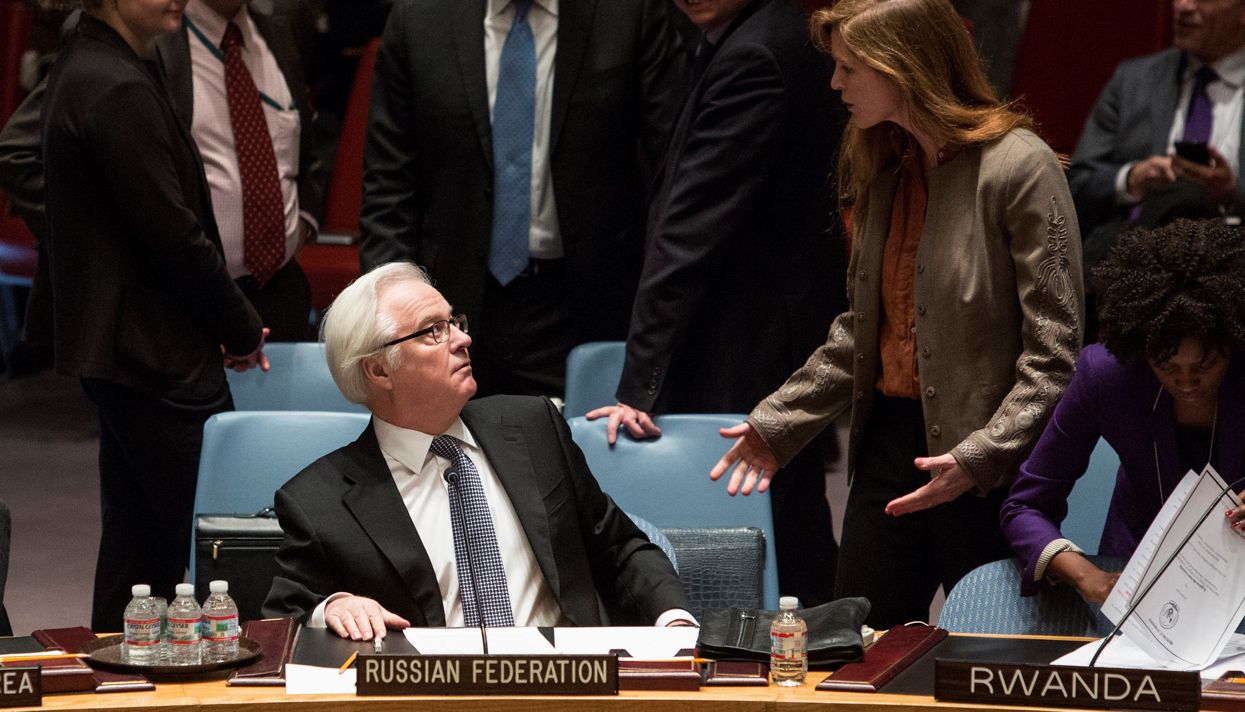
On February 20, Russian diplomat Vitaly Churkin died in New York. The last ten years of his life, he represented Russia in the United Nations and in its main body - the Security Council. Due to the deterioration of relations between Moscow and Washington, Churkin’s chief opponent in recent years has become a regular representative of the United States in the UN Samantha Power. She wrote a column for The New York Times, dedicated to the "good friend" Vitaly Churkin. "Medusa" publishes the translation of the column.
On Monday, Vitaly Churkin was gone, who for the past ten years represented Russia to the UN and was one of the most noticeable diplomats in the world. I represented America to the UN from 2013 before President Donald Trump arrived and in recent years has become, perhaps, the most noticeable opponent of Churkin. He consistently defended the deadly policy of Russian President Vladimir Putin in Ukraine and Syria.
At the same time, Vitaly skillfully knew how to tell stories, had an incredible sense of humor. He was my kind friend, I am very sorry for his death. It also makes me upset that in today's heated atmosphere those who speak well of Vitaly - as a diplomat and man, they are accused of silent consent with Russian aggression. When, having learned about what had happened, I called him on Twitter “maestro diplomacy”, I was convicted in an attempt to “set up the crimes of Russia and mourn its main accomplice”. “Ask the children of Syria and Ukraine what they think about it,” they wrote on Twitter.
I believe that Russia under President Putin poses a serious threat to America's interests. Those who, as President Trump - praise Putin or unfairly compare the influence of Russia and the United States on the destabilization of the situation in the world are deeply mistaken. The Russian authorities killed political opponents, seized the territories of their independent neighbors, allowed the death of countless civilians in Syria and intervened in democratic elections, including in the United States.
But I also believe that it is extremely necessary to build relations with individual Russians, who, in their complex and contradictory nature, do not differ from us. Moreover, our security depends on the ability to establish relationships contrary to ideological disagreements - we must not only understand each other, but try to solve problems together.
When I just arrived in New York, my predecessor Susan Rice said: “invest in relations with Churkin. He will drive you crazy, but you will need each other. ” Vitaly was a regular representative of Russia at the UN for six years , worked as a diplomat for a total of almost four decades. Russia is one of the five countries with a veto in the Security Council, so I needed Vitaly’s support to adopt resolutions to send peacekeepers to the conflict zone and to impose sanctions against individuals and states.
We often spent with him time in hot and sometimes very sharp disputes about such basic concepts as facts and justice. Russia's official position regarding the illegal occupation of Crimea was so far from the truth that I called him the best author than Tolstoy; According to Syria, I called him to answer for huge losses, after the joint offensive of Syria, Russia and Iran on Aleppo, I asked: "Is there really no shame at all?"
He, in turn, was a master to dodge the answers and declared me an impudent “mother Teresa”. He translated conversations about Ukraine and Syria into a discussion of US wars in Vietnam and Iraq. Sometimes, as in the case when he suggested that the inhabitants of Aleppo simply sprinkled themselves with dust in front of the cameras, my aversion began to harm our business relationship. But in most cases, we understood that we should work together, and we succeeded. We introduced the most severe sanctions against North Korea, helped to establish the fight against Ebola epidemic and contributed to the election of the promising new UN Secretary General [Antoniu Guttersh].
Both during many months of negotiations and in quick discussions before the voting, we could fiercely argue about fundamental things, but found a way to listen and understand what the other side wants. When the two we managed to coordinate some plan, other countries also began to make concessions, because even if we agreed, then they were affected.
I think it was best to recognize Vitaly when we could not agree. 20 years after the Bosnian Serbs killed more than eight thousand Muslim men and children in Srebrenitsa, the UK proposed adopting a unambiguous resolution on condemning this crime. Very soon it became clear that Putin, hoping for closer ties with Serbia, wanted to prevent the Council of Security Council to call this “genocide”. Vitaly and I worked together for several days on the version of the text that his president could approve. In the morning, before the meeting, Vitaly with a hard -to -hidden disappointment sent me a letter: "It did not work out." He put a veto on the resolution.
It is widely known that Vitaly Churkin put a veto six times on a resolution on Syria, but few people know that it was Vitaly who was desperately (and, as it turned out, unsuccessfully) tried to achieve changes to the texts [resolutions] so that Moscow could approve them.
Although Churkin publicly represented Putin’s position, he also believed in the relationship between our two countries. When US Secretary of State John Kerry and Russian Foreign Minister Sergei Lavrov tried to create a joint counter -terrorist group in Syria, Vitaly with all his might supported interaction. Even after the failure of the initiative, he urged to resume negotiations.
Even if our positions were unimaginably far away, we always answered each other's calls. When I asked him about meetings with employees of humanitarian organizations, so that they talk about the atrocities seen (including those committed by Russian troops), he usually promised to come or send a high -ranking member of the Russian representative office at the UN. When journalists or human rights activists disappeared in Syria and I asked him through the Russian ambassador to get assistance from the Bashar al -Assad government, he often turned to me for additional details to track the course of the matter.
Despite the fact that relations between our countries worsened, and in our time there was a strong decline, Churchin and I had a lot in common. We both loved sport very much; The only time I failed to get through to him was during the fight of Russians for the Olympic medal. We invited each other for games (he preferred hockey and tennis; I love baseball, but I could not convince him that this is an interesting sport, so we went to the NBA matches).
She and my wife Irina adored the theater. When I invited a group of followers to [the festival] “Shakespeare in the park”, he first jumped up from his chair to arrange a standing standing ovation. At Hamilton, he failed questions about the constitution of my husband, who is a professor of law. I showed him a series about the Age of the Cold War “Americans”, which he ridiculed as “a little stupid”, but continued to watch in the towards.
I called them with Irina to visit my parents for thanksgiving; He is the only one of the UN colleagues who visited our Irish monastery. During one of the last meetings of the eye on the eye, he caught fire to teach together in the magistracy, and changing his roles - so that everyone represented the position of the opponent.
Vitaly devoted his whole career to the protection of the country, the culture and traditions of which he appreciated. Although he never told me about the attitude to his president, it seemed to me that he appreciates how Putin restored the importance of Russia in the international arena - but would prefer peaceful methods. As far as I know, he never thought about putting the authority in protest against Putin's terrible actions. But it is important to understand that even if he did this, he would most likely be replaced by a person who is less ready for a compromise. This would only weaken the UN distribution capabilities in the spread of peace and stability and would undermine the relations of Russia and the USA.
While we all, diplomats, came to the UN and left, one value remained constant: Vitaly Churkin was a formidable enemy and a caring friend, and, of course, a desperate defender of Russia - the country that he adored and for which he tried. To restore relations of our countries, Americans do not need to make their principles. We must stand firmly on your own, not forgetting about the humanity of those with whom we fiercely argue.
Translated by Mikhail Zelensky