
Translated material
Animal style
Next to me are the two heads of the dragon. We are sitting in the Moscow Art Theater Hall, I am at the passage, dragons - neat boys of about ten years - on the right. They do not laugh, sit quietly. The performance is already about fifteen minutes. No, more: while we were sitting, it seemed like a buzzing-from an old TV, where there was no picture, but only ripples, the creaky totalitarian and grass marches poured from the stage.
Then Lancelot (Cyril Vlasov) appeared in the black doorway. Then Elsa (Nadezhda Kaleganova) with his father (Evgeny Perevalov), who served by the dragon Archivarius. And then - all three heads at once. In the play of Schwartz, the lizard, the fourth hundred years of the tyrant city, was humanized and began to appear to people in the guise of either an elegant blond, then a soldier in a helmet, then a dry dawn. Bogomolov’s evil is more comfortable: three heads are embodied in the form of dad, mother and son. Unusually quiet Igor Vernik-dad, a menacingly hare mother (Ulyana Glushkova) and a very serious boy of about ten years old.
As in all its latest performances, the pilgrims in the Dragon is apolitical. There are much fewer direct allusions than Schwartz had. But the performance still immediately spills out into the hall. Rather, life takes the form of the Bogomolov performance. Therefore, I carefully peer in the boys sitting next to me. It seems to me that these are dragons. There are no adults with them. I move away and remove my hand from the armrest.
 © Elena Nikitchenko / TASS
In the Lenkomovsky “Prince”, Myshkin (Bogomolov himself) went down from the stage - the credits explained that the prince “went to the river”. Of course, he didn’t go anywhere - he stood in the stalls, and the viewer laughed and frowned. In the Jeweler's anniversary, a blanket rolled up on an empty bed was thrown on an empty bed - and they said that it was a sleeping old man. The viewer saw: there was no old man on the bed, but he stopped coughing and dropping programs. In the "dragon" the mantis goes further: now the viewer not only "finishes" for the actors - he himself must glue the collage from various elements, which, teasing and annoying, offers him the director.
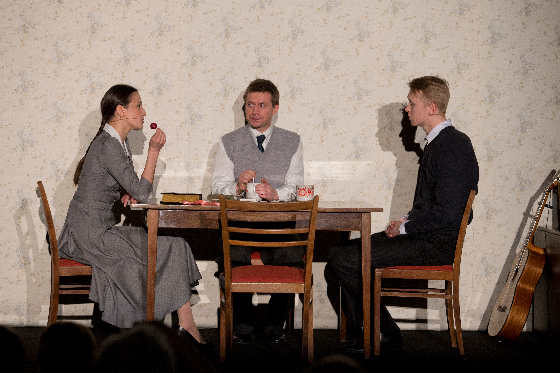
The interior of the room and the costume of Lancelot are clearly borrowed by the artist Larisa Lomakina from Mikhalkovsky “five evenings” (not without reason on a black background, the inscription “Evening of the first” appears over the faded wallpaper, there will be seven of them in all). Which, however, does not prevent the director from cutting the chords of “man and cats” when the hero talks with the cat (completely real cat performed by Kirill Trubetskoy). A little later, sitting down at the table, Lancelot will sing the same song under the guitar as Lyubshin in the Five Evenings. And as soon as he calls the dragon to battle, against the black background (aka screen), the reproduction of the “dead Christ in the coffin” of Hans Golbein the Younger will appear from the backstage to the wings. A very realistic picture, to which a mosquito is drawn here, sucking blood on the chest of the deceased. There is also a wounded Lancelot whose monologue is echoed by the death frames of the hero Batalov from the film “Cranes Fly” - and a fragment of the painting “Jesus on the Cross” of the Brothers Lenen; The face of Jesus quite harmoniously replaces the face of actor Kirill Vlasov, whispering “wait for me, and I will return” the voice of the poet Konstantin Simonov.
Of course, all this is done on purpose. But not only to annoy the people.
"Dragon" can be spoiled as much as you like - this collage each viewer glues for himself.
When there are so many quotes and they are intentionally frontal, then they are too provoked (cranes are flying under the “fly”, but not the Lancelot, but three dragons of the head, and agonizing, they still manage to sing the Rio-Rita children's voice), it’s not about the cultural context, not about the comparison of the Dragon orders with Nazism, but Hitler's German with Stalinsky Russia. It's about an attempt by the director to break through to a new form and new meanings. Moreover, the main tool of the breakthrough this time was not chosen by the word, as often happened to Bogomolov before, but a radical and exquisite visual series. And therefore, in addition to Larisa Lomakina, the co -author of the Dragon was the media artist Ilya Shagalov.
This is in form. If we talk about the meanings, then the “dragon” continues the theme of the “world on the contrary”, the world, turned inside out, turned inside out. The world where the children are dying, and the old people marry. But only now total melancholy was added to her. In it, perhaps, lies the main difference between the performance from the play of Schwartz, in which the final was open, but quite optimistic. In the performance of Bogomolov, Melancholy moves everyone: the humble dragon Elsa, and rebellious Lancelot, and the dragon himself.
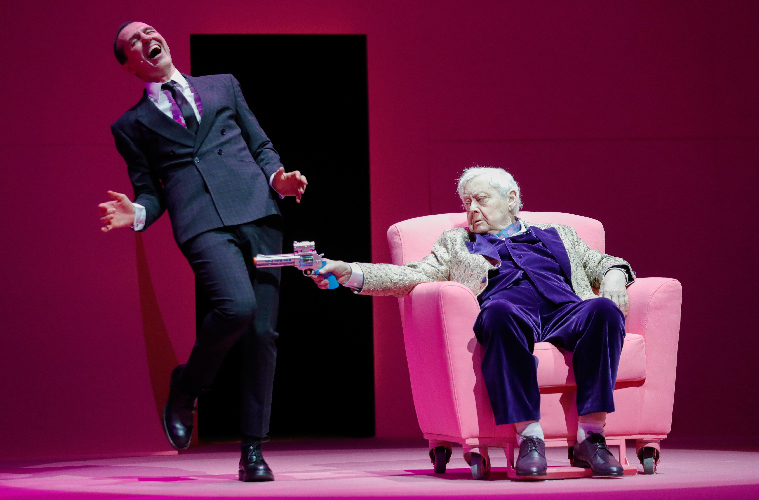
The wide - from the backstage to the backstage - the screen increases the faces of the old dragon, the hen of the burgomaster (Oleg Tabakov) and the young Lisobate Henry (Pavel Tabakov). The old man leaves the blackness on an armchair with a flashing light, everything tries to joke, chokes and even grunts. The pink young man submissive and Ponur. His phrase “Daddy, tell me the truth ...” does not require an answer, but it evokes almost the bestial sadness, in which the too peppy, witty Schwartz dialogs are drowning.
 © Mikhail Japaridze / TASS
A funny detail: “Dragon” can be spoiled as much as you like - this collage every viewer glues for himself. But if you certainly need a common sense, then here it is. “Dragon” is a performance that it is impossible to protect yourself from evil: one who fiercely fights with evil will certainly become part of it. The fact that good is reborn is the first - because it is thinner and more sensitive. And also that the well -known phrase of Schwartz is “the only way to get rid of the dragon is to have your own” in virtual times, it is time to rewrite: “The only way to get rid of the dragon is to become them.”
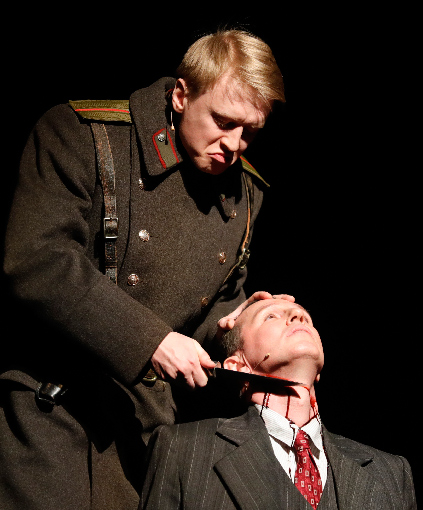
Therefore, in the last act, the winner of the lizard Lancelot will change into the uniform of the Soviet military and spoke in the voice of a soldier. Elsa, believing in his death, will turn into a vulgar tear. The director does not seem to be canceled by the Schwartsev finals: Lanselot will come to his lover-in blue-white soda and with the patches that have grown like a dead man. They will go to the forefront, take hands and turn to face the hellish flame on the screen - to the sounds of the song in the incredible performance of Diamanda Galas. “Gloomy Sunday” is called, differently-“suicide song”.