
Translated material
Imperial bluff
Isaac, it seems, will not be transmitted to the Russian Orthodox Church. The Kremlin washes his hands, foggy saying that Governor Poltavchenko had “not agreed” with this rash step with the first person. The Ministry of Culture is more clearly expressing his bewilderment and stood up for museum workers. Liberal Petersburg rejoices: "We won!" For the most part, the townspeople are careful and tuned to the partisan struggle - regardless of the enthusiasm of opposition politicians. Petersburgers generally relate to the news from the Center incredulously: even numerous hints of the resignation of George Poltavchenko in the federal media are perceived here with a grin. Indeed, these rumors were becoming more and more with every billion spent on Zenit-Arena. The rectors of St. Petersburg universities, who signed a kind of appeal with a request to transmit the Isaac ROC, deny their signatures (however, some did not recognize the paper even before the Kremlin reaction). It seems that the situation has been played back. In fact, there was nothing to recoup: the next city -protective riot in St. Petersburg, although he rallied the townspeople, left a strange aftertaste, as if he were a thoughtful distracting maneuver.
So, the chronicle of the struggle. Between the official New Year's festivities and the gentle old New Year, Georgy Poltavchenko announced that the issue of the transfer of the ROC “Resolved” . Rather, even he even announced, basically the information went through his press secretary Andrei Kibitov. The city perceived such an attitude as a slap in the face: the caustic "you are, he decided!" The conductors said in transport, people in lines, but what is there-even in the locker rooms of fitness clubs. On January 28, a rally in defense of Isaac, the number of people who came and a romantic occasion, united them, on an equal basis with a handful of non-monitors, was detonated, under the guise of a meeting with the deputies. Not politicians, parties or organizations, but everyone who at least once stared at the center of St. Petersburg, was ready not only to knock on the table with his fist, but also to go to the Department of Internal Affairs for Isaac. On Marsov, there were punks and blockades, anti -churchmen and deeply religious people. What is generally characteristic of St. Petersburg rallies - on shares, albeit an unauthorized and obviously unsympathetic administration, there were no detentions from the police. The protesters, in turn, neatly walked along the paths, obeying the traditional request “do not go along the lawns”, although winter, what lawns. Yes, and no one demanded - the police stood aside, talking quietly in anticipation when the warriors in blue bows will disperse (the blue tape is a sign of the struggle for the museum status of Isaac). In general, the intensity of passions was as if the Isaac was not given to the management of the dominant religious organization, but under demolition. After the campaign on the Marse Field, the Petersburg Legislative Assembly was considering a bill prohibiting meetings with deputies without coordination - by analogy with rallies (a loophole that local Yablochiki used so successfully).
No official documentation - that is, applications from the diocese for the transfer of Isaac - have not yet appeared.
In response to such consolidation and stubbornness on February 7, an extremely strange rally was held at Marsov for the transfer of Isaacia of the Russian Orthodox Church. The event was organized by PJSC responsible for housing and communal services, in fact - the global management company. The “protesters” were brought in buses from under Tosno. As luck would have it, on this very day, Frost –25 hit, which in the northern capital is infrequent. On the marceum, over the monument, soared the field kitchen. All those who came to support the authorities were given a small portion of buckwheat with stew, they played Kobzon's songs. About 30-40 engaged buckwheat enthusiasts accounted for the same number of journalists. The “picnic” went sluggishly, although maybe this is because I did not eat buckwheat. Then the rectors of the leading St. Petersburg universities at a meeting with the speaker of the Legislative Assembly in the Mariinsky Palace signed a strange paper calling for the Isaac ROC as soon as possible, it would be better - on April 16, to Easter. True, it soon became clear that not all the rectors voiced by Zachs signed . And their autographs were still on circulation. In St. Petersburg, there could be a “new Pussy Riot case”: we are talking about activists who supported the museum right during the service in Isaac. 13 people lined up in the cathedral with the slogan "Museum - city!" Soon after the first action on Marsov, by the February events they were already checked by the prosecutor's office. On February 10, George Poltavchenko unexpectedly conciliatively said that, in his opinion, the action did not interfere with the service. Neither the diocese, nor the servants of the temple, nor the police addressed complaints. And the governor decided not to be zealous.
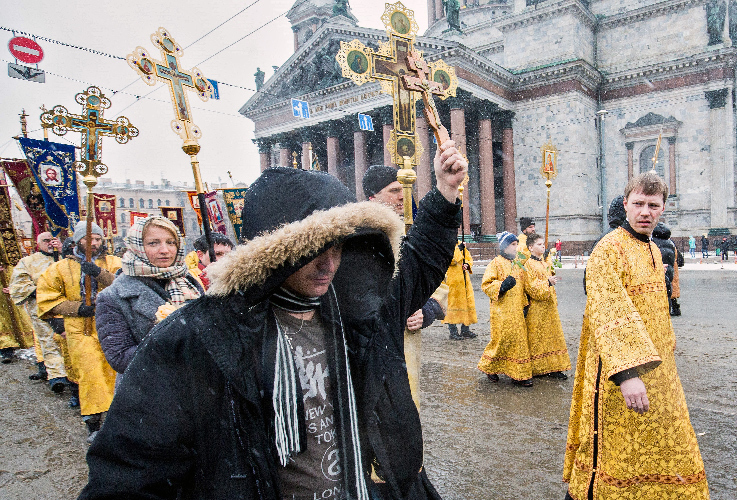
Then there was completely surrealism: on February 12, a procession passed around Isaac for his transfer to the Church. At the head of a column of 500 people who left the temple after the morning service, Vitaliy Milonov was walking in golden vestments. The local diocese to the idea of the deputy to devote the procession to the procession to accelerate the transfer of the Cathedral of the Church to be without delight, but with humility. A couple of hours later, in the square, the next “meeting with the deputies” began through the road from the cathedral. All the same intelligent protest, which does not step on the benches, even if they stand close, but bypasses them, does not trample the winter lawns and trustingly believes his radical thoughts. This time there were at least four thousand people, among them - the military, activists of Ingermanland, several generations of people. Someone in the crowd began to sing a “sacred war”, understanding the struggle for the cathedral. The police, although it forced the parking lots, was still cute and did not interfere with the process. At meetings with deputies, loudspeakers cannot be used, so Boris Vishnevsky and Maxim Reznik spoke mainly for nearby. The remaining several thousand people seemed to be just glad to go out and chat about the vast with strangers. Invalids-wheelchairers, people with crutches and canes, parents with children. After a brief introduction, it was decided to “hug Isaac”, stand in hand around. It turned out four rings of people who had a little embarrassed tourists who thought it was a queue.
Surrealism grew, and now Vitaly Milonov declares that the ancestors of the deputies of Vishnevsky and Reznik "cooked Christians in boilers." Dmitry Kiselev comments on the whole country in the “Vesti of the Week”, calling Vishnevsky “Malakhol” and noting that Milonov “is not with blessing”. Sergey Shnurov picked up the media wave, publishing on Instagram a poem about Isaac :
Merikos, Japs, Prussians,
Sedality everywhere sowing,
The Isaac wanted to worry,
But the holy racier rose.
And now they roam, dogs,
Glazeli was stunned everywhere.
“Can you tell me where is Isaac here?”
“But no, aunt, such a museum.”
After some time, because of the “glitch” the social networks video with Virshas disappeared, but then it returned, being ten times more popular.
Shnurov, as always, got to the point - in mid -February, a number of federal media synchronously reported that the transfer of the cathedral was allegedly not agreed upon by George Poltavchenko with the first person and, in general, the Kremlin did not accept such a stressful situation. Commentators hastened to notice that, be that as it may, the president is still well “feels the people”. But faith in the good king did not quite leak into the consciousness of the protesters: activists continue to draw up lawsuits in connection with violations in the execution of Federal Law No. 327 (on the transfer of religious property to the church), political scientists decipher the “signal” from the Kremlin. No official documentation - that is, applications from the diocese for the transfer of Isaac - have not yet appeared. In fact, there is nothing to recoup back, there was an except for the order of the city committee of property relations, which rather states a fact, and does not regulate the procedure for the transfer of the Council of the Church.
It reads that even perestroika in St. Petersburg began with the defense of the Angleter.
On February 19, the next procession passed around Isaac. This time the mass was evident: there are seminarians and groups of children with a teacher (teacher?), All parishioners who were not too lazy to come. You can, of course, believe that representatives of the Moscow Patriarchate personally paid all these people, but many of them went sincerely and did not understand the attacks of journalists. The supporters of the transfer of the cathedral again were “lucky” with the weather - people walked along the blocked roads around Isaac, resisting the buzzing wind, under wet snow. The event was a little detained, because on the same day the festive liturgy served in the cathedral in honor of the Day of Orthodox Youth. Young people-first-year-old seminarians-left the steps of the cathedral earlier and stood in the wind in anticipation of the rector of the Theological Academy, Archbishop of Peterhof Ambrose. Good half an hour, the guys froze without hats, not moving, occasionally sweeping away with frozen hands drops of talus snow from the icons. The photographers managed to shoot everyone portrait portraits and wondered if the children were offered to the guys. In the ranks of the sympathetic Russian Orthodoxons, they were waiting for the Zenit fans, but several people in sportswear at the entrance to the cathedral for the group were not pulled, and they did not take part in the action. But there were bikers and activists with imperial flags. Finally, the archbishop appeared, and people quietly went after the solemnly honey of the Ministry of Internal Affairs. And then, already in the cathedral, the organizers proposed to sign a petition against the film "Matilda". So as not to get up twice.
As time has shown, the struggle for Isaac is politicized purely externally. Like most of the most persistent local protests, it is rather the indignation of Petersburgers, from whom they take away something status, public, especially imposing a decision “from above”. It is enough to recall the “Kadyrov Bridge” or the remaining unrealized project of the Gazprom “Okhta Center”. In the first case, the “hand of Moscow” painted an ambiguous toponym on the map of St. Petersburg. It is not utilitarian here to such things: it is believed that even perestroika in St. Petersburg began with the defense of Angleter (by irony, in March 1987, an unauthorized mass action took place in defense of the demolition of the hotel near Isaac, flowing into round -the -clock duty; Angletter rebuilt again, but the USSR is not yet). And they remove the clips about Rubinstein street, still not daring to rename it into Dovlatov Street, although I really want to. Well, the expensive baroque Isaac, stuck on top of imperial classicism, is generally the flesh from the flesh of the inhabitants of the swamps. Unique from an engineering point of view, at one time as shame-grandioic as Zenit Arena, Isaac closer to the heart of a Petersburger than the Cathedral of St. Peter and all the treasures of the Vatican combined. And suddenly he is “given” by a religious organization, and even the Moscow Patriarchate, Culuaro, on holidays. To the detriment of the city budget, but, most importantly, hundreds of museum workers, which by default are treated with a share of tenderness.
And then, already in the cathedral, the organizers proposed to sign a petition against the film "Matilda". So as not to get up twice.
But is such reflection really important to someone "upstairs"? “I think the authorities simply noticed how strong a split in society occurred for a slight actual reason,” says Boris Vishnevsky, deputy of the Legislative Assembly. - And they decided to “dump” everything to the local administration. Rumors about the resignation of Poltavchenko? Every two months they appear with renewed vigor, there is nothing unusual in them. Now they talk about the joint use of the cathedral by the museum and the church. But it is so, for this you do not need to change anything. We will fight further. " The next rally for maintaining the status of the cathedral was planned on March 19. True, the Isaac's Cathedral Museum (Director Nikolai Burov urgently did not advise employees to go to protest promotions, and now, in a “suspended” state, museum workers are not even involved in the conflict). Instead of climbing on the barricades, not indifferent to the fate of Isaacia, they proposed to discuss the fate of the cathedral in discussions based on large media. It is so much that it is suspicious.
“The Kremlin experienced very severe irritation in connection with the“ zenith-radical ”, very strong,” political scientist Valery Solovy commented in a recent interview . - And even then the question of the resignation of Poltavchenko was resolved. But Mr. Poltavchenko wanted to go to a new position. In this regard, he undertook such a move - to transfer the Isaac's Cathedral of the Orthodox Church. Moreover, which is characteristic when he published this decision, in Smolny there were only he and two more people. Everyone else has already left the work. That is, it was all done backstage. He hoped that this would be perceived by the positive state leadership and protect him from leaving to nowhere. But a serious political conflict arose. ” The Nightingale also believes that the resignations of Poltavchenko want “economic forces”, that is, Arkady and Boris Rotenbergs, who supposedly have “their candidate” for the governor's chair. It seems that the invisible conflicts within the authorities, the general (city -protection) idea of civil protest and the popularization of local oppositionists, converged on Isaacia.
Is the conspiracy theory too much ornate? The Kremlin refers to a hundred -prose allegedly held in the northern capital, according to which most residents, including believers, against the transfer of Isaaca of the Russian Orthodox Church. But many, occupying a firm position in this matter, prefer to protect the city from the amateur performances of Smolny and (especially) the absurd ideas of the Kremlin, regardless of the personality in the chair. And Georgy Poltavchenko is not at all suitable for the role of absolute evil: his power is too ghostly and fleeting against the backdrop of the glorious dominant of Isaac.