
Translated material
“Feeling guilt is very good. It torments you, but paves the way in literature "
Interview with Orhan Pamuk
On February 25, Orhan Pamuk spoke in Yasnaya Polyana - in the fall of 2016 the writer received the Yasnaya Polyana award for the book “My Strange Thoughts”, and now he came to the Tolstoy estate to give a public interview. The conversation was led by journalist Alexander Gavrilov. Gorky publishes the text of this conversation.All those years that I read your novels, I have saved thoughtful aesthetic questions. And then suddenly in Russian the book “Other colors” is published-an essay, fragments of the interview, discussion about the craft. And in it Orhan Pamuk answers very deployed to almost all these questions. The book is quite magical, this is such a meta-sulfur: the study of the writer by the creative method of the writer himself. But it is stupid to ask again questions to which answers are already given. Therefore, now I will start with the simplest. It seems to us in Russia that you can determine a person by offering him a choice from a drink, a pet and a writer. Let's start: tea or coffee?
Actually, both tea and coffee.
A cat or a dog?
Cats, dogs I love at a distance.
Tolstoy or Dostoevsky?
Both are also. Both Tolstoy and Dostoevsky taught me a lot. When I wrote my first novel, I read a very good book by British critic Steiner “Tolstoy or Dostoevsky”. The enormous differences between writers, as well as their similarities, were shown there, talked about the predecessors who formed Tolstoy and Dostoevsky, and whom they formed in turn. Reading this book, I learned to write based on their differences.
In several of your interviews, you say that writers constantly feel guilty and it is the wine in a sense that drives literature.
Writers tend to feel guilty because they feel responsible for everything. Dostoevsky also talked about this. This is a different level of sensitivity. At the beginning of the writer's career, you also feel guilty because you give the time to a lesson that does not bring income. But the writer’s fault is also connected with something deeper. To be a writer means to seek to understand people from your own choice. And, developing this sensitivity, you develop compassion, the ability to put yourself in the place of everyone. But seeing so deeply alien suffering, you understand that you are in a privileged position in relation to other people. And then you feel guilty again.
But guilt is very good. It torments you, but at the same time paves the way for religion and literature. Everything comes from guilt. Feeling the pain and suffering of another person, understanding them and sharing is a very human quality. Writers are sensitive people. Good writers, of course. For example, a writer whose house and the estate I visited today is a very sensitive person, and it was this sensitivity of Tolstoy that gave him the opportunity, when he wrote novels, to identify himself with people different from him. Naturally, most of these people had more difficult living conditions. And it is quite natural that you begin to experience guilt, and the art of writing a novel is connected with this feeling of guilt.
The writer feels everything, the witness, but does not participate in anything, because it is necessary to observe and remember everything. You once said that you experience the peak of alienation and isolation in a noisy office.
The desire to be a writer is connected with this. And many authors that I know - not writing journalists, namely writers who work on art books - experience a desire to be outside everyday office life. You do not want to share anything with others, you want to sit in a secluded room and trust your own imagination. You find thousands of excuses so as not to be like others. And this is the place where the choice begins to be a writer, an artist, a general man of creativity.
In one of the articles of the book “Other colors”, you notice that, telling about yourself frankly, you feel fear.
Yes ... from one side, that's how it is. The writer should have the courage and courage to frankly talk about his life, especially mentioning autobiographical details. Jean-Jacques Rousseau, for example, was one of the first to talk about negative, negative feelings, unpleasant moments of life, his mistakes-all this formed the basis of his book “Confession”. At some point, he discovered that he was talking about his sins, about his mistakes in such a way that this information becomes not only religious, not only a description of sin. On the contrary, it enriches the human being, tells him a deeper feeling as a person and this relieves us partially from the horrors of religion. And after that, let's recall that Tolstoy wore a medallion in his youth with the image of Jean-Jacques Rousseau.
Probably, it is especially scary to reveal to such a writer like you. Your books also cause passionate love (this is very clear), but also a very bright hatred.
Well, I would not say that these feelings are caused by my books. Rather, political statements. My books do not hate even in Turkey. I always had problems on political grounds. But not because of the books that I write, but because of the statements that I make outside my art books. I look at what they write about me on Twitter, social networks, and many readers there say: “I do not love him! I hate him! But I like his books. ” A large compliment, thanks, but I would like to know, why don't you love me and? (the hall laughs)
In the book “Other colors” in one ironic, but terrible essay, you recall the Istanbul earthquake. The hero perceives the shakiness in the face of the elements as a betrayal from his own library and even punishes it, throwing two hundred and fifty books.
Understand. This was the period when I got married and I moved to another place - and not only because of the earthquake I had to get rid of some books, there was a good idea. And, of course, I threw out the books of all uninteresting, bad Turkish authors. I threw out the books of those authors who wrote nasty things about me. Why should I keep in my house a whole shelf of books of people who continue to insult and attack me on the pages of newspapers?
But it says that you threw several Soviet novels.
Do not tell anyone. I like Konstantin Simonov, a wonderful journalist, he came to Turkey several times. I tried to read his novels (and, excuse me, if his relatives or friends are here), but his books are not very good. But let's forget about the Soviet period.
When the reader opens the book and finds in it some new unusual layer for himself-at that moment he takes your book from you or adds to it?
You ask if the meanings of the book are exhausted by the meanings that the author put into it? Of course, there are other meanings. When you first read the book, naturally, your brain works to understand what the author wanted to say, what was his intentions. But time passes, an understanding of his intentions comes. And you begin to evaluate the author and how successfully he coped. I would say that a good critic is a person who, first of all, sees through the paragraphs and pages of the author’s intention and understands whether he coped or not.
But after years, the author’s intentions are less significant for you, they fade into the background, in the third plan, and other meanings acquire more importance to you. I can give a lot of examples from Tolstoy: let's recall, for example, closer to the end of the novel “Anna Karenina”-somewhere around 1877-78-when Vronsky was volunteering for the Turkish war. Tolstoy, unlike Dostoevsky, did not adhere to such nationalist views, and there is a certain element of criticism on his part. At that time, Tolstoy knew, of course, that he wrote a great wonderful romance, but he wanted not only to publish in popular magazines with large circulations, he wanted to express his attitude to the Russian-Turkish war. This, of course, is not the main meaning of the novel, but still one of its meanings. But today, of course, we are not doing to this point, he is in the past. This is such an element of journalism ... We no longer attach such great importance as Tolstoy at that moment wanted it to be given to the renovation readers. But still, this makes the book more authentic, historical, since we see how it is connected with the current events of that era.
How interesting we look at this topic - from different sides and very mirror. It seems to me that today Turkish and Russian consciousness generally has important similar features. A cloud of imperial memory hangs over each of our solutions, over our every idea. Phantom pain in history. What can be done with this, if not everyone is given a couple of brilliant novels from this, as you like - and to what extent this historical memory can and should determine our elections and solutions today?
Well, when you say “historical memory”, you seem to mean that in both of our countries there were empires that we lost. There was a royal empire in Russia, then the Communist Empire. There was an Ottoman Empire in Turkey. We had empires, and we lost them. This is part of us and our culture.
But I do not take this neo -imperial rhetoric, nostalgia for empires, which often becomes just an excuse for aggression towards neighboring states. I like Ottoman culture. I am not indifferent to the ottoman past. But I like the Turkish map in modern form, I do not need the territory of other countries. Politicians who mention the empire in our country have in mind different than me. But if they talk about the Great Ottoman Empire, they receive votes of voters. They appeal to the pride of the nation - of course, each country has the right to be proud of itself. But I still believe in the eternal world - we are now in the village of Tolstoy, in the end.
The culture of the Ottoman Empire is very interesting, it should not be forgotten. Her wealth and complexity gave me my language and my literature - perhaps even the formula of my books. The previous generation of Turkish writers were modern people, preoccupied with ethics issues, people of pro -European views. At the same time, there were many people among them with left -handed views, socialist. For them, the Ottoman Empire meant only one thing - a bad, reactionary Islamic regime. But I would not give such a simple definition. It was a complex, rich culture. It is not necessary to be an aggressive imperialist or Islamist, you can be a secular person and love the Ottoman past, use it to create a new history and new identity. My “black book” and “my name is red” are based on these beliefs. They often ask me a question about the Ottomanism when I am in Europe, but in Russia I feel some kind of revival, excitement, people are interested in whether we really hope to see for the third time the revival of the Ottoman Empire? But I am a realist, I believe that this will not happen. Yes, some politicians are invested in such an worldview to get votes. But, when you get all modern weapons from the USA or from Europe, dream of the empire infantilely.
In one interview, you said that over the past twenty years, your shame in connection with “insufficient Europeanism” has become very subsided.
I would like to clarify. This shame is generally experienced only by representatives of the upper class of the Turkish secular society. Europeanized secular Turks, for which Islam is not so important in everyday life, thinking about Europe, feel defeat, embarrassment. Feel provincial. Starting from the second half of the 19th century, for more than a hundred years, most of humanity looked at Europe with admiration. Europe with visible pleasure used the results of the industrial revolution: mass production and cheap raw materials. The difference between Asia and Europe suddenly became huge! The economy of European countries went uphill, and Asian countries still lived in the Middle Ages. With such a smart organization, welfare and the army, one could take possession of the whole world. With new medicine, the opportunity to cope with the most terrible diseases like the plague who mowed people in Asia and left Asian countries poor and resources and people. And therefore, in the 1880-1890s and at the turn of the 19th-XX centuries, Europe in the eyes of intellectuals from poorer countries seemed so successful that the European Performance of this part of society was inevitable. When you have a sense of national pride, a comparison with Europe causes a certain embarrassment, yes. Responsible intellectuals wanted to see Turkey Europeanized.
But look: the protagonist of the book “My Strange Thoughts” does not share these feelings at all. The hero of this book, which, in fact, was awarded the Yasnaya Polyana award, is the street seller of Buza, a cheap, slightly heady drink.
That is, he is not at all like you or your circle of communication.
It took me six years to write this book. This is such a Tolstoy panoramic novel, thorough, with a description of the whole life of Istanbul, representatives of its lower class. His heroes are people who came to Istanbul in the 50-60s of the XX century. Which began to build their miserable shacks on the captured state land, where construction was prohibited. Since this happened in a state where the government was not too preoccupied with the support of citizens, there was neither electricity nor water. They just had to survive. These are the difficulties and topics that are far from such a typical representative of the upper middle class as me. But after I exchanged the fifth ten, I got confidence that I can write not only about those people who surrounded me in childhood and youth, but already about other people whom I had not been familiar before.
Of course, my main hero, mebullet, is not at all like me either by a personal history, and experiences, or economically or religiously. At the same time, there is something that unites us-imagination, romanticism. The book is based on conversations with people on the streets of Istanbul: police officers are retired, employees collecting electricity accounts, food and buza sellers. I specifically decided to include their voice in the novel so that the panorama of the city is wider. I remember, during the time of Pushkin, someone said-and maybe even Pushkin himself-if all the aristocrats wrote only about their beautiful childhood, how they lived well, what would happen to Russian literature? And this applies to any literature. Yes, it is wonderful when we speak and write about ourselves. But the power of the artistic word allows us to talk about other people with such convincing force that the reader believes that we say the same as about ourselves. The popularity of this novel in Turkey and in other countries, the Yasnaya Polyana Award, which I received (which was very pleased with), convinces me that literature is a powerful tool of communication, a multi -layer, deep tool.
A question from the audience about your, perhaps the most experimental book “My New Life”. The author of the question asks what to do with a fear of riding a bus that appeared after reading your novel.
“My new life” is a poetic and experimental book. The most, as readers are expressed, a complex book, whose hero is busy with the search for a loved one, he is not even completely sure whether it really exists. The main character is looking for her, overcoming long distances in Turkey on night buses. In principle, we all know this feeling of a person who goes on a bus at night, sleeps, but through a dream hears the noise of cars passing by. Something between reality, sleep and subconscious. This is most of the poetics of this book. And there are two most common reactions to this book, which account for 90% of all reader letters. The first - "I did not understand anything." The second - "I really want to ride a bus at night in Turkey."
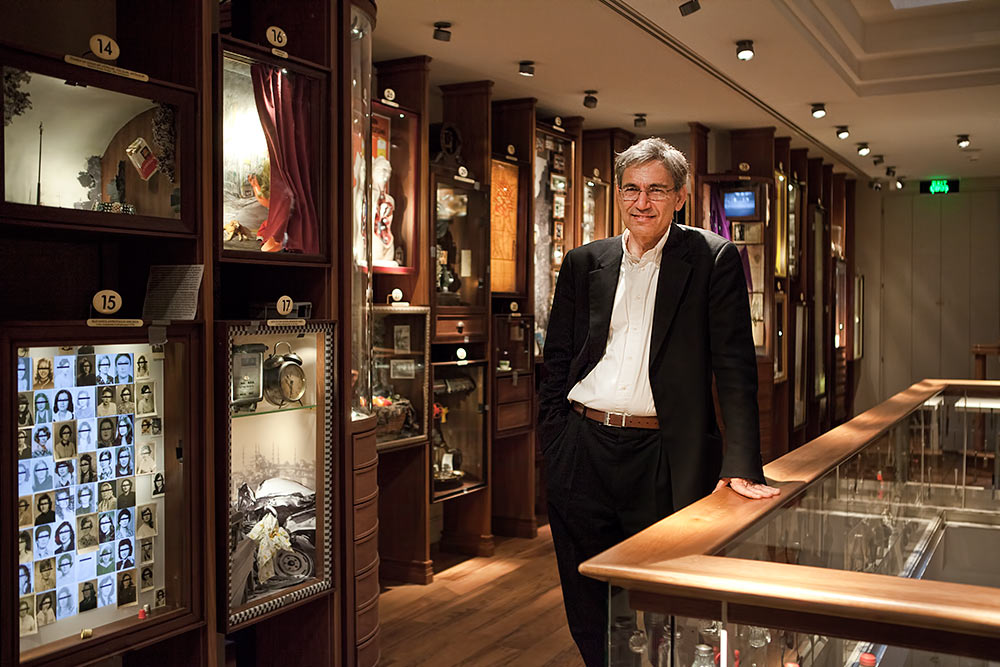
Orkhan Pamuk in the Museum of Innoconness, Istanbul
Via Wikimedia Commons
What to do to the writer with the fact that he is read too literally or too poetic?
I write novels, and my readers know that this is fiction. Yes, there are readers who read my novel “The Museum of Innociality”-the 600-page chronicle of a person passionate about a girl-and ask me: “Mr. Pamuk, are you Kemal?” Readers have a temptation to identify the author and protagonist. We understand that the author could have a similar experience and, most likely, he, taking his experience as a basis, changed it to create a novel, make it beautiful. And also hid himself behind the category of “fiction”, “fiction”.
I have long wanted to ask you the question of just about the "Museum of Innociality." I know that this novel was written for a long time, with breaks. But in the end, he became not only a book, but also the museum itself. As long as this remains a literary reality, there is some conditional agreement between the writer and the reader: "This is fiction, it does not matter what is from the truth." But when it is a museum that people come to, look at these cigarette butt ... How do you feel what is happening there?
Good question. To make clarity: the “Museum of Innociality” is both a novel and a museum, he thought both as space and as a book at the same time. Not that I first wrote a successful romance, and then in a wake of success I opened the museum. From the very beginning I thought about a whole project. In the museum you can see all the objects described in my novel. А роман написан специально в такой форме, чтобы его можно было рассматривать как музейный каталог, где все объекты сгруппированы в определенном порядке, который, в свою очередь, позволяет читать текст как роман.
И вот я писал роман и собирал объекты, работал с дизайнерами и архитекторами. Но всем, кто когда-нибудь строил дом, знакома история, когда маляр может исчезнуть, получив задаток, или плотник опаздывает. Так что с музеем мы немножко задержались. Но через 4 года он все-таки открылся.
И вопрос в том, какой опыт ждет людей, которые прочитали роман, или, наоборот, которые пришли в музей и еще не читали роман. Сначала я верил, что внимательный читатель придет в музей и будет искать соответствующий экспонат из романа. Логика музея — следовать главам романа. Но как только посетитель попадает туда, он, как правило, просматривает первые пять витрин, а после этого возникает уже другой подход, желание смотреть более глубоко. And I like it. В принципе, я не планировал этого. Часто посетитель музея еще и не прочитал роман, но собирается это сделать. Или его привел знакомый или жена, которая прочитала книгу. Они приходят в музей с ироническим настроением. Это же выдуманный музей, ничего такого не было. Но когда они видят все эти объекты, заботливо собранные на протяжении долгого времени, подобранные и выставленные особым образом, они парадоксально чувствуют и видят реальность. Все экспонаты из повседневной жизни середины XX века: бытовые предметы, билеты, пепельницы, все, что окружало людей среднего класса того времени. Я работал над музейным аспектом очень серьезно и внимательно.
Я хорошо помню свое собственное переживание, связанное с музеем. Я действительно читал книжку прежде, чем пойти в музей. И когда ты проходишь один за другим объекты, о которых ты читал в книге, ты понимаешь, что ты в пространстве, которое написано Орханом Памуком. А потом ты выходишь из пространства книги «Музей невинности» и оказываешься в Стамбуле — городе, о котором одну из самых знаменитых книг написал Орхан Памук. Совершенно понятно в этот момент, что ты — крошечный второстепенный персонаж Орхана Памука. Это диковатое чувство. Но мне в нем было скорее комфортно, как ни странно.
Спасибо за такие утешительные слова в мой адрес.
Мне кажется, что здесь, в Ясной Поляне, мы все более или менее персонажи русской литературы, и я благодарен премии «Ясная Поляна», усадьбе Ясная Поляна, председателю жюри Владимиру Ильичу Толстому за то, что мы смогли себя почувствовать сегодня одновременно еще и переводными персонажами турецкой литературы.
Я тоже благодарен за эту премию, за то, что она дала мне возможность после сорока лет ожидания увидеть дом Толстого. This is a great honor for me. Мне было 23 года, когда я стал писать первые книги, и я прочитал биографию Толстого авторства Анри Труайя. В книге были иллюстрации из музея, и я отлично помню эти картинки, которые сегодня увидел своими глазами. Мне понадобилось 44 года, чтобы добраться. Простите, что я не смог этого сделать быстрее.