
Translated material
Stock on the city
Official data on the ecology of Krasnoyarsk says everything is fine. What happens in reality?
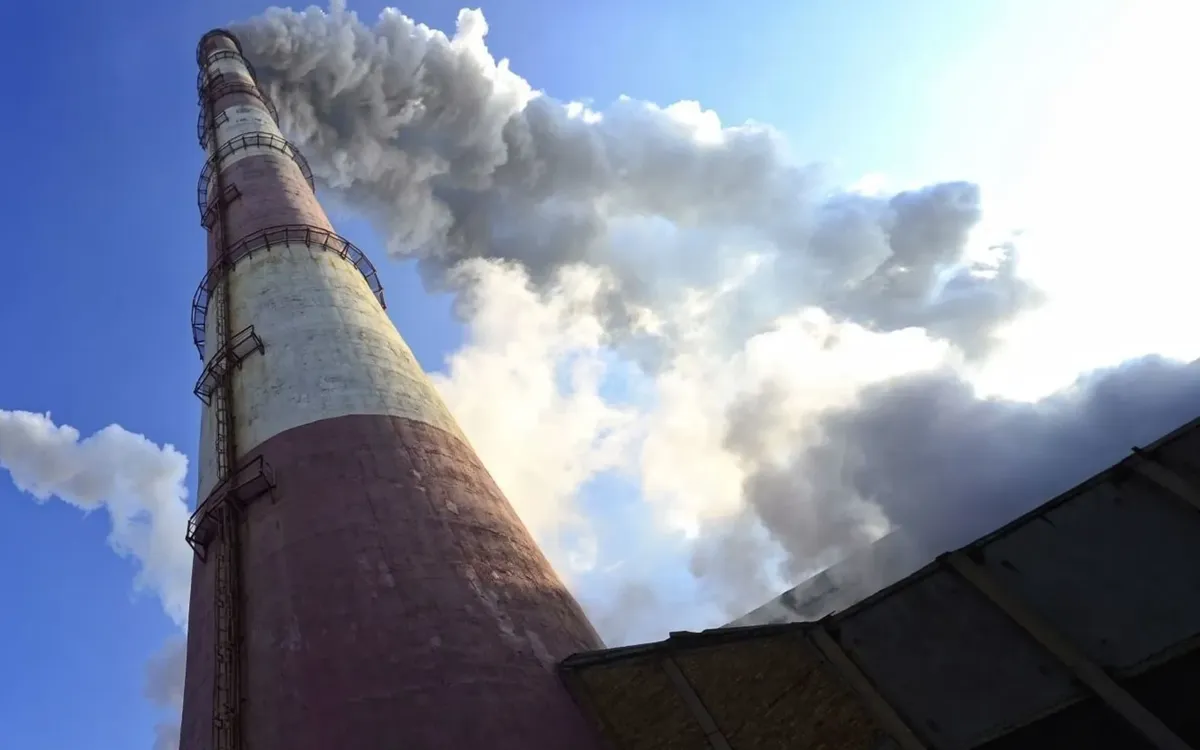
An amazing thing. According to Rusal, his Krasnoyarsk aluminum plant (KrAZ) has been increasing production in recent years, having gone through the smelting of aluminum already in the first place in the world. The Siberian generating company also increases the capacity, its Krasnoyarsk TPP-3, which previously gave only heat, five years ago, the first power unit with an installed electric capacity of 208 MW. The current gives the burned coal. At the same time, according to the regional administration, in Krasnoyarsk, it is easier to breathe from year to year, the environmental condition of the city improves rapidly. This follows from the response to the request of the “new” vice-governor of the Krasnoyarsk Territory Inessa Ansentieva. And it also follows that the authorities are not going to undertake anything significant. And why, since and so good?
Three pages tells what measures have already been taken by the regional authorities, as a result of which “from 2012 to 2015 in Krasnoyarsk, pollutant emissions from stationary sources from 294.5 thousand tons to 195.0 thousand tons were reduced.” And "the level of atmospheric air pollution in Krasnoyarsk according to the integral indicator of integral atmospheric air pollution ( sorry, so in the original. - A.T. ) Iza 5 over the past five years has halved." The table is also given: in 2010, Iza 5 is 21.86, in 2015-10.70, i.e. The decrease occurred from a very high value to simply high.
To the question: whether the Government of the Russian Federation on the catastrophic environmental situation in Krasnoyarsk has been informed, Aquentieva replied: “According to the state report of the Ministry of Natural Resources of the Russian Federation“ On the state and environmental protection in the Russian Federation in 2015 ”, in 2015, he was excluded from the priority list of cities of the Russian Federation with the highest level of atmospheric air pollution.”
(The performer of this rainbow response is indicated by Dmitry Yehanin, the Deputy Minister of Natural Resources and Ecology of the region. This official has already entered the annals, once commented on the residence of the Krasnoyarsk residents during the smog: “The factory smells were already so settled in the territory of traditional places that the citizens had to get used to them.”)
The answer Aventieva requires a comment. Indeed, Krasnoyarsk was excluded from the priority list of cities with the greatest pollution (for which the IA is equal or higher than 14). But not at all because pollution has become less. The content of formaldehyde and phenol in the air has sharply decreased due to only the decree of the Chief State Sanitary Doctor of the Russian Federation No. 3 dated January 12, 2015 "On amendments to GN 2.1.6.1338-03" The maximum permissible concentrations (MPC) of pollutants in the atmospheric air of settlements ". In short, the standard is three times increased. Here are the calculations of the Ministry of Natural Resources of the Russian Federation: in 2015 we measure formaldehyde according to the previous standards, its average concentration in the cities of Russia would be 3.0 PDKS.S. (The maximum permissible average daily concentration . - A.T. ), but now it is 0.9 PDKS.S. That is, we do not live in the trash, but, as youth says, "norms". The triple excess of MPC is declared the order of things. The famous Orwell Doublelethink: “Freedom is slavery”, “ignorance is power”. Probably, we, the population of Russia, were stronger and finished and finally got so strong that they became many times more resistant to toxic substances.
In the state department of the Ministry of Natural Resources of the Russian Federation they write directly: “It is important to emphasize once again that a sharp decrease in air pollution levels and a reduction in the number of cities of a priority list are associated with the increase in the sanitary and hygienic standard of the PDKS.S. Formaldehyde is 3 times, while there are no significant changes in the levels of pollution of the cities of Russia, and the number of formaldehyde emissions into the atmosphere, unfortunately, is growing. When used to evaluate the levels of air pollution of the former PDKS.S. Formaldehyde, the number of cities of the priority list in 2015 would be 29 instead of 11. And since in these 18 cities according to formaldehyde everything seems to be safe, then any special environmental measures aimed at reducing this, which has a carcinogenic effect, substances, the city administration may not be taken. ”
But for excluded from the list of Krasnoyarsk, other carcinogens are relevant. The specifics of the cities remained with brackets.
Be that as it may, in the priority list, now 11 small Asian cities with the total population of 1.5 million are excluded once 8 cities, including millionth Chelyabinsk and Krasnoyarsk, as well as large Irkutsk, Novokuznetsk and Blagoveshchensk. (Regarding the last city, is it necessary to especially mean what is not in mind not the Bashkir, but the Amur city? There are not in these lists of the cities of the European part, only Asian. This is to the question of the need for decolonization.) Perhaps it is worth noting only a breakthrough of Yuzhno-Sakhalinsk. Here, the CHP in reality was transferred from coal to gas, which reduced the emissions of solids from stationary sources by 44%.
And there are questions and comments to other figures in the response of the vice-governor, the editors have documents with other emissions. But it is hardly worth mentioning IZA 5 (an integrated atmosphere pollution index, taking into account the average annual concentrations of five impurities) in relation to Krasnoyarsk. What is this “IZA 5” if Krasnoyarsk is a city of non-ferrous metallurgy, and even buried from Kansko-Achinsky brown coals. We have the whole table of Mendeleev in the air here, and you are about “five impurities”. Such a technique, assessments and approaches are the 60s of the last century.
It is pointless to load the numbers about a decrease in emissions because their decrease means exclusively someone's desire to see them reduced, but by no means what is happening in reality. On the pipes of sensors - no. The factory walls, under the torch of the selection posts of air samples - no. Follow what is thrown into the air, entrusted to the subjects of the emissions. And information about a decrease in emissions comes from manufacturers of product and smoke, and not from independent observation.
Krasnoyarsk has already written Putin several dozen petitions about salvation from the environmental disaster, about the "insufficient control of local authorities for business entities." Six months ago, they even received an answer from the presidential administration: it is necessary to blame the “geographical and meteorological features” of the location of Krasnoyarsk, and the local authorities have nothing to do with it. And if the regional authorities are based on data from large businesses, then further on the food chain, the presidential administration uses the data of the regional authorities. That is, the Kremlin responds to the Krasnoyarsk residents, based on the testimony of those who, in fact, the Krasnoyarsk complained. And just as in Aventieva’s response - only on seven pages - in the answer from Moscow it is said that thanks to the efforts of civil servants to breathe in Krasnoyarsk, it becomes easier and more pleasant. “During the period 2012-2015, positive dynamics is observed in the direction of reducing emissions of pollutants from stationary sources”: they decreased by 17.52 thousand tons (from 146.3 thousand tons in 2012 to 128.78 thousand tons in 2015).
As for the main disaster-night volleys-it is noted that it is impossible to organize environmental supervision in the evenings and at night: according to the law, the official cannot work more than 40 hours in the 5-day week. But "in the case of mass appeals about pollution of atmospheric air, individual employees are episodically involved in the performance of their functions outside the working hours established for them."
The quality of air in the city who is just following. The Ministry of Natural Resources of the Territory, Rosprirodnadzor, Rospotrebnadzor, the Federal State Budgetary Institution “Central Siberian UMMS”, KGBU “Center for the implementation of measures for nature management and environmental protection of the Krasnoyarsk Territory”. There are federal observations and marginal posts.
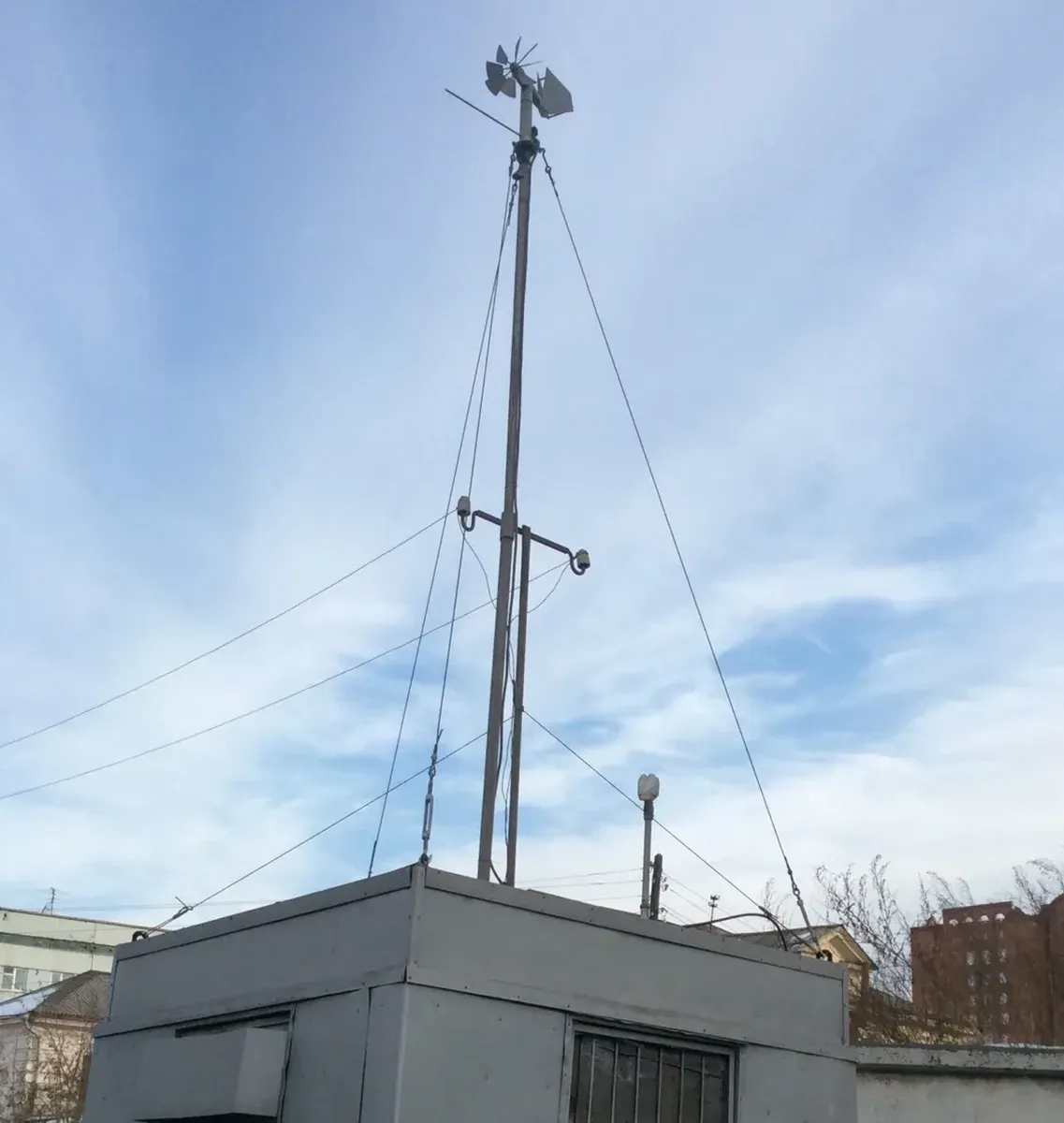
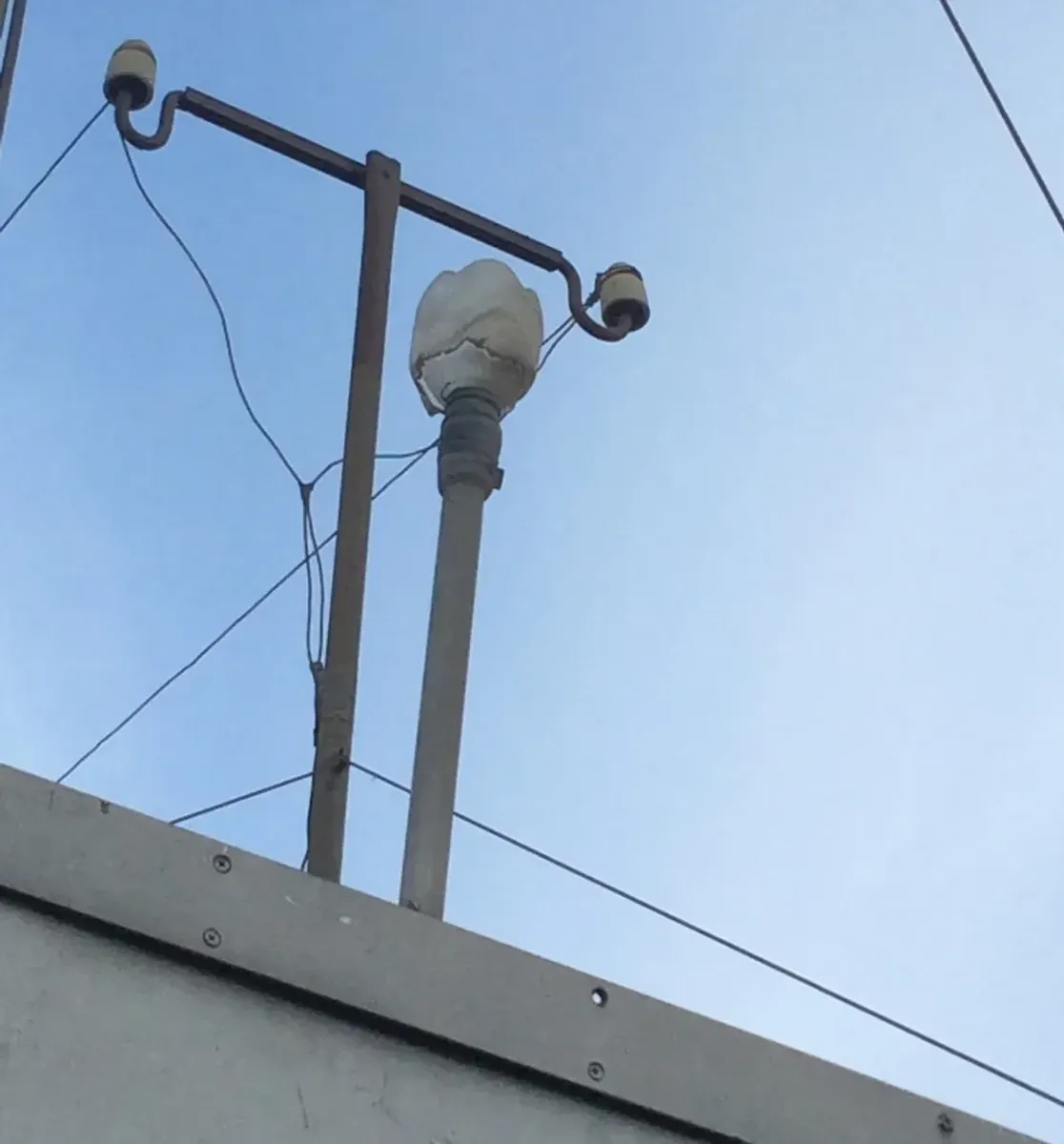
And - no sense. Here you have only one personal observation about the air measurement system in Krasnoyarsk. Surikova Street, a stainless steel of a parallelepiped booth with a small, darked and clogged with boards from the inside with a window. This is a federal stationary post for selecting atmospheric air, the only one in the city center and the entire central district. On the walls of the graffiti - an alternative decoding of the abbreviation SGK is not a “Siberian generating company”, but “the death of the city of Krasnoyarsk” (SGK belong to three coal TPPs Krasnoyarsk). Another graffiti asks: "No strength?" On a mast of a mast with a weather vane and a winged anemometer and a sampling probe (air intake). It is inserted into it with a neck and firmly wrapped with a cloth with an island with a plastic bottle with a cut bottom, this “rose” is covered with a kapron stocking melted along the edge. This whole design is covered with a thick layer of soot and dust, and it is intended just so that the dust does not interfere with the air samples. Such a filter of rough cleaning. Probably there is a thin one.
The first of this plastic bottle and Kapron stocking (read GOST introduced in 2013 - did not find the mentions of these materials) were outraged by journalists of the TVC television company. Then ten days I stopped daily near the post, the last time on February 27. Judging by the tracks in the snow and the appearance of the structure, all this time the stocking was not replaced and did not star. That is, it should be, the technology is like that. Aluminum KrAZ is melting using Soderberg technology, the centenary of which Russia will celebrate in a couple of years. (And only Russia: Others refused it due to monstrous environmental pollution.)
And SGK uses in Krasnoyarsk a cyclone air purification scheme. And what about the fact that the cyclone has been celebrated for the centenary for a long time? The Krasnoyarsk TEP-1 is the largest among the SGK stations and the oldest in Siberia: the beginning of construction is 1936, but all the main work with the simplification of the structure were shocked in 1942-1943, when the thermal power plants were commissioned. (Former Deputy Minister of Nature of the region Sergey Shakhletov: “The TPP-1 has a system of air purification since the century before last. Not even the past, but the cyclone type before. And here it is necessary to make a political decision.”)
Fedpostov of observation should be 10-20 to such a city, there are 8 of them. There are three more regional posts, and they fix the excess of marginal concentrations regularly, almost daily, but the federals do not confirm these observations. For some reason. Does the stocking interfere? However, to employees, four times a day of measurements here, the least complaints. Even when they record multiple excesses of MPC, departments obliged to investigate and suppress these facts do not respond. Things are not excited. So what difference does it make what they measure there.
That's all, in general, about the numbers in the reports and answers. These smashed nylon stockings and a plastic bubble against the background of the average annual cancer growth of 5% (the figure from the last regional state hospital about the state of the environment) is about the attitude of the Russian Federation to its subjects, and about the essence of the regime, and about the sorting of all of us (no, here is not fascism, there is simply neglect of non -core assets), and about priorities - Syria, Donbass, and about ... about ... Continue yourself.
Yes, more. The last two Krasnoyarsk publications suddenly responded to our last two. Why - it would not be clear, before - did not happen. Public Relations Director Andrei Morozov (living in Moscow) “with great pleasure” invited me (constantly living in Krasnoyarsk) to come to Krasnoyarsk to get acquainted with the “state of affairs”: “Visit our enterprises in this city, meet and discuss the situation with our specialists, business partners and consumers of our services.” This is not a joke. Moskvich Morozov seems to know the composition of the Krasnoyarsk air better than me. Thanks for the invitation, it is better to organize treatment in Moscow at least several of our children from pulmonary departments and oncology departments.
On March 18, Krasnoyarsk will reach the rally “For Clear Sky”. Apparently, it does not reach someone that it is easier to breathe here all the last years.