
Translated material
"Manaraga" by Vladimir Sorokin
How to burn books correctly: Galina Yuzefovich - about the new novel of the Russian classic
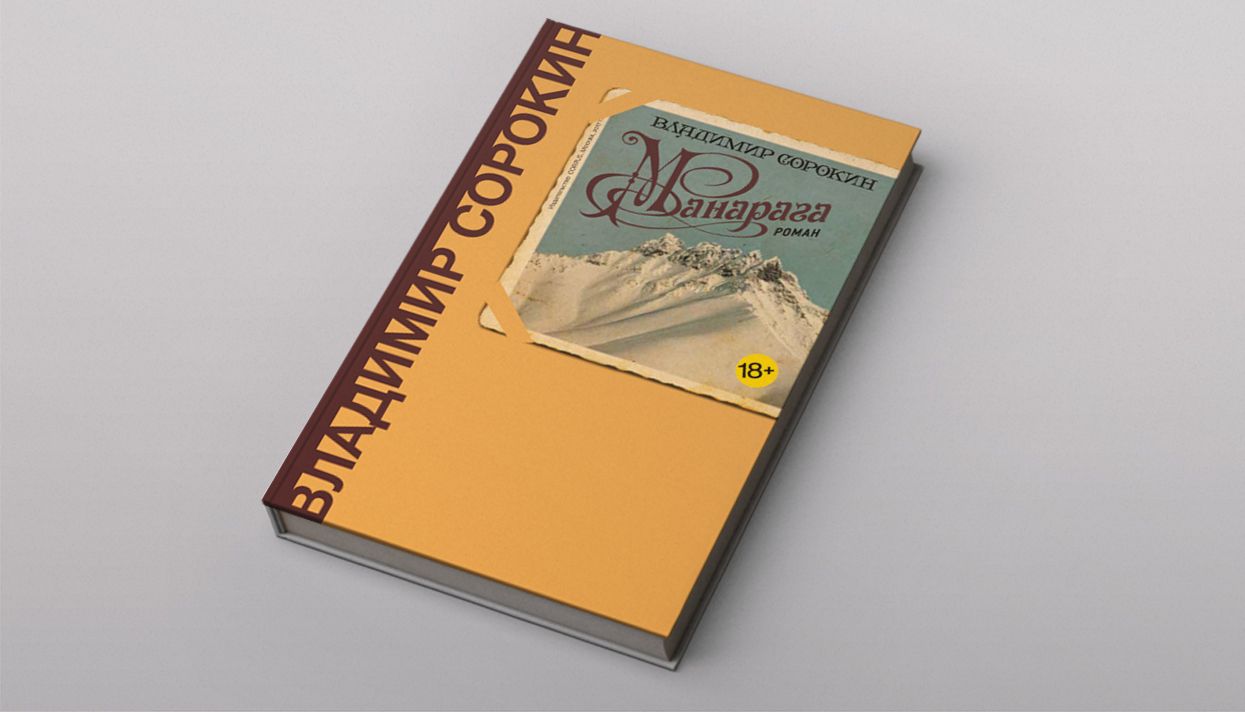
In mid -March, the publishing house of Corpus will be released by Vladimir Sorokin’s novel “Manaraga”, telling about the relationship of mankind with books. After the new Middle Ages and the second Muslim revolution, books stopped printing - and they turned into a rarity. At the same time, they began to use them for unusual business - Book_n'Grill: in rare publications, delicious dishes are prepared (sturgeon barbecue on the “idiot”, a steak in the first edition of the “Fools in Finnegan”, a banta lamb on Don Quixote). The less often and more valuable an instance, the tastier. The main character of the novel, the chef Geza, a specialist in Russian classics, learns that the threat hangs over the business-fakes appeared who copy old editions as many as thousands. About the new novel by Vladimir Sorokin, laureate of prizes Andrei Bely, “Nose”, “Big Book”, says the literary critic of “Medusa” Galina Yuzefovich.
Vladimir Sorokin. Manaraga. M.: AST, Corpus, 2017
Last summer, in a kind of parting the literary number of Esquire magazine, Vladimir Sorokin wrote literally the following: “Recently, in one large shoe store, I saw shoes stylized for products from time to mass production: uneven skin, rough heel, sole, with copper hats of“ nails ”, which, of course, were not there. It was a mass product that has a form of manual dressing. The view of these boots, as it were, said: “Humanity is tired of the same things. Is it not time to at least externally return to the piece product?” The paper book is more and more inferior to electronic, the conversations that books will soon stop printing at all, have become a common place, the circulations are falling. It seems to me that the book can only be saved by a piece of goods, challenging not only the digital, but also in some way the Gutenberg era. Each book should look as if it had been printed manually from lead, fingers of the matrices drew on manually made by manually made. Her binding should store traces of painstaking and leisurely work. The book should smell like the original, unique thing smells. Having become such a thing, the book will erect a bastion around it, irresistible for the digital world. ”
A new novel of the writer is a detailed answer to the question hidden in this passage: how exactly will the paper book erect the same bastion and why will it need it in the world of the winning numbers? As usual, Sorokin, this answer turns out to be paradoxical, very funny and extremely disappointing: in the near future, already in the middle of the 21st century, books will turn into fuel in the very literal sense of the word - they will cease to read, but they will begin to cook food.
However, of course, not on any books and not any food. Precious lifetime publications, books with autographs of the creators, manuscripts, inconabulas and other rarities will become logs for expensive, illegal and therefore especially attractive culinary-literary attraction Book_Grill. Enterprising bugs will begin to get rare books from museums, libraries or private assemblies (it will become unsafe to keep them at home), special book postmen will take the delivery of the desired book to the customer’s house, and there the already specially invited chef will prepare a dish corresponding to its volume and content - barbecue bar on Dostoevsky, Arracher's steak on DOS PASOS Oysters near Parmesan in the first edition of Dead Souls ... At the same time, the process of frying is a variety of the show: the chef does not just burn the book, he spectacularly leafs through the burning pages with a special adaptation (professionals call his Escalibur ), therefore, on cooking jargon, the cooking process is called reading .
The protagonist “Manaragi” is an experienced Book_n'Griller named Geza of a clear-dwarf, a Russian classic specialist (in the world of book grill, each boss has his own specialization-someone is preparing in large American novels, someone in English or French literature, and someone in the literature of ancient or, on the contrary, post-Soviet). Geza tours around the world from Norway to Japan, deftly eludes the police (in this, special “smart fleas” help him-something between a parasitus-mutant and a special chip connected directly to the brain) and the invaluable specimens of the “idiot” or Chekhov’s “steppe” burned. The peaceful course of his life is interrupted by a secret message from the headquarters of all BOOK_N'Griller, the hero should urgently arrive at the secret collection of book chefs in the picturesque Bavarian castle. There, Geza recognizes disturbing news: with the help of a special “molecular machine”, unknown attackers created a new circulation of the first edition of the Nabokovskaya “ADA” - several thousand completely identical copies, impeccable copies, in which no one will ever be able to recognize a fake, and obviously, the plans of the villains are much more dangerous, which may seem at first glance ... The nest of the falsehoods is at the peak of the managon in the managon. The Ural Mountains, and it is Gzeus who will have to go to this region that far from the literary process in order to take part in the destruction of the “molecular machine”.
Vladimir Sorokin is one of approximately four modern Russian writers, whose read is not bored, in general, never. Built according to the model of “dead souls” (so ruthlessly burned by the Geza in the impregnable estate of the Transylvanian mafia boss), the “manarag” is a chain of various grill-pats, during which the hero gets acquainted with different ones-very literary and decreased, so to speak, customers. A large and orthodox Jewish family on the ocean catamaran, who ordered a stuffed chicken neck on a woman, will talk and behave exactly in Bablevsky. Opera singers who wanted caramelized fruits on the “novel with cocaine” by M. Ageev, of course, will immediately throw cocaine and spoke in Ageevsky. Well, the film crew that has just completed the work on the film on the “Master and Margarita” and celebrating this event with curtains a la did a still life in the first edition of the Bulgakov romance, will arrange a cheerful brawl with a devilry and muzzle in the style of Koroviev and a hippo. In the novel, there are also charming and irony references to one’s own Sorokinsky creativity-a kind of cameo for true fans, and branded gluttony kunshtuki: fragments “under Gogol”, “near Tolstoy”, “near Nietzsche” and even (a surprise!) “Under Prilepin”, all stylistically impeccable, and in places really shiny.
In addition to a series of self-sufficient bright episodes, there is an energetic general plot in the novel (even the villain will be presented to the reader in advance according to all the laws of the detective genre, and in the mode of “anyone, not he”), and the hero with a stunningly lively and characteristic manner of speech, and a strong, reliable world of the future, who has just departed from the great Muslim-Christian war and not quite quite Confident in your own well -being. In a word, an excellent novel is much more integral than the chaotic and excess “telluria”, much more clear and simple than the muddy and overwhelmed “blizzard”, and indeed, perhaps the most successful book of the writer from the time of “Blue Sala”, to him the greatest and most similar to him.
The only thing that raises some issues is, in fact, that the “manarags” of the Sverhead. Ultimately, it comes down to the idea of the ratio of a copy and the original, about the inevitable celebration of the first over the second and the superiority of the thing, which, using the words of Sorokin himself at the beginning, seems “original and unique”, over the one that is really. Why is this happening, why to replicate a thing, valuable exclusively by its uniqueness, and what does it all have to our life today (and whether it has or should be read as an exquisite and abstract metaphor) - Sorokin circumvents these questions in silence.
As a result, with all its rounded plot completeness, “manarag” leaves a feeling of some conceptual incompleteness. It is difficult to resist and not give a quote from the Martven “Tom Soyer” about “The Barlow's Hall of Firm’s Hall”: “Where did the western boys get from, that someone would have a desire to fake such crazy knives and that they would become even worse from a fake, this is a great secret that, one might think, will remain indignant.” How it was there with the knives of the Barlow company, but this is exactly the case with Manaraga.
Galina Yuzefovich