
Translated material
Will Edip a blue beard go?
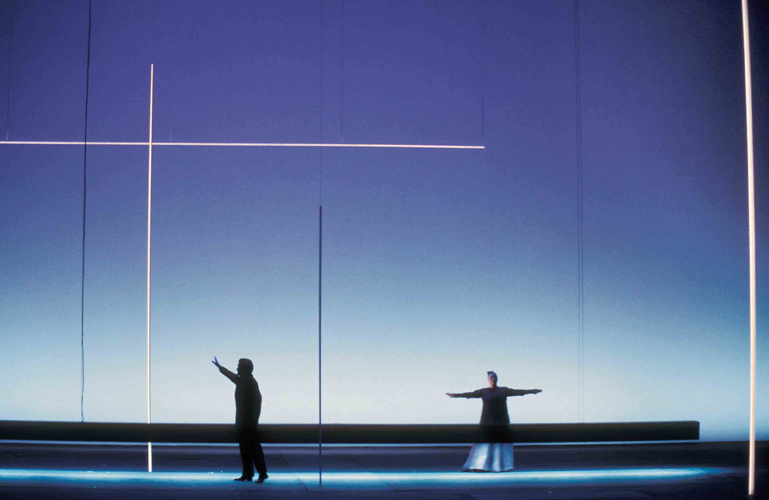
The theater of Stanislavsky and Nemirovich-Danchenko decided to replenish the repertoire with two important, but completely non-hit scores of the 20th century. This is Bela Bartok “The Castle of the Duke of the Blue Beard” based on the play of the white baluster and the Operator of Igor Stravinsky “King Oedipus” on the libretto of Jean Cocteau along the same tragedy of Sophocles. They go one evening. The seriousness of intentions emphasizes the choice of the main scene and the director - Rimas Tuminas, who successfully debuted on the opera a year ago . Ilya Kukharenko introduces Colta.ru readers to the course of business.
Both of these things are not so unknown in Russia. It would seem, Bartok and Stravinsky are not the most deployed pages in Soviet music. But still, Bartoku was much more lucky than other representatives of musical expressionism-say, Richard Strauss, Ceminsky, Schrexer. There was a completely beautiful production of the “castle” in Bolshoi, they sang Obraztsov and Nesterenko, and in the Hungarian language. From this production there was a record on Hungarian plates. And I remember how a schoolboy seems to have bought a 1984 record in Vologda, which was called Oedipus Tsar with Ukrainian composition. I was then very surprised at this shift (I haven't read Sophocles yet). In 1963, there was a production in Yerevan, in 1972 the clavier was released in a Russian translation, and they also say that before the war it was planned to be staged in Bolshaya and Kozlovsky in the title role. One way or another, in the Soviet context, both of these scores existed. The story was not entirely closed.
But their neighborhood is not very characteristic. Together they are almost not performed. The first edition of the “Duke of the Blue Beard” is 1911, and “King Oedipus” is 1927. By the standards of the beginning of the 20th century, these things are defended from each other for a rather large period of time, and between these decades - of course, aesthetic abyss. Bartok is located in the center of musical expressionism and literary symbolism, while Stravinsky in 1927 is already trying in every possible way to return to classical foundations and plays with them with a modernist way. That is, “Oedipus” is such an indicative essay, built on the abandonment of the exaggerated emotionality of expressionism, and the “Duke” is, on the contrary, its flowering.
In principle, there is a practice of fulfilling the “king of Oedipus” as an independent thing to which nothing needs to be added. Despite the fact that it has only more than 50 minutes of music in it and it stretches in time only depending on the narrator, most often even in Russia (for example, there was experience in Mariinka) it is played by just one piece. Whereas the “Duke of the Blue Beard” for some reason all the time asks for himself some kind of pair.
And here there are different strange rapprochement, often associated simply with theatrical needs. Still, “Oedipus” is a rather crowded score: a male choir, many soloists. And in the "Duke" there are only two people on stage. And most often it is combined with the same duets. Or generally with mono operates. In the 80-90s, quite often he walked in pairs with the “waiting” by Schenberg ( “ Erwartung ” -a monodrama for soprano and orchestra.- Ed. ). That is how Bob Wilson put in Salzburg, and it was one of his best Salzburg productions. A very emotional human drama was frozen in its minimalist constructions - this well -familiar Wilson effect was completely win -win, worked there. And the participation of Jesse Norman in Ervartung made a completely bewitching impression.
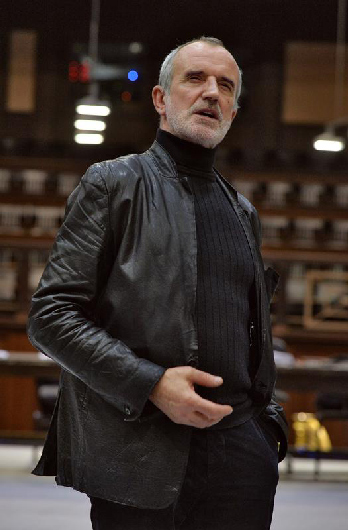 © Yuri Martyanov / Kommersant Rimas Tuminas during a rehearsal
The theatrical fate of the “Duke of the Blue Beard” is generally more interesting than that of the King of Edip. Maybe because he did not disappear from the stage for a long time as the Oedipus, which, after a number of performances in the late 20s-early 30s to the second edition of the mid-40s, disappeared from the repertoire. They somehow did not remember about him-at least as about the theater thing.
And the “castle” was performed both in the late 30s and at the very beginning of the 50s very good singers and conductors. And, perhaps, he simply faster came into the field of view of serious directors, and they treated him very interestingly. There was even Pina Baush. In recent years, a series of very successful “castles” has arisen in different combinations. One of the most curious was set in Paris by La Group Fura Dels Baus , they fell through him with the vocal cycle of Janachek "Diary of the disappeared." There was a very beautiful story: the Duke's castle - this was, in fact, the Palais building Garnier , they very cunningly twisted the projections of the interiors with the help of any unevenly hanged kaprons. Critics are very praised by Andrea Bret's recent production on Wiener Festwochen . Again, the premiere of Chernyakov recently took place in Hamburg, where the modern opera “without blood” was put in the pandan to the “castle” ( Senza Sangue ”) , also associated with the relationship of a man and a woman, written by Peter Evna according to the novel by Alessandro Barikko. Very clear combination.
As for the “king of Oedipus”, it is primarily terribly interesting that there are its authors, what kind of ideas they had about what neoclassicism was. After all, the beginning of the 20th century is just the departure of classical Greece, an attempt to lay out this slender white -stone harmony and explore the Dionysian riot. What, for example, Strauss does in his Electrre. And then they wanted to somehow return classical antiquity back. But in order to cleanse her of all kinds of layers, Stravinsky decided that the libretto Cocteau should be transferred not to Greek, but to Latin. Universal, dead, but still intuitive language.
The only impending left by the authors of the venerable public is the figure of the narrator who must communicate with the audience in her language. Somewhere from the mid-60s, interesting directors began to take up the “King of Edip”, he was set by the arrows, Obraztsova sang to Jokasta there. But still, of all the productions, the one that Julie Taylor and Seiji Ozava in 1992 is still standing out. Having composed the modernist performance of the festival nature (they played only three times, but immediately professionally recorded on the video), they very much tried to completely change the aesthetics of this thing, but also observe all the necessary author’s remarks. There is an actress of the Kabuki Theater as a narrator who talks with an audience in Japanese, with characteristic genre intonations and gestures. There is a certain duplication of Oedipus - Philip Langridge sings the vocal part, and the stunning dancer, one of the masters of Dance, Buto Min Tanaka leads his plastic line. Stravinsky and Cocteau insisted on statue. And there is a platform, multilevel platforms, very interesting dolls and hats in the form of ancient statues.
This work was the most noticeable penetration into the European theater context of what can be conditionally called the "ritual theater." Peter Brooke, Peter Sellars, did this, we have Anatoly Vasiliev and Tadasi Suzuki. Archaic, Asian, southeastern types of theaters that came in the wake of the interest of these directors to European theatrical reality-this suddenly became terribly relevant. In 1996, Bob Wilson put in the Chate of Edip - with a detailed mimic prologue in the style of the theater, but. In the same years, Peter Sellars turned to the oratorio, who returned to her last year in Ex-en-Provence, continuing his series of the neoclassical oratorial Stravinsky. This time the “symphony of the psalms” was set to the pandan to the “Oedipus”. At first there was Persephone (one evening with Tchaikovsky’s Iolanta), told by the language of Cambodian dance. Oedipus has fewer exotic (African masks), but still there are a lot of ritual theater, to which, of course, this score is very located.
So the main intrigue for the upcoming production at the Stanislavsky and Nemirovich-Danchenko Theater-why, in fact, such different works turned out to be together and how this contrast will be understood by the Tuminas team.