
Translated material
"Russia becomes an ideological lighthouse for many Western politicians"
Arkady Ostrovsky is a journalist, a regular author of Financial Times, the editor and author of The Economist, author of the book “Invention of Russia”, which received the Orwell Prize in 2016. The book is preparing to go out in Russian at Corpus.
- The “honeymoon” of the Kremlin and Trump ended: the number of references to the politician in the Russian press decreased sharply, the tone became colder. The return of hostile rhetoric in relation to the United States can be beneficial to the Russian authorities?
-I must say that anti-Americanism is completely not organic for Russia. In Russian culture, America was rather a dream, the way of the future, the other world and the new light. In my opinion, the first time America as a concentration of evil arises in Gorky in the story of 1906 "The city of the yellow devil." And this despite the fact that Gorky’s letters about America are very benevolent. The image of America as a future passes through the poetry of the 1910-1920s, and in his work “On the Basics of Leninism”, Stalin wrote that Leninism is a combination of a revolutionary spirit and American businessiness.
In the 1970-1980s, there was caricature anti-Americanism in the USSR-everyone perfectly understood how the West actually “rot”. But today, for the Kremlin, anti -Americanism has become one of the main supporting and organizing structures, which explains and justifies everything that happens in the country. It is very scary to take out this design. Firstly, it is not clear how to replace it. Secondly, the population may have a strong cognitive dissonance: before everyone, it was clear why it was necessary to rally and endure the reduction of income. Therefore, for the ideology of the Kremlin, to have the United States as an enemy is much more profitable than as a partner, especially since it becomes quite clear that there will be no partnership here.
Another explanation is that Putin and Trump are populists with a strong nationalist element. Let Putin’s state-owned, imperial nationalism, and Trump is associated with raches and anti-Islamic moods. Since nationalists, by their nature, rely on the image of the enemy as legitimizing their power, at first they often recognize another, but then the stage of confrontation inevitably occurs. The initial euphoria of the Kremlin in connection with the election of Trump was connected not only with gloating (look, everything was spitting, they arranged a Maidan for themselves), but with the joy of recognizing another.
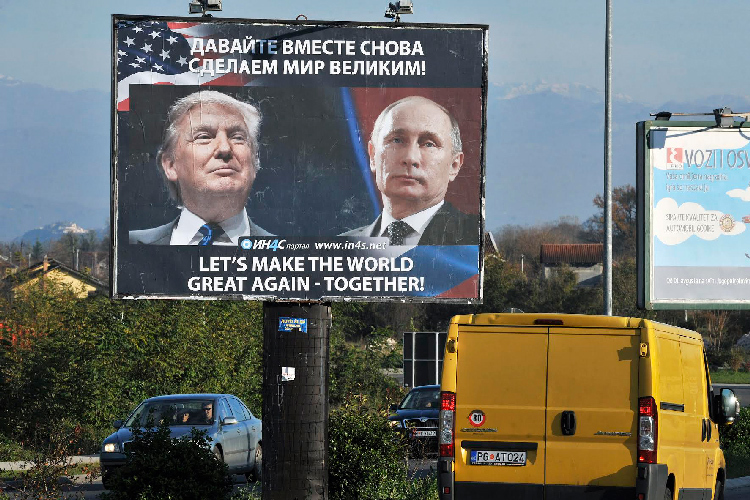
And although Putin and Trump are not very similar in psychotype, it is completely wonderful that Trump uses literally the same techniques - for example, when he does not let the press for briefings and calls it Fake News . On television, everyone is lying - this is one of Putin's key phrases in 2001, during a meeting with relatives of the dead on the Kursk submarine. And the main slogan of Trump is “Make America Great Again” ? Of course, this is a tracing paper with "we will raise Russia from the knees."
-Is it possible to say that the construction of fake reality for political purposes is in a sense Russian technology?
- In Russia, this phenomenon has really always been important. Russian media always constructed reality, and not described it - this applies to both Soviet and post -Soviet media. It has always been more about words than about the subject of description. In this sense, “we’ll build something here” is a very Russian thing, it begins with the Bolsheviks, if not earlier. And the design of the country always involves the marks of facts. In the 1990s, this construction continued. Even the most striking and talented media of that time - “Kommersant” - also constructed reality: it wrote not about the country that was, but about the one that they wanted. Then, in the zero, the gloss was engaged in this - the conditional "poster" described the European city when it was not yet. Such futuristic projects are always dangerous.
In the political field, Fake begins to be used after the 1996 elections and further, when politics is finally replaced by political technology. We can talk about the 1996 elections anything, but still Yeltsin is a real historical figure, it did not arise from the TV. But what began further - the idiotic games of the oligarchs, which demolish the government in 1997, bring their security forces there and so on - this reaches the apogee during the 2014 Olympics, when it turns out that the victories of Russian athletes were not real, but at doping. And then it turns out that Crimea is exactly the same doping.
- Do you think that what is happening in the United States can be connected with Russia in a more difficult sense than through the Kremlin’s alleged attempts to intervene in the course of the American elections?
- Yes, I do not mean hacker attacks, although I am sure that they were. It has always been: the USSR intervened in the American elections in 1984. It seems to me that the connection should be sought in the feeling of the need for a new agenda, a simple narrative related to history. Why in both countries they talk about Fake News ? When you are dealing with the present, you need facts, and when you nostalgic for the past, the facts only interfere with you. Trump is a symptom of global shifts, which, I think, are to some extent associated with the end of the Cold War. The confrontation with the USSR kept everyone in good shape. Then they relaxed and spread. It seemed to everyone for a long time that post-Soviet Russia was a special story: the country was engaged in itself, there were some processes, it seemed like nothing similar to Western ones. And suddenly it turns out that Russia was no exception, but rather, the foresight of what is happening in the world today, just here these problems appeared earlier and more acute.
- Russia has become a “pilot project” of a new structure of the world?
- Yes, and this project is connected with the end of the Cold War and the collapse of the USSR. There was a short period when it was believed that Russia, having thrown off the communist power, would become a “normal” Western country. But the so -called Russian elite used its power not to build institutions and create a political base, but to multiply this power and money. It soon became obvious that some idea was needed. Russia in this sense is an idea of centric country, with a sense of a special mission and goal, like America. In the second half of the 1990s, Yeltsin was obsessed with the desire to find the Russian idea, to understand what we, if not about the empire and not about the confrontation with the West. He even created special commissions on this issue, but then they chuckled at him. In the newspaper Kommersant, they wrote that, of course, it would be nice to have a national idea, but it was rather an optional luxury - it is enough just to delete the Soviet period. And Putin felt this vacuum well, starting with the restoration of the music of the Soviet anthem and other symbolic acts. But at that time it was a kind of addition to the growth of the economy. And by the third time of Putin with the economy it became ill, and even swamp. It became obvious that the ideological agenda should be the main one.
In the United States, the end of the Cold War was perceived as the final victory of liberal ideology and the result of military superiority. The collapse of the USSR and the end of the Cold War were united in one event, which was deeply incorrect - the Cold War was completed by Gorbachev. Moreover, the USSR did not break up under the pressure of American military power, but due to the fact that the advantages of the Western model became completely obvious, and Gorbachev did not want to use force in order to suppress this perception. In America, the sense of triumph was supported by the idea of the end of history. Francis Fukuyama wrote in his famous essay that liberalism had two opponents: fascism and communism. Fascism was destroyed by military means, and the communist system was self -destroyed. And now the ideological struggle has ended, liberalism is becoming a universal model.
But the essay ends very strangely. He writes: in essence, all this is true, but we will be terribly bored without history. The ideological struggle suggested passions, patriotism, and willingness to sacrifice oneself in the name of an abstract idea. And now it will end, everything will be reduced to economic issues, to consumption and technological progress. Maybe Fukuyama writes, it is this longing, this boredom and emptiness, and will lead to the return of history.
America, indeed, lived for a long time with the idea that only the economy should be engaged in. Sometimes she used military power to promote democratic values. Then, with the examples of Iraq and Afghanistan, it turned out that the army was not very suitable for establishing democracy. On the other hand, it became not so good with the economy - the pressure from China and other countries began, which wounded the national pride of the Americans. In this situation, the lack of breakthroughs has a need for another story. Half a century before Fukuyama, Orwell wrote about this in a review of Hitler's Mine Campf: we do not understand how Nazism, fascism and militaristic Stalinism are emotionally attractive than consumer hedonism. Once people will probably wake up, but today they are inclined to the feet of dictators.
It seems to me that we have come to this mobilization agenda now. Putin and Trump felt that in the absence of giant economic victories, it is much more efficient to return to a state of struggle. This, of course, does not mean that their countries are similar to the USSR or Nazi Germany. But we live in the postmodern era: it is enough to create the appearance of this mobilization that they are doing well. Putin - with the Olympics and the Crimea, Trump - with his Mexican wall and the struggle against Islam. For such a media war there is not so much money. Another thing is that real people will die from her.
- Do you seem too loud to the statements that the political 20th century is ending before our eyes and a new global configuration is being formed?
-I'm not sure that we are observing something completely new; Rather, we are in the circle of the same ideologies that exist since the end of the large empires. What we don’t know is whether we are experiencing the last battle today with opponents of globalization, urbanization and the liberal agenda, whether this will roll back this time a complete triumph of liberalism (and then the 1990s in Russia is the beginning of a trend that is frozen, but then returned), or this is the beginning of a completely different wave, which can end with isolationism and new wars. This is the main question now.
-We see that Trump is trying to abandon the United States Messianic role as a defender of liberal democratic values in favor of pragmatics and national interests. And what happens in this sense in Russia?
- In Russia, the Bolsheviks claimed the place of the fourth Rome. In a sense, the USSR was indeed the center of the Comintern, the cradle of the future world proletarian revolution. Now Russia is becoming a symbol of bond, traditional values, nationalism. The regime has a symbolic content: even the last dictator is in a hurry to sing Putin today, and American ultra -rights say that Russia is the center of traditional civilization. The country becomes a kind of ideological lighthouse for many European politicians.
America really abandoned this role, it gave its status a special nation, which was very important for the country for many years. Trump's answer to the question Fox News is very indicative: "How do you work with Putin, he is a killer?" “Well, we have a lot of killers.” In the West, this made a shock impression on everyone, because in fact this means that we are all the same, there is no longer any moral superiority of the United States.
- Before the American elections, political scientists argued whether Trump could turn into a dictator in the event of a victory or the American system of references is quite stable. So far, the supporters of the institutes won?
- I do not believe that there are unshakable organizations - you can destroy anything. Now just for this is a struggle. The first big fight will be, of course, with the media. But America is not Russia, here you can’t select NTV or take the first channel. The most important thing is that the Channel One is not here either: people read local newspapers, watch local TV. There is no one national newspaper Pravda. The New York Times is not read in California, Los Angeles Times -in New York, and neither one nor the other is read in Texas. But Trump grandiosely uses Twitter to turn directly to the people through the heads of elites and institutes, like Franco. In general, his past as a person from a TV program is much more important than all his experience in business.
But if California once tells Trump for something “no”, then he will not be able to do anything about it-not to enter there. What really cannot be broken is the Constitution and the federal structure of the United States. Trump cannot centralize the country, he may be president of Nevada and Texas, but not New York, Washington or California. Let's not forget that more than half of the population voted against him. I think he will try to strengthen his power, all this will be accompanied by giant political crises, but he is unlikely to succeed. People who surround him at key posts do not want and will not participate in this. What will you do with Secretary of State Rex Tillerson, who previously headed the largest company in the world until recently? He has his own reputation, and he will do what he considers necessary.
In general, I must say that, despite all Trump's statements about Putin and Russia, now America has a very powerful team of people who have been engaged in Russia for a long time and seriously. Just as an adviser in Russia in the White House, Fiona Hill, a wonderful researcher and author of the best work about Putin, has been appointed to Fiona.
- Europe is more vulnerable regarding the existential threat from the right populism?
-In some ways, in some ways. But the main thing is in another: of course, Brexit and everything else is unpleasant, but this is not the scale. America is the most powerful country in the world. There is no such state that could defeat its military non -nuclear means. Therefore, the United States with authoritarian manners is much more dangerous than any European country.
- But if Germany ceases to play the role of the last bastion of liberalism, then the entire European Union can fall apart ...
- I think that if Marin Le Pen comes to power in France, then this will happen earlier. She will arrange a referendum, and nothing will remain from the EU quickly. For Germany, this is also a very dangerous thing: for many years after the Second World War, the EU has been the main form of existence and development of this country. While he was, we could say that our goal is to strengthen the EU. But what to say if he is not? Will we make Germany the great again? It seems to me that the main task facing the liberals today is to return the feeling of the unconditional value of freedom and formulating the agenda that would be intellectually more powerful than the agenda of nationalists and populists.