
Translated material
Woland is watching everyone
"Master and Margarita" Sergei Zhenovach is the successful experience of the stage life of the novel
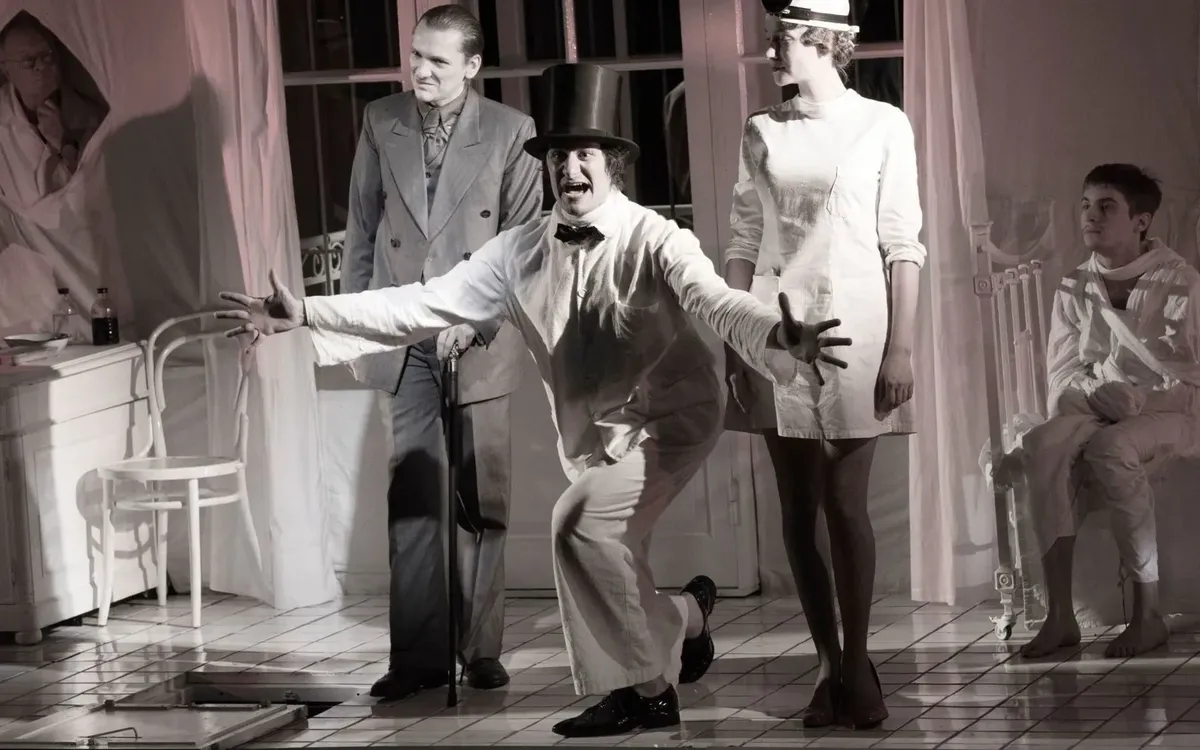
... The fire is raging in the stove, the tongues of greedy flame dance. Soon a novel, a city, a past life will disappear in them! Clean flame, hellish bee - from this image, a burning furnace, the performance begins ...
Let's say right away: “Master and Margarita” by Sergei Zhenovach, perhaps the only, just successful experience in the stage life of the novel. They worked painfully, shifting deadlines - in heavy rehearsals, confrontation with text. Now it is clear what the months have gone to - to pull out the volume life of the heroes and ideas of the novel out of prose.
Borovsky. The backdrop of the play consists of built -in, rifled sick leave - a white deadlock of longing, an image of extreme loneliness. The scenographer, the full co -author of the director, here, where, it seemed, you can turn around in lush fantasy, stingy: a hospital bed, a desk, two poles of the life of the protagonist. And in the center of the balcony - sick leave hanging between times.
Zhenovach was unpredictable. Designing the guess of what performance he puts, I chose the wrong elements in the imagination. But in fact, he read all the editions of the novel, the draft notebooks of Bulgakov, the diaries, and, with the exact following by the canonical text, staged a performance corresponding to the original plan of the author - a novel about the devil, where a consultant with a hoof is the main character.
Despite the fact that the action begins and develops in a psychiatric hospital, that almost all the heroes of the novel, including Pontius of Pilate and Yeshua, are patients of the house of sorrow, that Voland's retinue looks like a team of orderlies in white robes with black mirrors of otolaryngologists on their heads, that hallucinations, confusion of consciousness, the confusing segor of the patient - not so much a language and a solution to a language and a solution performances, which occurs not just intelligently - bewitching convincingly. It seems that the legendary Bulgakov prose, which has long become a literary hit for young and old, wants to find flesh on the stage of this particular theater.
The director gently and decisively arranges his accents: the famous phrase of Yeshua about “cowardice is the most terrible vice” lies with the shadow of both the broken master and for the long -hesitated to leave her husband Margarita. In the readiness of Woland, to fulfill the request of the one who is named in the plural (“your novel read”), the connectedness of darkness and light is acutely obvious, the highest dialectics began as a conspiracy of the rigidly built orders of good and evil. What is the Bulgakov atmosphere? This is an atmosphere of verbal magic, captivity of words. It passed into the performance. His main character is directing. Copelessly clear. And the mysterious.
Yeshua. The main opposition of the novel is Yeshua and Woland; Gospel chapters are the core and rod of the novel. Yeshua is the very truth, surrounded by words, in it strength and light. In Zhenovach, this is a tall, culodier, with a long, semi -children's neck almost a boy (Alexander Suvorov), blessed, detached. He and Pilate Podols of Hospital shirts are stained with blood. And he pronounces only a few phrases. But it is present with all key scenes - then standing quietly behind the door, then sitting quietly to the side. Like Woland.
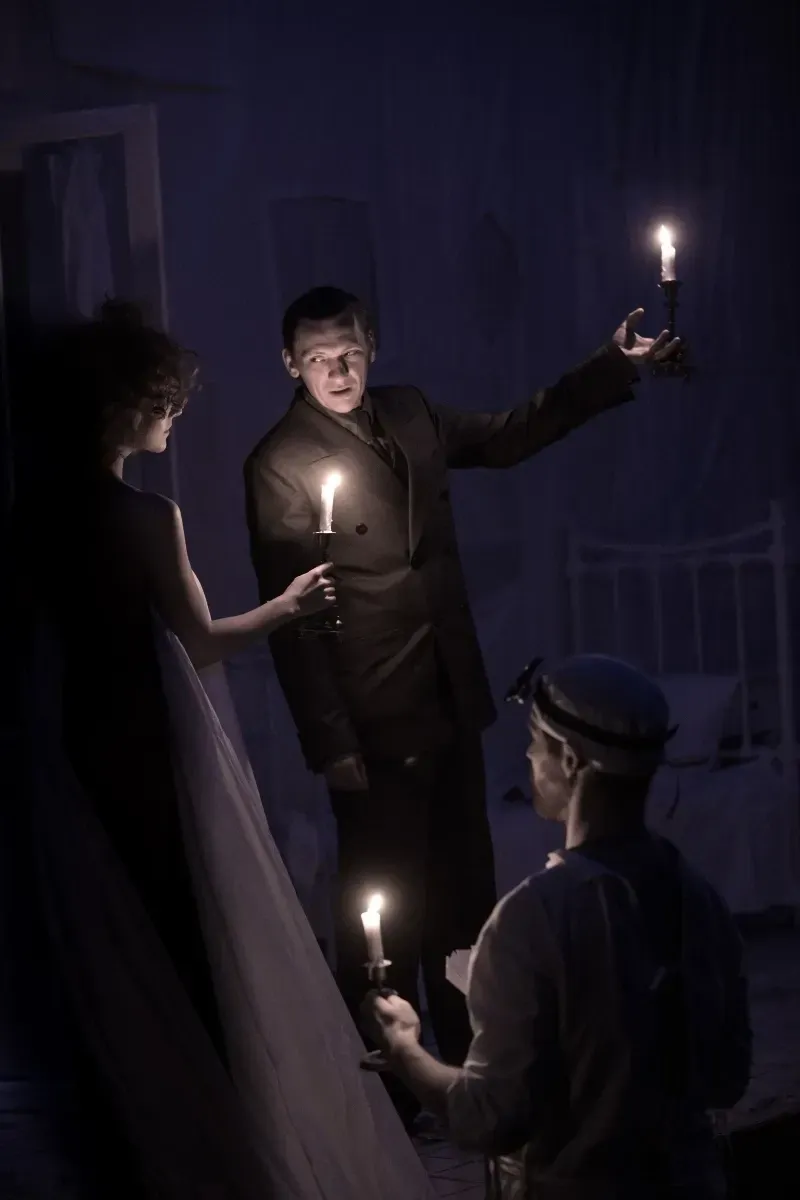
Woland. Alexey Vertkov became the main thing in the play - his inner power subordinates everyone. He calmly hits red wine, slowly asking Margarita. Only when Levi Matthew asks to take the master and his girlfriend in the world, will he allow himself the intonation of a grumbling joke. No mysticism, different eyes, ominous tone - Satan is simple and attached. But he is the manager of the whole system of what is happening. The main thing in the huge crazy house of this fallen world.
The church is angry with Bulgakov for this image almost more than more than once angry with Tolstoy. And the point is not only in his powerful charm, the point is also in the strange comfort of the idea of strict retribution, that final justice that is condensed in the phrase “I am a part of the power that always wants evil and always performs good”.
Svita. An excellent ensemble of dashing guys: a little that - they will calm down with injection, put on a stretcher, they will take a cut head. A session of black magic is held on the living room, without the decoy. So, unexpectedly a man from the public, who was on the way of Woland's retinue.
He was asked where he spent the night, and without delay checked the veracity of the answer: "At home." Gella tightly tied two scarves, tied the viewer’s neck with them, pulled with Koroviev in different directions - and op! - Between the scarves there was a cheerful red bra.
Money will sprinkle into the hall (“Part of the foreign currency is genuine!” - Correct the basin). At the request to give money, the hippo will immediately receive a bill from the rector of GITIS, take it to himself, and barely gather returning - the money will flare up brightly and burned before the eyes of the audience. The top of the session becomes a trick with tearing the head of Georges Bengalsky - the unfortunate is put under a chair, a torn head will grow out of the desk at the other end of the stage, and by the wave of Woland will return to the place. The brilliant number of twin artists Alexei and Andrei Samoilov passes with a circus drive.
In the second action, after the ball, Koroviev (Grigory Servant), Azazello (Alexander Proshin), Hippo (Sergey Yevlanteyev) go out in half -burnt clothes. Behind the scene, “Griboedov”, Torgsin, Moscow are burning. The flame is buzzing, the flashes lie down on the back. Everyone sits around Margarita on an iron bed. There are few places: Margarita puts tired legs on the basement, Azazello carnels carnivorously closer to it, a hippo with a fish is paved on top, Gella turns into a ball - an ark flooding from the flood of events. But as soon as Margarita says: “... my lover, master!”, He will mix everyone to the side, and he will arise on the bed - he.
The master, Igor Lizengevich, will enter the first scene from the balcony, jump onto the homeless bed, in a whisper will scream in his face, regretting that he did not meet Satan.
Long narrow brushes of his hands will be puzzled to stroke his forehead, helplessly hanging in the story of the past. But in it there is still not enough incinerating electricity of the spirit, that naked internal “wire”, due to which he falls in love at first sight, writes a brilliant romance and suffers a catastrophe with him. Yes, of course, we meet him at the moment when he has already “burned down”, but the album of the former person should sometimes appear with fiery letters through the ashes. Only once in the Master will an acute former curiosity flare up: when Woland offers to go with him ...
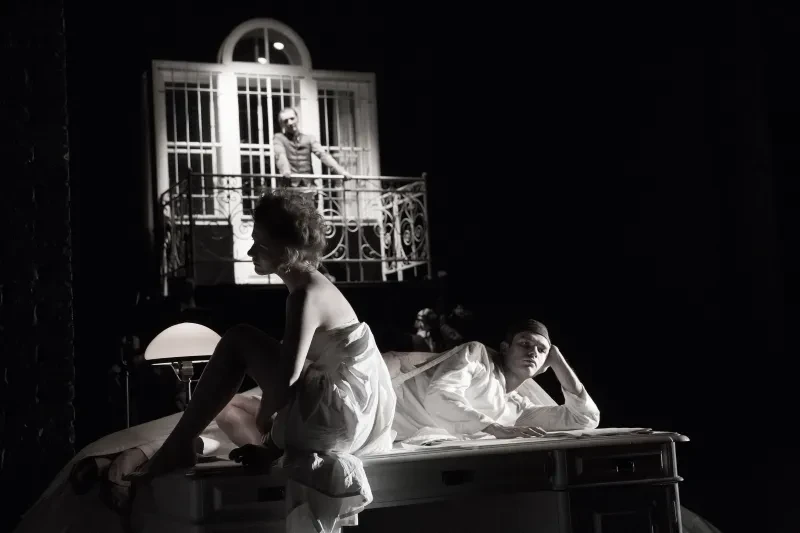
Margarita, Evgenia Gromova, will not accidentally appear in the Persian ladies' peignoir in the first stage. Later it will be separated by half, and it will go into the black and white glow of the ball, the second act will be held in a sheet pulled around the chest. Her scene with Azazello - from the most comical in the play. He is in light bulbs, with a rattle on the lift, is pulled up to the height of the balcony: there is a bargain about a mysterious foreigner and a wonderful cream.
But, it seems, the director is not inclined to endow the heroine by the power of a woman, for the sake of love entering into an alliance with the devil. In this young feminine Margarita, there is no character of character, the size of the feeling - that which created the love myth “M. and M. ".
Pilate is the most unexpected solution of the performance. Pursued by an unbearable headache, with a towel around his head, he (Dmitry Lipinsky) rushes through the stage, as in hot coals. Hallucinations pursuing Pilate, as if dictate his main mistake, an attempt to atone, and the final defeat of conscience. And silently, standing in the center of the stage, the suffering of Pilate Woland observes.
... The head, cut off, returned, stolen, that is not able to accommodate what is happening - Berlioz, Bengal, Pilate, finally, the head of the master with the flour of being with a sophisticated memory - a through image of the performance and part of his sound score - the noise and cries of the crazy house “Return my head! My head, head! "
Zhuravsky, Deputy Minister of Culture of the Russian Federation, for almost a year has implemented a difficult decision on federal federalization of the theater, which left the main sponsor. And now - the first premiere of the style in the new status. That is how, responsibly, with an understanding of the real values of theatrical affairs, power in relation to culture should behave. A fatal example of the reverse Mikhail Afanasevich showed us in his biography and the final novel.
Bulgakov.
Who could predict that the son of a professor of the Spiritual Academy, who read a prayer rule with a symbol of faith in Sunny Kiev childhood, becoming an adult, will deploy the phrase “... crucified for us at the Pontiaste Pilate, and suffering, and buried, and who risen on the third day by scripture ...” On one of the most famous Russian novels of the twentieth century? ..
Perhaps only the forces that he is dedicated.
Bulgakov was sent during to preserve the verbal cast of the deceased world that disappeared into his surfacing in his surf. And no one in Russian prose of the twentieth century did it so powerfully and talented. He died when the assignment was executed, a sunset romance, the main message of the century, almost completed. But the convergence of different editions of the final still leaves an excessive multi -layer. So in the play.
Woland, ascending into the darkness, will indicate the vector of the last justice: "On this road, oh, three times a romantic master, on this ..."
“The gods, my gods, how sad the evening land is ...” The master will say farewell, he will bake his head with his hand and freeze, looking into the hall. Just like that, in one of the dying photographs, propping his head with his hand, in the famous hat, Mikhail Bulgakov lies, already unrecognizably changed by the disease, before ascension to eternity.
And the last words of the novel are "You are free!"