
Translated material
Tusk is a sign of stability
Europeans do not want to be hostages of the domestic political struggle in Poland
An attempt to subordinate the conservative government of Poland to subordinate the decisions of the European Union to the goals of its domestic political struggle. The official Warsaw was in full isolation. The meaning of this scandalous episode of the EU summit in Brussels goes far beyond the limits of current relations between Poland and the Union.
On Thursday, already on the first day of the summit, the chairman of the European Council, the Pole Donald Tusk was re-elected for the second 30-month period, against which the president and government of his country resolutely objected. All the leaders of the EU countries voted for this decision, and only Polish Prime Minister Beata Shidlo was against it. (British Teresa May abstained, since her country leaves the EU.)
Tusk headed the liberal government of Poland before three years ago was nominated by Warsaw to the post of chief European official and was elected consensus of the leaders of member countries.
From that moment he became a representative of all these countries without much obligations to Poland. His work is to preside at meetings of the European Council (EU summits), prepare documents for them and look for compromises between national leaders, when their opinions on major political issues diverge. Like any other Europeanch person, he must be neutral and for the period of his mandate “forget” from which country he came to Brussels.
But the current leadership of Poland, on the one hand, accused him of insufficient protection of Polish interests in the EU, on the other hand of playing along with the Polish opposition, from which he himself came (headed the previous government). He was blamed for the fact that the European Union criticizes the actions of the ruling majority of Poland, which are contrary to the laws and values of the EU, including the restriction of the independence of the judiciary and the freedom of the media.
The leader of the “right and justice” Yaroslav Kachinsky completely entrusted him with the moral (if not more) responsibility for the death of his twin brother Lech Kachinsky, the then president, in a plane crash near Smolensk.
The Polish leadership decided that it could withdraw an unwanted compatriot from a high European post, justifying this by the fact that at one time he was nominated by Poland. There were no other candidates for the second presidential term in the European Council, and Warsaw proposed her own: relatively little-known at the international level of the European Parliament Deputy Yatsek Sariusz-Molsky, whose status and authority is clearly not enough for this position.
Obviously, in Warsaw, it was hoped that after the Polish veto partners in the Union would postpone the vote and begin to look for a new candidate. For the first time in the history of the EU, this did not happen. The partners only “took note” of Poland and without discussion immediately after the start of the summit voted for a dusk, which in his speech pledged not to allow his country's isolation, to work with all the members of the European Council, including Polish leaders, because he was “devoted to united Europe”.
Angela Merkel set a tone before the start of the summit, going up to the journalists upon arrival: "Germany will support the re -election of Donald Tusk." And after the meeting, she added that the search for consensus is important, but it cannot be used for blocking, and "re -election of a dusk is a sign of EU stability."
In the same spirit, Francois Hollande, who noted the high business qualities of a dusk, and the Prime Minister of the Netherlands Mark Rutte, who called for cooling the intensity of the dispute in a restless time for Europe, spoke out. Even the Hungarian prime minister Viktor Orban, who, due to his nationalist position, is usually in solidarity with Warsaw in the EU affairs, said that he supports Tuska, although the Central Europeans have special positions in the union for many problems.
“We do not want to become hostages of the domestic policy of Poland,” said Lithuania President Dalya Grybauskaite, explaining the behavior of most colleagues.
Such a turn of events caused a violent reaction of Warsaw, who publicly poured on Brussels, Berlin and Paris all his discontent with the “dictatorship” of the European Union, which violates the state sovereignty of its members. Tusk, the widlo said, should not take a drawing side in political conflicts, should not take the side of the opposition against the democratically elected government.
The re -election of the stupid created a precedent: no matter how important the consensus principle in the EU is important, the most important decisions in it can and will be made by a qualified majority, which will not allow individual countries to block the movement forward. In the end, joining the EU, they knew what they were going to, passing him part of their sovereignty. It is significant that this happened shortly before the elections in the Netherlands and France, where populists and Euroskeptics are advancing on the heels of the European political mainstream.
The main topic of the summit is directly related to this episode: about how the EU will live on, overcoming the crisis of Brexit. European leaders are discussing a draft of the Roman Declaration, which should solemnly adopt on March 25 at the anniversary summit dedicated to the 60th anniversary of the creation of the European Economic Community (EEC).
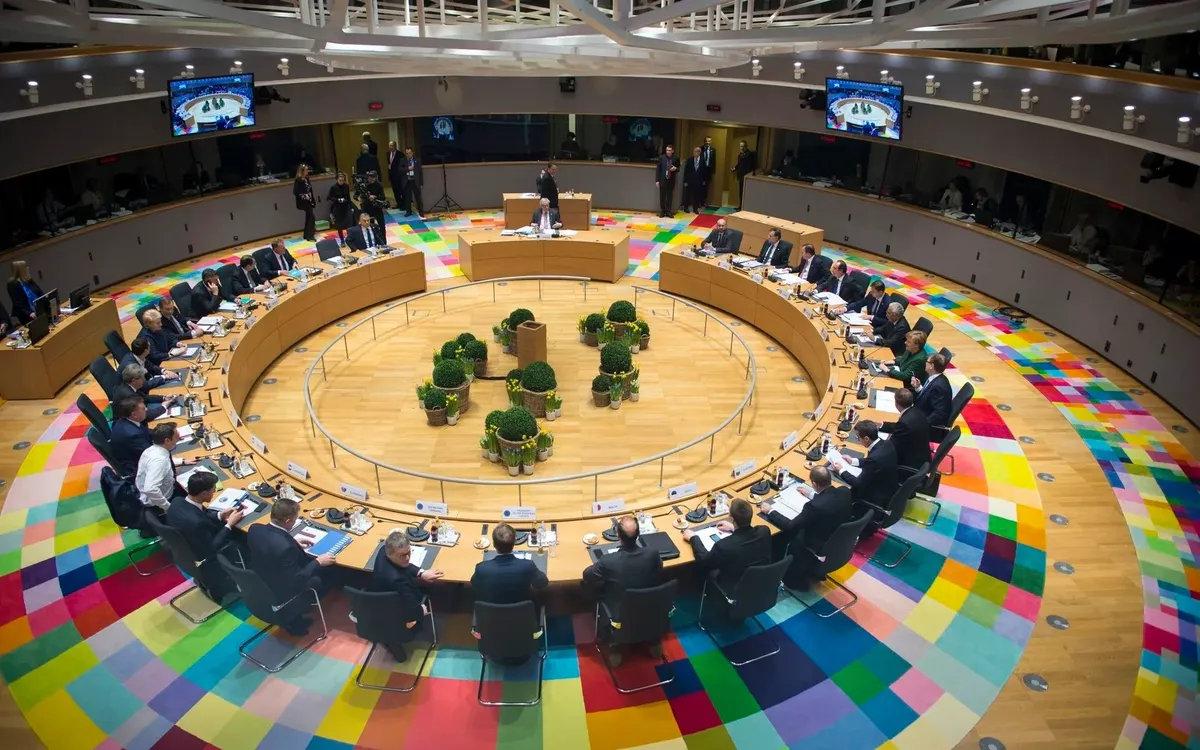
The current summit in Brussels was first held in the new palace of the European Council, the futuristic appearance of which emphasized that the European Union is seriously and for a long time, aimed at the future, and that it, of course, will overcome and already begin to overcome the most dangerous crises in its history. Journalists met the leaders of European countries in a giant, 11 floors high, an atrium in the form of a glass cube with an egg -shaped structure in the center. According to the authors of the project, he personifies the transparency of the EU and its openness to the outside world and globalization, and the egg -shaped “lamp” is the desire for the light of the future.
One of the central issues for the EU anniversary is the possibility of “Europe of different speeds”. This concept, which has been inhibited by the UK, as well as some new EU members, including Poland, becomes quite passing after Brexit.
Its essence is that some EU members who are ready for closer integration may advance along this path, without waiting for those who are not ready or do not want to yield part of their sovereignty in the relevant areas.
In fact, “Europe of different speeds” already exists. Not all EU members enter the eurozone with a single euro currency, not everyone enters the Schengen space of open borders. But everyone is obliged to fulfill the principles and rules of a single market, democratic principles and freedoms enshrined in the EU agreements.
Last Monday, the leaders of Germany, France, Italy and Spain gathered in Versailles, which confirmed the desire for “Europe of different speeds”.
“We must take the courage and give some countries the opportunity to move forward (along the path of European integration) faster than others,” said Angela Merkel at the end of that meeting. “This cooperation remains open to those who were delayed.”
Upon arrival at the Brussels summit, communicating with reporters on the sidelines of the European Council, other state leaders spoke out in favor of this idea.
Hollande spoke of “differentiated cooperation” or “differentiated integration”, about the possibility of “turning on increased speed” for those who wish and ready. He gave an example of the creation of an independent union prosecutor's office. Only 17 of the yet 28 countries are ready for this. He recalled that Paris has long advocated the deepening of the eurozone, the creation of its budget, tax and social harmonization consisting of several countries, the development of the EU’s own defense structures and the unification of funds in technical developments in the field of defense.
The theme of strengthening its own European “defense” also sounded in the speeches of other leaders, in particular the Prime Minister of Finland, Juh Sipil. And the head of the Belgian government Louis Michelle called “Europe of different speeds” by the unity of all EU members on the most important issues and the opportunity for those who wish to move forward faster with respect for various opinions in the EU. “This is the only way to the future growth on the digital agenda, transforming energy, security, and the exchange of disorders,” he emphasized.
But the concept of “Europe of different speeds” is still and even with growing distrust of the governments of a number of EU countries, especially new members from Central Europe. They are afraid to become second -grade partners in the Union, where the core of more advanced in the sense of integration and economically more developed countries dominates.
In order not to spoil the solemn moment of the celebration of the EU anniversary, the authors of the project of the Roman Declaration of the future of the Union did not include a mention of "Europe of different speeds", although the whole spirit of the document speaks of such a vector of movement.