
Translated material
Erdogan calls to impose sanctions against the Netherlands
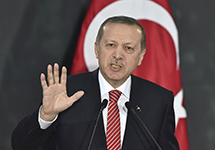
Turkish President Recep Tayyip Erdogan urged international organizations to impose sanctions against the Netherlands. It is reported by Reuters. Erdogan said that the Netherlands behave like a banana republic, and criticized European countries for the fact that they did not condemn the official Hague for the expulsion of Turkish ministers.
The leader of the opposition Republican People’s Party of Turkey Kemal Kylychdaroglu called on the government to suspend relations with the Netherlands. “This issue has nothing to do with a referendum. This is a national issue. The debt of any political party - regardless of whether it is right or left - to protect Turkey’s rights. We are ready to fulfill it,” Hürriyet Daily News quotes .
Meanwhile, the Foreign Minister of Turkey Mevlut Chavushoglu, speaking at a meeting with compatriots in the French city of Metz, following Erdogan accused the official Hague of fascism. "The Netherlands are called the center of democracy, but I would put such a definition in quotation marks, because in fact it is the center of fascism," the official said. He assured that Türkiye would continue to pressure the Netherlands until he receives an apology.
Meanwhile, the Dutch Prime Minister Mark Rutte said that he would do everything to reduce the confrontation, which he called the worst event from his country over many years. He called the idea of apology "strange." “This man (Erdogan. - Ed.) Yesterday I introduced us to the Nazis, and the country is Nazi. I intend to repay the conflict, but I will not bring apologies,” he explained.
On Sunday night, the Dutch police dispersed several hundred Turks living in the country, gathered at their consulate in Rotterdam. Protesters threw bottles and stones into law enforcement officers. Horse units, as well as police officers with dogs and water bodies, were involved in the acceleration.
On March 11, the Government of the Netherlands withdrawn permission to land the aircraft of Chavushoglu . It stated that the official of the official in Rotterdam is a public danger.
The Turkish authorities planned to hold a series of rallies with the participation of ministers in order to convince compatriots living in Europe to support changes in the Constitution in a referendum scheduled for April 16. However, the mayor of Rotterdam Ahmed Abutaleb banned a rally in connection with the difficulty of ensuring security and said that the country's authorities would not allow the head of the Turkish Foreign Ministry to participate in it.
After that, Chavushoglu threatened the Netherlands with the introduction of strict sanctions in case of ban on entry into the country. In The Hague, it was noticed that in such a situation, "achieving a reasonable solution is impossible."
Erdogan stated that the Netherlands authorities were “as cowardly”, and called the refusal to let in Cuplash “with relics of Nazism and fascism”.
The temporary attorney in the affairs of the Netherlands in Ankara Dana Housing was called to the Turkish Foreign Ministry in connection with the incident.
Later on Saturday, the police stopped in Rotterdam a car with the Turkish Minister for Family and Social Policy Fatma Bethul Sajan Kaya. She came from Germany and intended to get to the Turkish consulate, near which she was expected by several dozen compatriots.
On December 10, 2016, the party of justice and development in Turkey introduced a draft amendments to the current Constitution of the country, which expand the powers of the president . Erdogan declared the need for such a reform two years earlier, shortly after his election by the president. Supporters of changes in the constitution assure that this will simplify the country's management system. Turkish Prime Minister Binali Yyldyrym said that the proposed changes would save the country from attempts by the coup.
The amendments abolish the post of prime minister and expand the legislative and executive powers of the president. The head of state gets the opportunity to appoint and remove the ministers from the posts, as well as deprive the positions of members of the Supreme Court. In addition, the ban is excluded to combine the presidential post with the leadership of the political party. However, the Great National Assembly retains the right to initiate litigation against the head of state. To open the proceedings, the corresponding request must receive the support of more than half of the deputies.
On January 21 of this year, the Great National Assembly adopted amendments to the Constitution . However, the number of votes was not enough for them to enter into force without a referendum.