
Translated material
Secret eye of animation
As animators study their own injuries by means of art
Animation has long and very tightly working with the topic of the disease. I’m not talking about treatment, although it is clear that animation classes are often used for the rehabilitation and socialization of patients, especially children, even a special kind of animation therapy. I am talking about the art of animation, which has the opportunity to explain the disease to us, give the viewer to understand and feel the patient, to find out his thoughts, which, perhaps, in another, in no visual way, is difficult to formulate. And, of course, for those who own animation, this is one of the important ways to work out their own injuries by means of art.
The space of freedom
For a story about the disease, documentary animation techniques are often used, in particular, those for which special studies are done, direct interviews and drawings of patients are taken. And in this sense, animation dedicated to the disease can be called inclusive, since when creating a film, healthy collaborates with patients.
Body diseases are interested in animation a little less than diseases and mental characteristics, for the story of which the language of animation, which can open the subconscious to the audience, is especially suitable.
Speaking of bodily diseases, animators are trying to understand: what, for example, it feels not to see. In the Canadian film Private Eyes \ “Secret Eyes” (2011) Nicola Lemay \ Nicolas Lema talks about a blind boy who decided to find a gift for him before his birthday. The cinema is children, and the fact that the Matthew is introductory is no tragedy from this, on the contrary, it turns out that the boy has a lot of “secret eyes” that others do not have where people have arms, legs, ears, nose, and they “see” that others do not see. The director uses a black-and-white stereo-image, the frame is immersed in the darkness, objects are outlined only by an outline at the moment when the boy falls into the “field of view” of the boy. So we feel the space that Matthew learns with his secret eyes, and only his imagination paints objects in different colors. https://wwww.nfb.ca/film/private_eyes/
A cartoon with the complex name Orgesticulasmus (2008) Belgian Mathieu Labaye \ Mathie Labai tells about the director’s father, who was painted with a young age of scattered sclerosis, then chained to a wheelchair and early dead. In the film, we hear the voice of Benois Labaye, thinking about his own disability: “When you lose mobility, you must invent movement in your own way. And what is happening in my head is a way of reconstructing the internal space, it is also my freedom. Stunity opens up a whole bunch of new opportunities, in particular, internal freedom, internal space. A person is inexhaustible at the level of desires, energy, internal power. And you find it even with greater intensity when you are deprived of movement. ”
Through the animation, the director tried to express the very inner freedom that an immobilized person findsThe director begins a story with a photo chronicle of the life and illness of his father, and then as if he is building a table scanning the brain of a person who is in a wheelchair. In each cell - one, an endlessly repeating short movement: to wave the brush, go to the toilet, hang linen, climb into the bath. The characters making these simple movements, inaccessible to the disabled - young and old, men and women, look like residents in the rooms of a multi -storey building. And everyone’s bodies, like a puppet, pull the threads. We do not see who the puppeteer who pulls them, perhaps they obey the instructions of the brain, but in one of the cells-rooms the same movement-to get off the chair-take turns performing a girl, an old man, a fat man, a child, each in his own way, and suddenly a many-sided hero, tearing the threads, pops out from the tuture table and begins to dance everything with a large and large with frenzy, changing the face, body and gradually turning from a person into flying abstract forms. Paying tribute to the deceased father, the director through animation tried to express inner freedom that the immobilized person finds.
What I wanted to say about
Often the story of bodily disease is a way to say about something more important for the author. Like, for example, in the PEP MASK tape of a student at the University of Birmingham, William Marler \ William Marler. A hero who suffers from cystic fibrosis and forced to use a special stimulating breathing with a mask every day, chooses precisely this routine procedure, so angry it in childhood to say thank you and at the same time ask for forgiveness from parents. The artist draws a white line on black: here his hands are habitually groping for the tips for a mask in the table, colored spots run in front of the eyes from tense breath, the air breaks out of the streams of bright luminous lines, and the mother calls and reminds us that it is necessary to breathe. “Mom, I’m not seven years old - but it is very important ...” The words fly out of the tube and getting out like ropes, the hero screams in irritation, but, dropping the phone, he falls his head in his arms and mutters: “Sorry.” Mom calls back herself: "I love you."
The story of one’s own illness can be a metaphor for something else that, perhaps, the author does not want to talk directly about. A graduate of the Jerusalem Academy "Bitsalel" Joav Brill \ Yoav Brill shot the film "Ishihara" \ Ishihara, where he tells how in childhood he and his peers perceived that he is a color blind. The main formal solution was chosen by Ishihar tables (a test for detecting colortonism, looking like circles made up of many multi -colored circles). The film is visually schematical, as if we see the life of a children's community from above, in the form of a plan, and people look like the same circles of faded colors. A dalntonik boy, on behalf of which is a story, is thrown out of his circle, where he is not considered the same as others.
The formal move, which at first producing the impression of abstract animation, makes it possible to tell a nimble human history. It’s hard for a child to be not like everyone else. Having become older, he throws out all the colored things from his wardrobe so as not to make mistakes and not differ from others, wears faded and tries to play that he is invisible as a secret agent. In an interview, Joav says that he, like his brothers, Daltonik, so that he used common experience to write the script and interviewed other people who do not distinguish colors. But he was somewhat dramatized, because he wanted the underlying plot to be clear - the focus of color blindness to be a metaphor for the fodder and secrets of homosexuality.
Communication for salvation
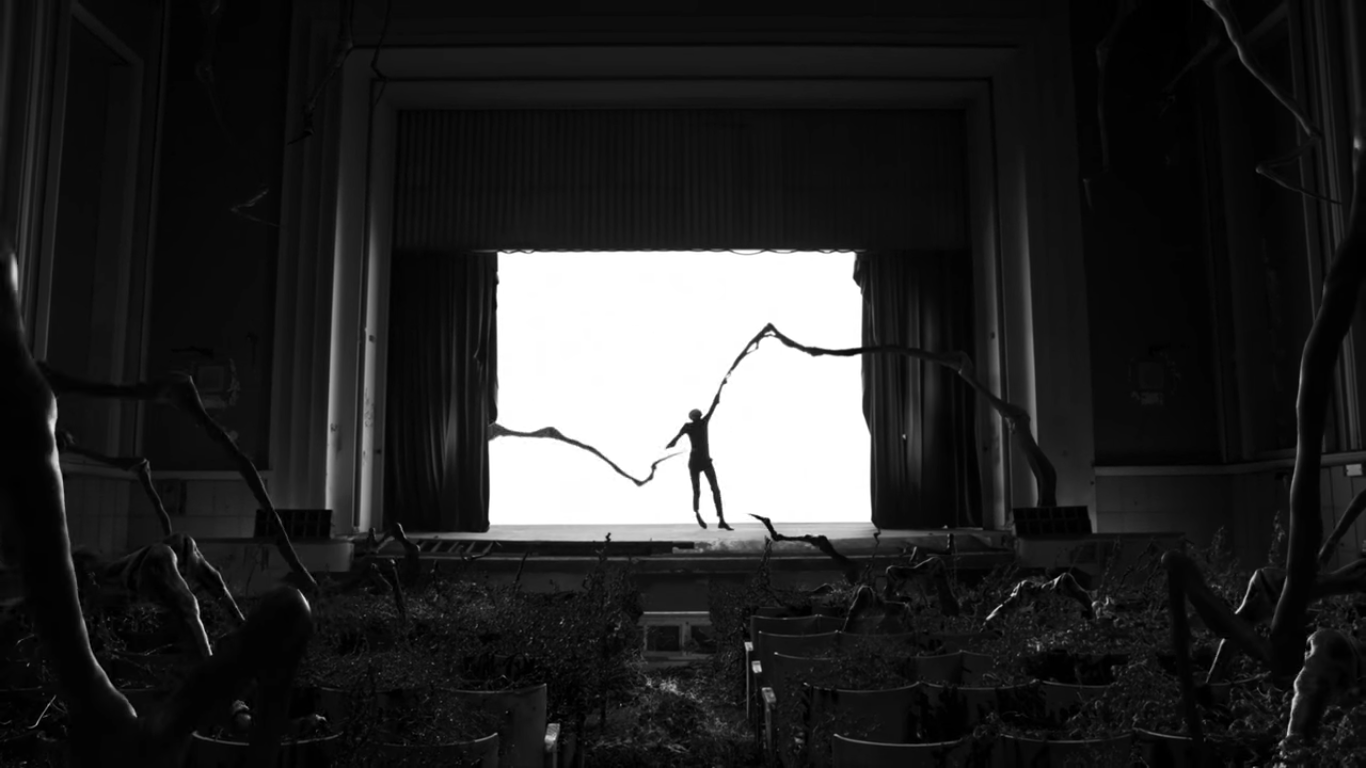
Among the "bodily" diseases there are two that are in animation, and indeed in art, are certainly metaphorical: cancer and AIDS. Cancer means death, this is still so, no matter what successes medicine does. The most popular image of cancer is a living and terrible creature (coming from ideas about metastases spreading through the body). Director Xavier Reyé \ Xavier Reye in the video of the performer Stroka \ Stromae for the song Quand C'est works with him? \ "When will this happen?" - He connects the actor with computer graphics. Here, cancer is similar to the branches of terrible living plants or the tentacles of monsters that grab a person and take his soul somewhere into the sky.
And AIDS, which at first was also associated with death, now, first of all, a sign of social dysfunction. AIDS is terrible where there is no drug, where poverty and ignorance. And recently, most of the cartoons about AIDS are based on real history of African diseases - audio days or specially recorded interviews. Like, for example, in the film of Samantha Moore \ Samantha Moore “Favorite” \ The Belved One, built in two interviews with women from Uganda, telling about the AIDS of the AIDS of loved ones - about the mother and the husband who refused to be treated.
I will still tell about two “oncological” plots, because they are very different from the general tone of paintings about cancer. The first is the film by the British Emma Calder \ Emma Calder-“Everyone is waiting for something to happen” \ EVERYONE IS WATINGACHING to HAPPEN. He is dedicated to her colleague, the English animator Richard Wright, who was discovered by intestinal cancer, and the film is built primarily on his texts from Facebook, where the hero, hiding anxiety behind irony, describes what is happening to him. The media side of the matter is very important - the picture is visually built in photographs of the hero from social networks - home photos and friendly parties, turned into funny animated collages, and the story itself is a collage from the hero’s posts on Facebook, blog fragments on the forum dedicated to the intestine, and interviews. That is, the sick hero is just arranged by the explosion of network communication, filled with jokes, endless stories of food and illness, which, apparently, help him to stay afloat. And, of course, through social networks, the director shows us a happy final: Richard writes on the blog that the results of the last check showed that he is clean from the illness, and before us, as if on Facebook, are scrolling around friends who demand to arrange a festive party in honor of this.
The second story, already with a tragic ending, is an even more unique and showing us strong example of an attempt to resist grief and despair. Ryan and Amy Green, who worked as developers of computer games, the little son Joel was dying of cancer. Parents decided to make a computer game dedicated to the boy’s illness, and they redirected their despair to this work. They managed to collect money on Kickstarter to launch this project, so a small indie game “This Dragon, Cancer” \ That Dragon, Cancer appeared. They called their project "The Journey of Hopes in the Shadows of Death." A fragment of the first episode, published in the media, was an attempt to recreate with the help of three -dimensional animation a terrible night that Ryan spent with Joel, not being able to help him. Thus, he created the situation rather close to the movie than to the game, since the player cannot affect its result, and he can only accept his fate as the Green family. So in the whole game - the player has few opportunities to influence its move, they are completely simple and cannot cancel the tragic ending. Three -dimensional animation is made very conditionally, in particular, people have practically no people here. But the creators gave the child Joel's funness, his love joyfully clap his hands in all good luck and other small details, having great value to parents. For the sound design of the couple, Green used real notes made at home when Joel was still alive - his three older children.
Four -year -old Joel died, scraping three years. The religiosity of the Green family greatly influenced this game, firmly entered her plot, and one of the critics believes that the theme of Job, the suffering of an innocent, is clearly heard in her. And, although faith and prayer helped parents cope all these years with grief, it is clear that catharsis was no less significant. Ryan and Amy canalize all their pain in the project about his son. Turning every step of their suffering into an element of the game, they did not remain in private with pain, creativity gave them the opportunity to share their pain with others. And this is what unites the history of Richard Wright and the Green family - they were looking for salvation in communication, which facilitated their fear and grief, and this became the material for animation. (You can download the game here - http://www.thatdragoncancer.com )
The material uses links to publications of social networks Instagram and Facebook, as well as their names are mentioned. These web resources belong to Meta Platforms Inc. - It is recognized in Russia as an extremist organization and is prohibited.
The material uses links to publications of social networks Instagram and Facebook, as well as their names are mentioned. These web resources belong to Meta Platforms Inc. - It is recognized in Russia as an extremist organization and is prohibited.
movie