
Translated material
Exacerbation in Kyiv: branches of Russian banks are scary, DPR and LPR in transport blockade, nationalists promise the new Maidan
Anxious questions about what is happening in Ukraine
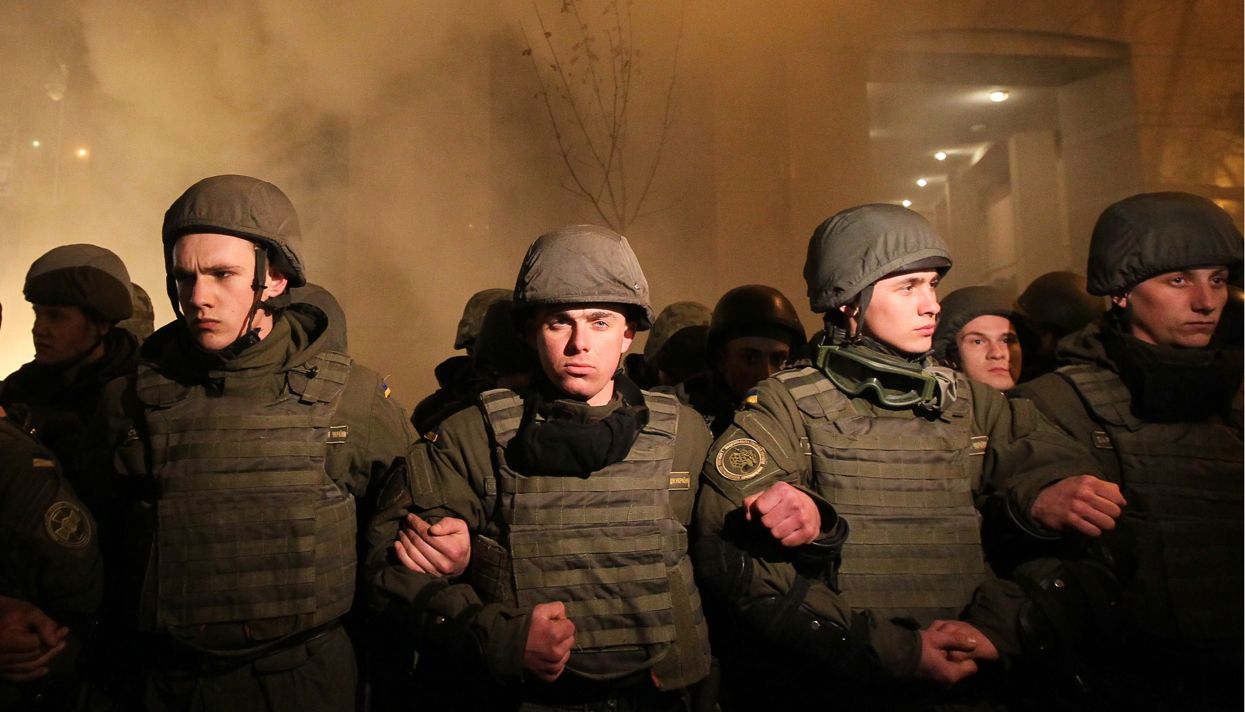
In the past few days, the domestic political situation has sharply aggravated in Ukraine, and this can lead to the next deterioration of Russian-Ukrainian relations. On Wednesday, March 15, the Council of National Security and Defense of Ukraine (NSDC) established a transport blockade of self -proclaimed DPR and LPR; In relation to Russian banks working in Ukraine, they promise to impose sanctions . Both decisions were preceded by shares of nationalists: paramilitarian detachments have been blocking roads since December 2016; Activists poured Sberbank ATMs with foam, and in the evening of March 14, they threw stones at Alfa-Bank's office. "Medusa" answers anxious questions about what is happening in Ukraine.
Who smashes branches of Russian banks in Kyiv?
Protests against branches of Russian banks in Ukraine have been taking place regularly since 2014, that is, from the beginning of the full-scale Russian-Ukrainian crisis. As a rule, companies experience attacks from radical nationalists, who believe that banks of the aggressor countries do not have the right to work in Ukraine.
On March 13, 2017, nationalists, including representatives of the National Corps right -radical party and the organization of Ukrainian nationalists (OUN; the organization was recognized as extremist and prohibited in Russia), blocked the entrance to the Main Department of Sberbank in the center of Kiev. Its windows were closed by partitions and built nearby a symbolic concrete wall. On the same day, several dozen Sberbank ATMs in the capital of Ukraine were filled with foam, disable them. “This bank cannot exist in Ukraine. Until he ceases to exist in Ukraine, we physically will not give this bank to work, ”said the head of the National Corps, the Verkhovna Rada deputy Andrei Biletsky.
On Tuesday, March 14, the same activists attacked the Alfa-Bank building: they defeated glasses in the office and shot down a sign from the building. Similar incidents were in other cities of the country; In particular, on March 8, in Odessa, the Alfa-Bank branch was doused with paint and sealed with leaflets “Gori in hell”.
How do banks react to this?
On March 14, Sberbank of Ukraine said that due to the blocking of the main office and spoiled ATMs, it was decided to lower the daily limit of cash issues at the box office to 30 thousand hryvnias (about 65.7 thousand rubles). A five percent commission for transferring funds in foreign currency has also been introduced. The press service called it a “forced decision”, which is dictated by security considerations. The pogroms have not yet been commented on Alfa-Bank.
Press Secretary of Russian President Vladimir Putin Dmitry Peskov said that Russian banks in Ukraine are "dangerous and inappropriate to work." Representatives of Sberbank previously stated that they were not yet ready to leave the country.
Do the Ukrainian authorities support activists?
Previously, the Ukrainian authorities did not respond to the actions of activists against branches of Russian banks. However, on March 15, at a meeting of the National Security and Defense Council of Ukraine, an order was given to the National Bank of Ukraine (NBU) and the country's security service (SBU) to draw up a list of banks with Russian capital, in respect of which sanctions can be imposed.
The reason for this was that the Russian Sberbank, Alfa-Bank, VTB and Unicredit-Bank agreed to accept customers with passports of the DPR and LPR (the decree on the recognition of documents of the self-proclaimed republics was signed in February 2017 by Vladimir Putin). Sberbank began to work the first with passports of unrecognized republics, while the Ukrainian branch of the bank said that they would not accept DPR/LPR documents.
What sanctions against banks will be and when they are introduced is unknown.
Will Russian banks in Ukraine still close?
Theoretically, there is such a probability: a regulator can withdraw a license from banks. The procedure will begin with the introduction of the temporary administration, then the Ukrainian fund of guaranteeing individuals (FGFL) will put up the bank for sale, and if buyers are not found, it will launch the liquidation process. According to this scheme, several local banks have already been closed in Ukraine.
But this scheme may not work with Sberbank, Ukrainian economist Andrei Blinov said in an interview with Medusa. In the case of the closure of Sberbank, individuals will have to reimburse the invested funds. If the FGF does not find a buyer for the bank, this duty will fall on the shoulders of the state, which can provoke a serious drop in the hryvnia. The National Bank, according to Blinov, is not ready to go for it. “Most likely, some tough on paper will be introduced, but absolutely meaningless sanctions against individual Russian banks,” the expert said.
And the transport blockade of the DPR and LPR is also installed. What is it?
The transport blockade of the territories of Donbass not controlled by Kiev was introduced on Wednesday March 15 from 13:00. This means that all roads and railway tracks in the direction of self -proclaimed republics should be blocked. An exception is promised to make for humanitarian goods, they note in the National Security and Defense Council.
It is not known how the distinction line will cross the distinction. The head of the Donetsk military-civil administration (this is a former Donetsk regional council, now he is located in the city of Kramatorsk, which is controlled by Kiev) Pavel Zhebrivsky on March 15 said that he was waiting for clarifications regarding the rules of entry for cars. Most likely, if they do not carry the goods in them, they will be able to freely pass. Cargo transport will be blocked.
The representative of Russia in the tripartite group to resolve the conflict Boris Gryzlov called the blockade “violation of the Minsk agreements”. In the Ukrainian parliament, the National Security and Defense Council was supported by the Popular Front party close to the government. In the “Opposition Bloc” (most of it, former members of the “Party of Regions”) of the blockade, on the contrary, were criticized ; The Blok statement says that the blockade violates the Constitution of Ukraine and will lead to an even greater rejection of uncontrolled territories.
Is the blockade really introduced under the pressure of activists?
Back in December 2016, civil activists, together with the deputy of the Rada and the former commander of the Donbass battalion, Semen Semenchenko, announced the beginning of the blockade of transport communication with the republics. So they protested against trade relations between Kyiv and separatists. A few weeks later, paramilitarian detachments blocked large railway and road highways.
Official Kyiv condemned the blockade and called on the participants to terminate the protest. On March 3, the protesters' headquarters said that the National Guard of Ukraine is planning a power overclocking of participants; And on Monday, March 13, the SBU detained 43 people in the area of the anti -terrorist operation zone. Nevertheless, by mid -March, Kyiv adjusted its position - and officially supported the blockade.
President of Ukraine Petro Poroshenko promised that the blockade would act until the DPR and the LPR are returned back to the jurisdiction of Ukraine of Ukrainian production (about 40 Ukrainian enterprises in the republics in early March were nationalized , which became the response of the separatists to the civil blockade).
On the streets in Kyiv is calm?
Coordinators of the civil blockade, deputies Semen Semenchenko and Yegor Sobolev (both of the “self -help”), as well as the non -partisan deputy Vladimir Parasyuk this week began to convene people to the “New Maidan”. On Tuesday, March 14, in the center of Kiev there was a rally of supporters of the blockade, in which about 500 people participated. Some of them previously smashed Alfa-Bank, others picked up the office of Ukrainian businessman Rinat Akhmetov-nationalists are sure that he finances separatists in Donetsk and Lugansk.
There were shares against the transport blockade - for example, in Mariupol (Donetsk region), employees of the budget sphere entered such a rally.
Juliana Skibitskaya, Kiev