
Translated material
Dungeons, dragons and CIA
What board games do American scouts study
At the South Bywest conference in Texas, several unusual board games showed journalists. Their creator is the senior analyst of the CIA David Klopper, and the games themselves are used to train employees. Klopper brought to the conference a game with a variety of mechanics: one is similar to a desktop “pandemia” with Dungeons & Dragons elements, another borrows gaming processes from the Magic: The Gathering card game. The CIA believes that the use of games allows employees to understand complex processes and mechanisms that they face in their work.
David Klopper has been working in the CIA for 16 years. He began to create games in 2008 on the instructions of one of the leaders of the department. According to him, with a proposal to develop new textbooks for employees, the head of his boss turned to him. Klopper, being a passionate gamer, decided that instead of the usual tables, seminars and flipcharts, he would try to develop game materials.
According to ARS Technica , whose correspondent visited the presentation of Klopper's games on SXSW, at the conference to journalists showed three games that are used for training in the CIA - and one is still under development. Visitors to the conference were divided into groups and offered to try their strength in all three games. AT journalist was allowed to photograph games, but not the CIA employees who represented them. According to Klopper, the games themselves are not secret information, nevertheless, photographing brochures with the rules was also prohibited.
The first game is called Collection and is a little like the German pandemic board game, in which players need to prevent the spread of four deadly diseases. Collection can play from three to seven people; Each player represents some kind of CIA specialist-for example, political analyst, military analyst, economics expert. The task of the players is to cope with three crises at different points of the globe (judging by the photographs of AT, crises can become tsunami in Indonesia, hunger in North Korea, Palestinian intifada, energy crisis in the Caspian, and so on). Each crisis has an intensity scale that gradually increases. If at least one of the crises gets out of control, the team loses.
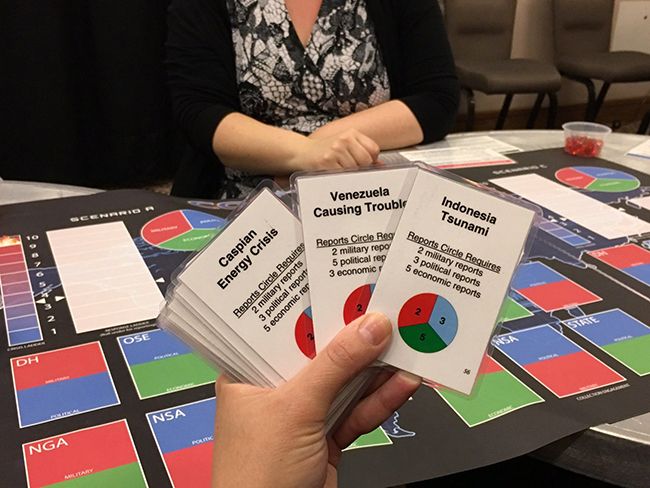
During the game, agents move around the world, establish ties with informants and collect intelligence. To resolve the crisis, it is necessary to collect a sufficient amount of data. The game uses mechanics from desktop RPGs (Dungeons & Dragons or D20): so, for the successful collection of intelligence, you need to throw a playing bone with ten (and not with six, as in a regular cube) by faces, and the final result of the throw is determined by bonuses and fines - the number of support for other departments, and so on. For victory, players must cooperate with each other: for the course, everyone can do two operations that are limited by its specialization. Attempts to solve the crisis alone almost always end in losing.
The second game is called Collection: Deck and resembles the card Magic: The Gathering (CNN, however, compares it with the card version of Pokemon). Here everyone plays for himself, solving certain problems with the help of playing cards lying on the table, while rivals can use various cards to interfere with each other. “For example, you have a satellite card,” explains David Klopper. - With its help, you can take a photo from space. But another player uses the “Satellite Communications” refusal card, and you can no longer use your companion. ”
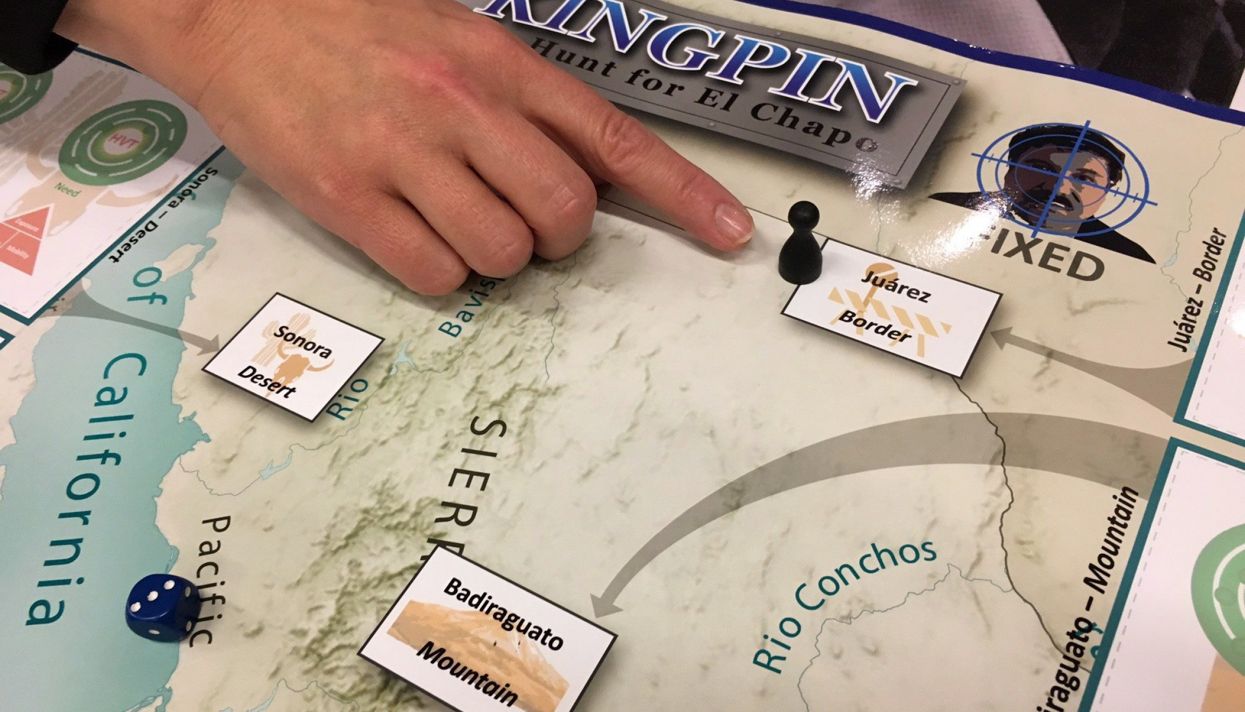
The third game on the SXSW - Kingpin: The Hunt for El Chapo (“Boss of the criminal world: Hunting El Chapo ”) - is devoted to the capture of criminals who are on the international wanted list. The main element in it is cooperation between law enforcement agencies around the world. One team plays for the "police", the second - for the criminal. The development is another game - “Gather a satellite”. In it, players need to distribute resources and budget together in order to build and maintain a satellite network in working condition. The difficulties that players may encounter are included in the constant changing requirements of the Ministry of Defense or the decision of the Congress to cut out the financing of the program by 10 percent.
According to CNN, so far the main source of inspiration for David Klopper and other people who develop games for the CIA are classic board games. In the future, as the representatives of the CIA digital innovation department, who also arrived at the SXSW, said the emphasis will be placed on games in virtual reality.
Konstantin Benyumov