
Translated material
Museum re -conservation
42 years of state glory
In the graduation class, our cute literature teacher in a white voice retold a resolution of the Organizing Bureau of the Central Committee of the All -Union Communist Party of Bolsheviks (b) “On the magazines“ Zvezda ”and“ Leningrad ”from 1946, where Anna Akhmatova was also exposed. She retold a textbook. So all the schoolchildren of the USSR at least briefly met this name. It was 1974. The resolution was quietly canceled in the fall of 1988, but in the bustle of the New Age, schoolchildren did not learn about this.
The biography of Anna Akhmatova, until the two thousandths of the two thousandths of the trial of the long-stored diaries, memoirs and notebooks seemed to be the mysterious code of proud suffering, impenetrable loneliness, inexhaustible existence, confrontation of the system. In addition to the oral text, approved by the poet himself and discretely reflected by various witnesses, there was no biography. The joke is known: Anna Andreevna lived in the ardov apartment window, where in the post -war period, a hurrying Lidia Korneevna Chukovskaya, which, was known, was seen, as you know, multi -volume notes. Anna Andreevna exclaims: “Quietly, L.K. It goes, it is necessary to put the plate. ” The canon of Russian literature was read with this “record” for a long time, the hierarchy of its defendants was approved, the opinion of A.A.A. About the “Doctor Zhivago” - “For what they fought ...” (she meant that Pasternak wrote a typical novel of the 19th century), objectionable were cast into the abyss (take at least Mikhail Kuzmin, the dark demon “Poem without a hero”, who set the rhythm and stanzine of this work). So what biography can demiurge or priestess have? A naive question.
And it so happened that it was genuine, without which the Enigmatics of Akhmatov texts, especially in later ones, could not be understood without a mythical canon composed of the poetess itself.
What biography can demiurge or priestess have?
In 1937, she pulled the text “On the granite of the steles looking into the abyss”:
... for the valley May
In my Moscow bloody
I will give stellar flocks
Radiance and glory.
But there were voices in my life, not taking into account and undermining this canon. Here Emma Gershtein, a close friend, biographer and interpreter A.A.A., believed that the text of the “Poem without a Hero” deteriorated from the option to the option (and there are about a dozen of them). And Lydia Ginzburg did not recognize late verses at all, considering them hemless and foggy. Sofia Polyakova left a piercing memoir about A.A.A., where he writes that she was not alien to low diction. As it turns out now from all sorts of memoir reservations, the performance of A.A.A. The world fame was exaggerated. Brodsky and the company of his friends in the late 1950s were surprised to learn that A.A.A. Alive and you can come to visit her. Ellanda Proffer reports that American philologists of the 1950s and 1960s barely heard her name. Elena Schwartz, who did not recognize the authorities and did not tolerate elaborations, arranged a scandal, refusing to give Akhmatova. And Viktor Krivulin confused one Finnish playwright with the story that it was he who advised A.A.A. To go to the public execution of prisoners of war in January 1946, although at that time only for the second year was able to. By the way, I saw this play personally. As evidenced by the speeches of all the other named.
This happens with museumified objects, as if frozen in anticipation of perky subversors, arsonists and thugs.
And it is not by chance that in 2007 the text of epoch-making unbridledness appeared, which overthrow Akhmatova not like a pedestal, but in general from all lists-I mean the “anti-Akhmatov” defectologist Tamara Kataeva. And what is curious, this text of the “final assessment”, together with the truly monstrous “stories about Anna Akhmatova” by Anatoly Naiman, “Akhmatov orphan” printed in the year of the century A.A., once outlined a magic circle like that he painted Homa Brutus, who had a sung of a panel, and now only Wiy can give strength to real unnecessarily converters. But either the gut is thin, or the real darkness did not come. This happens with museumified objects, as if frozen in anticipation of perky subversors, arsonists and thugs.
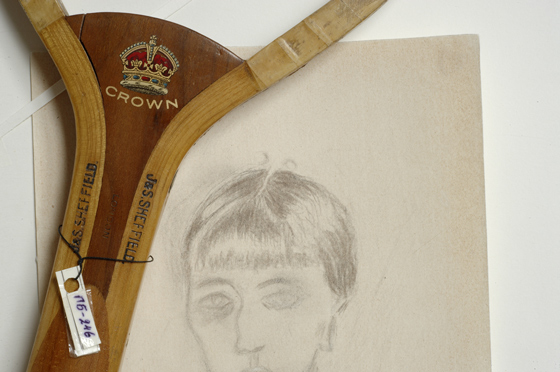
But we will try to find the truth of the human biography of A.A.A., peering into a series of a few personal objects, miraculously surviving in the chaos of the twentieth century. Let's start with Akhmatov self -portraits, sculptural and graphic. These are very expressive objects, since in them, dated by December 1926 (drawing) and 1927 (plasticine head), the visible canonization of their image is read.
 © Alexey Pakhomov
The immensely sad virgin, the young muse of crying, was reduced by the photographer Alexei Pakhomov with a tough essay, trotted with Sigma, tennis racket Nikolai Punin. The second “civil wife” in 1922 came to his house Akhmatov. The ups and downs of their then and future life can only be stolen with the help of Wikipedia. But the thing is different: Akhmatova, who portrayed the Virgin, is already 37 years old. This self -portrait was preserved by Pavel Luknitsky. Apparently, he was drawn for him, Akhmatova’s connection with him was documented and lasted in the 1930s. And this expressive “self -portrait” can be interpreted as the fruit of automatic writing, unconscious drawing of its own psycho -based essence, to distinguish it as preservation, museumification of its canon. She is forever painful and young, as expected. Sadness and sorrow do not let her go. She is beautiful in her sorrow, she is Undine, caught by Nikolai Punin, an empty racket, a metaphysical set. And now forever - a smooth hairstyle with a bang, hollow cheeks, a closed dress with a round collar. As if she portrayed herself the heroine of the book by Boris Eichenbaum, where she was named "either a nun or a harlot." Then this will repeat this in the report of Zhdanov, having established this dual title for schools and institutes forever.
But a racket as a silhouette of a female neck with a tight inventory medallion blocks the trance of a painful virgin, wrapping an impassable biographical conflict into a ringing tennis presentation, which is impossible to recapture.
Akhmatova becomes a lordician, a defender of the absolutist state of language and literature.
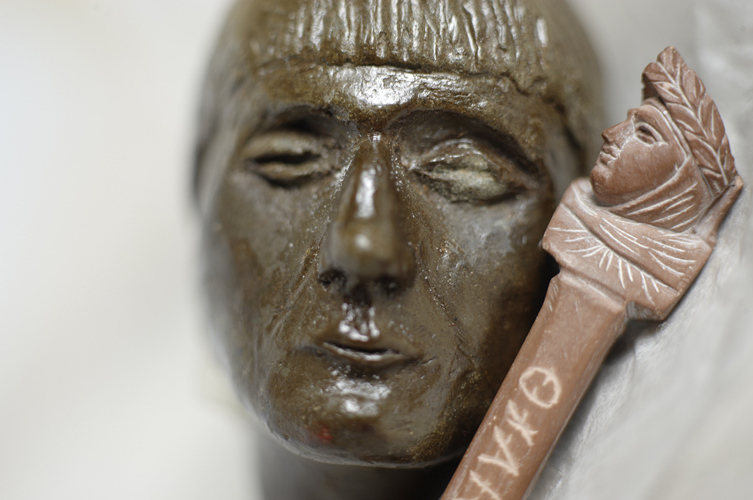
From the collection of Pavel Luknitsky, a plasticine head is also emerging, blocked to him as a gift. There is a diary record of this, he meticulously kept a diary, where he reflected in a lyrically detailed way and, in particular, his connection with A.A.A. But another item, captured in the photo in addition to a sculptural self -portrait, is a pencil with a top in the form of Dante's head, deployed in profile. This thing belonged to Nikolai Gumilev (almost the only surviving that he touched) and interprets the mournful image of A.A.A. otherwise. The pencil on the image of the image appears to be a bunch of phasium, the poet’s invisible head joined him. Only instead of an ax is deployed by the plane of the Eastern face of Dante. And Akhmatova becomes a linger, the defender of the absolutist state of language and literature. Lictor is endowed with the right to carry out executions.
It is in this magical subject that the symbol of immense power is read, neither vision (the eyes are half -closed) nor speech (lips are compressed). Since the word (literature) is ubiquitous and there are no boundaries and ends to it. A blind first-floor, Homer, in itself represents a metaphor for genuine poetic vision from under the dark surface of mystical conflicts and magical objects. Blindness and dumbness in culture have always been a designation of Catharsis, agony, which befell the entire arsenal of an affordable world. And only the poet can cope with her.
 © Alexey Pakhomov
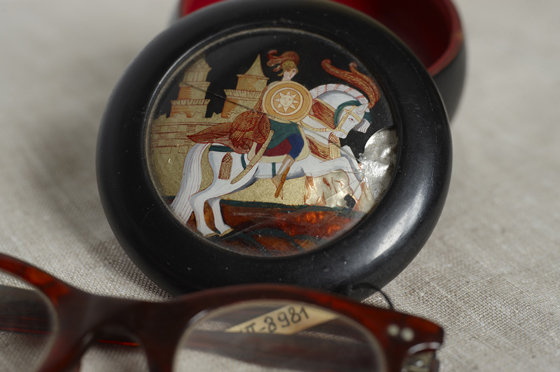
Excessively reduced in one image genuine objects belonging to two poets - Anna Akhmatova and Mikhail Kuzmin. These are simple reading glasses and a round box with a glass insert-doll, where the rider is depicted (George the victorious?). Kuzmin’s little thing is so expressive that, peering into it, you think: what artist painted her with such decisive elegance? It is unlikely that this is a item of artisanal fishing. A reared white horse is too impudently depicted, overcoming an equilibrium, depending in a convulsive arc, resting at the oval of a dark frame. As the Kuzminsky Dolnik resembles - trembling and accurate at the same time and endless, like a scroll of the ocher road along which the rider rushes.
 © Alexey Pakhomov
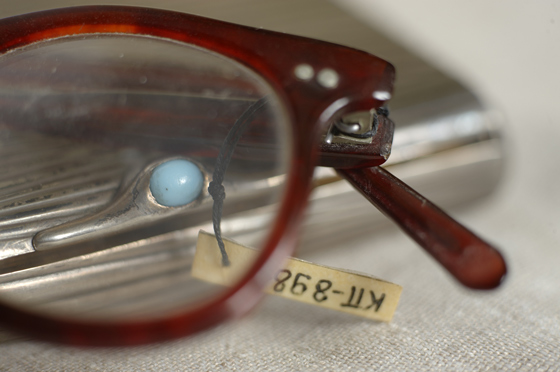
 And here is the blue eye, the turquoise pea of the cigarette case of Kuzmin, looks at us through the plus diopters of Akhmatova's glasses. Poetry, unlike literary biographies, reconcies and reunites everything, looks at us from empires. You can’t read it against this.
Mask, I know you
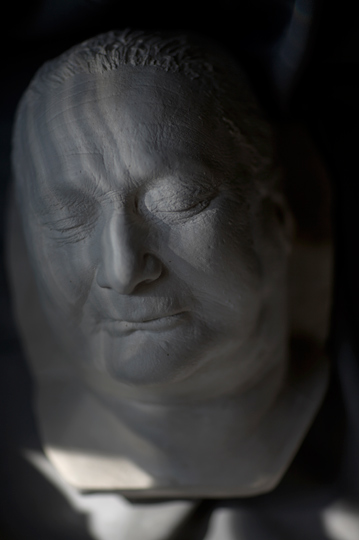
Posthumous masks that were shot from the deceased leaders of Russian culture do not exist for admiring. In museums, they are shown in conditional, farthest windows-nekropoli, it happens that flowers are laid to them, they are sigh and meditate next to them, they overshadow themselves with a sign of the Cross. The aesthetic zone where these objects are located is imbued with tense pathos and infinitely renewed sorrows. As a rule, sculptors who commit the mournful work of communication with the face of the deceased act according to a certain unwritten canon.
Blindness and dumbness in culture have always been a designation of Catharsis, agony that had already begun.
They try to give the mask the features of elevated and detached, not reminiscent of the destructive work of death. It turns out some speculation in sleep. Lermontov also expressed in the great poem “I go out on the road” the treasured and desired complex “Sleas-death”: posthumous masks are made according to this canon. They are tidied and tidy, cleaned of the mortal hour, aesthetically harmonized. The sculptor-former leads the last makeup, gives the posthumous portrait of the features of a historical character, who was alien to the properties of a petty person who is experiencing death-and we will not find on a chela of great traces of horror, exhaustion, languor and mother. Therefore, masks preserved in the cultural pantheon have no death traits. The viewer, who considers them, as a rule, turns to his own death complex, is looking for this mournful arrangement in himself. Outwardly, all masks are united by features of dignity, pride and unearthly rest.
 © Alexey Pakhomov
Mask A.A.A., photographed by the artist Alexei Pakhomov, is not just an aesthetic revision, but the search for phenomenal features that provide the character of the cultural pantheon “Transparent presence” in the modern continuum of the Russian language.
The mournfully closed lips, as if saying all the last words to descendants, serenely calm forehead of a person who fell into the paroxysm of self -deepening, interpreted in the deepest dream of the eyelids ... But with all his cultural conventionality, culturally prepared (sculptor), the mask is the only object that was reliably in the material contact with the articulation apparatus of the poet that has just removed. It was this circumstance that served as the basis for the work of Alexei Pakhomov. The artist seemed to ask the fantastic task of the posthumous visualization of the figure of the literary pantheon. It was as if he was trying to “get” her from the total non -percent zone, where she turned out to be not only because she died on a certain day, but also by the political will of everything past from the date of time. The artist seems to tease a constraining cocoon of cultural censorship.
This was already happening in Russia in the last century, when the pantheon of outstanding personalities, who did not, could not be by the symbols of the “overseeing literary norm”, underwent exquisite revision from the leaders of the actual literary scene. Whether it is the poets of the 1920s-1930s, or postmodernists and deconstructors of the 1980s-1990s. Neither those nor the others were busy searching for aesthetic contact with the inhabitants of the Pantheon, this, in fact, was included in the ideology of various projects of “destruction of idols”. The new auditers were busy humanizing the “sacred” biographies, they offered a variety of models of “return to the human bosom” of the drop -down idols. So it was with Tolstoy, Pushkin, Gogol, this happens with Akhmatova. Apocryphic jokes really returned these figures the lost carnal of human biographies.
The artist seems to tease a constraining cocoon of cultural censorship.
Alexei Pakhomov is also concerned about the problem of deconstruction of the dogma, but he solves it in a completely different ideologically and other aesthetic means. The mask, which the artist transforms with his vision, in this case is a certain lens (glacial lentil), who focusing in himself and himself a whole political complex of vectors, starting from the shameless aesthetics of the deceased and ending with erasing from its "posthumous portrait" of personality traits.
Alexei Pakhomov boldly sees his object from the world of a political photoshop, which has already carried out a “sweet work” on the hooking and emasculation of the idol.
At first glance, it seems that the linza mask itself seems to be inaccessible to any manipulations, since it independently emanates the sacred flows of its mortal meanings. This is a continuous stupefying grief that is beamed by inconsistency and becomes hopped (mourning is no longer sober). This is the magical presence of the most long -disappearing personality, erected to the degree of overseeing instance. Thus, the mask radiates and scans. It is turned into a cult symbol, has become a dangerous totem.
The artist, building his visual works based on genuine masks of Russian writers, had to deal with all this complex “cultural structure”. To build a new transparent lexical dogma, he needed to cancel the former. To do this, he chose a completely unique path - to correlate two streams, build a kind of visionary prism and achieve a natural (if this word in this context is appropriate) refractive rays into a pure spectrum of contemplation, devoid of political context. The artist depicts the deceased masks in the light, literally visible, he searches each time on the convex surfaces of the blinds of epi, which can interact with visible luminous flows.
So Fayum portraits were made.
As a result, Alexei Pakhomov achieves an amazing effect: the mask as a three -dimensional object is projected onto a certain surface of visible light, but not in a direct geometric way. It seems that he finds from many opportunities the only “bright” duplicate of the closed contour of the deceased. It seems to wrap the cast of this new complex, light -star surface. So, in essence, the Fayum portraits were made, which covered the faces of the dead, and the emotional current of painting was to spiritualize what turned into a Perest and already could neither radiate nor absorb. But since the mask itself already represents a complex lens, the intersection of two streams truly produces a prismatic effect.
Alexei Pakhomov in his dynamic search, destroying, at first glance, canon, has something related to graffiti. The self -resuming activity of stray city drawers has a tough psychophysical foundation - and this is what relates to Pakhomov. Graffitists are overwhelmed by mania to “fix again” motionless. They saturate with rhythms the indifferent walls of abandoned buildings, unfold like a scroll, a spectacle of a moving car, painting it with non -existent words, graphics of an abstruse alphabet lift her eyelids to the blind firewall. Another integral element of their practice is to circle an inextricable line that does not need strokes: a single liter or their meaningless connection, which does not claim to become a word.
I wrote about this widespread plastic call to note how Alexei Pakhomov (and an amateur graffitist too) fixes the most slippery, flowing and elusive of everything that is, - being itself. After all, it appears before us, as soon as we begin to think about him, obviously inexpressible, but sensual. It is woven from permeable layers. It is prone to rolling, rolling and complete disappearance forever.
Download the entire issue of the magazine "Disagreements" (No. 13) "Eternal Values": PDF , MOBI , EPUB