
Translated material
Notes of a madman
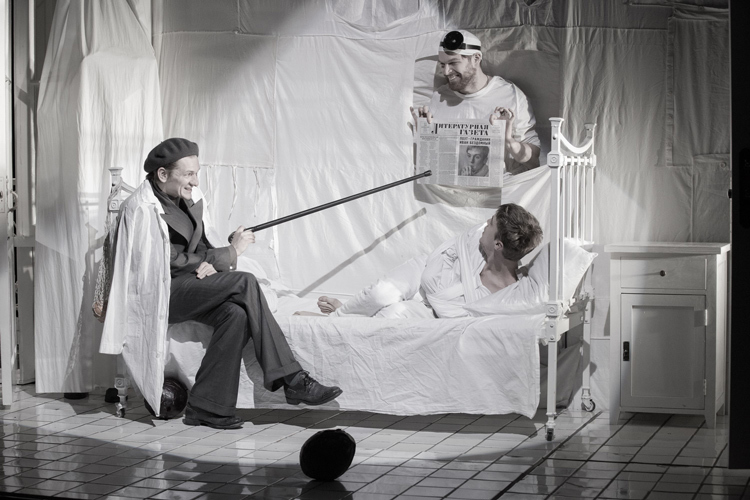
It seems that Bulgakov is still outdated - he took and dilapidated overnight. This thought occurred to me after watching a new performance by Sergei Zhenovach in the theater art studio.
Zhenovach is one of our most accurate interpreters of the classic text. Each of its classics performance is not just an attempt to find a theater equivalent of prose, but a love act, stage embodiment of intonation, the author’s breathing, his key thoughts. Bulgakov for our generation with Zhenovach is not just a sign - cult: in his youth, he saturated our brain, the system of our thoughts, divorced quotes, which became the language of “their circle”. His ideas seemed to form a worldview. Zhenovach turned to Bulgakov's prose as early as his youth, then put the White Guard at the Moscow Art Theater, and now the “Notes of the Dead” are in the styles - an interesting composition on the “Theatrical Roman”, “Notes of the Young Doctor” and other works of the writer.
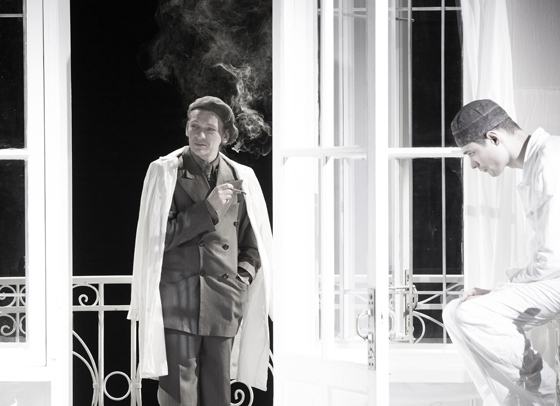
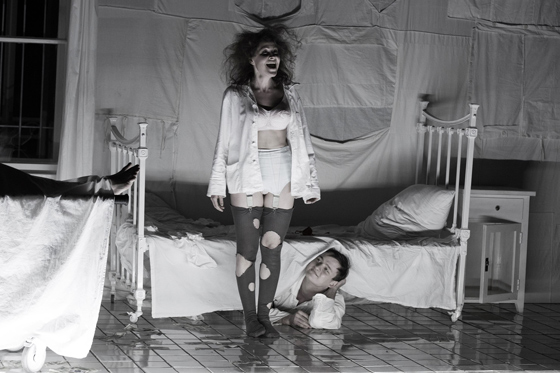
“Masters and Margarita” play about the same scenery as the “Notes of the Death”. The new production could be called “notes of a madman”: the action was transferred to a psychiatric hospital, for which the scenography of Alexander Borovsky was possessed in something like a nationwide shirt or medical dressing gown - the backdrop from the duvetes played this role perfectly. The same bed, table, balcony, only instead of green cloth - white cotton of hospital linen. And the same Ivan Yankovsky, who played Maksudova, now plays the homeless. This circumstance, of course, is not known to everyone in the hall - but for the theater it is important: it turns out the Bulgakov dilogy.
The very idea to transfer the action to the clinic, telling about the coming of Woland with the lips of the crazy people, or the mysterious foreigner, who suffered from a visit to Moscow, or imagined this strange incident, is quite understandable. The theater has to choose a through action from a multi -page novel, focus on one line, and one cannot but pay tribute to the skill of a staging - the history of the master, Ivan and Woland Zhenovach connected virtuoso. The novel, as it seems, was almost not affected by the seizure of many seemingly important scenes.
 © Studio of Theater Arts
In the center was the figure of Woland - this role was given to Alexei Vertkov, a beautiful and strange artist who knows how to naturally look unwell. Yes, and the role he played in the film “Chamber number six” in the film is involuntarily taken into account in the background, shading some madness of the character, a kind of equivalent of a green left eye. Vertkov is very organic in Woland's costume, his advantages-experience and age-help young artists to stay in a businesslike way: I can responsibly say that he is the best Woland of all I saw.
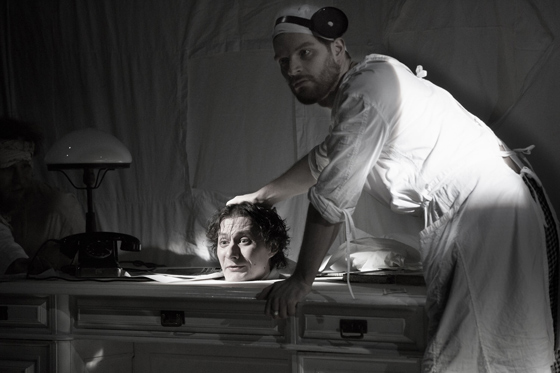
Yes, and there are no complaints about the retinue of this Woland: young and elongated guys frolic perfectly, especially Vyacheslav Yevlanteev, in the role of a cat Hippo with charm, reminiscent of young Oleg Tabakov. They at Zhenovach and the orderlies of the psychiatric hospital, and the servants of Satan, and the circus-hull; In general, they are responsible for drives and tricks. Speaking of tricks: the directorial decision to turn Voland's grandiose miracles into manual fraud and naive illusions look quite justified. The modern public sincerely rejoices these simple focuses - it is especially inspired by the appearance of the speaking head on the desk just a quarter of a second after the disappearance of the living Bengalsky. All this children's, almost cabbage jacket is very reviving the atmosphere.
The material resists.
And she needs revival. The performance, in my opinion, is difficult, there is no lightness, swiftness, usually arising when the theater finds the desired nerve.
Of course, almost everyone loves Sergey Zhenovach, and there is nothing to eat thoroughly and thoroughly (“masters”, for example, were waiting for the last season), he literally nurses the premieres, it is borns and a bit to the texts of the classics, so that the high quality of its performances is provided automatically.
But at the Master and Margarita, I did not feel the joy of Erdman tested in Stya and the recent miraculous “suicide”, and even at the “Battle of Life”, which was like not a performance, but by reading in roles, but for me it was an amazing hit in the author’s style, which was found for the dickens prose theatrical form. And the “notes of the deceased” were fascinated not by relevance - although the performance has enough coincidences with the mood of the current time - but the most stage flesh, the effect of the combination of the Bulgakovsky Kyiv past and theatrical present.
 © Studio of Theater Arts
From the very beginning of the performance, according to the “Master”, I was not left by the feeling that the textbook phrases, familiar even to those who did not read the novel, is impossible to hear more. The stories about the cut off the head of Berlioz and about the spilled sunflower oil seemed to be an old joke, told more than one thousand times. The darkness, which came from the Mediterranean Sea, and the bloody lift of Pilate’s cloak - at Zhenovach, presented with a stained blood robe of a crazy patient - they did not give a horror, but boredom.
What is the matter?
It is worth making a reservation: I do not know a single successful performance on the “Master and Margarita”, as I have not seen any successful adaptation. The works of Bulgakov are actually perfectly to be transferred to the screen and on the stage, have a happiest fate-but not stubbornly resisting the material of the “master”. The ridiculous and light text of the Moscow scenes is desperately resting, but sometimes it surrenders under the onslaught of the theater - this buffoonery at one time perfectly turned out to be a student Zakharov Sergey Aldonin on the stage of the Stanislavsky Theater. But the thoughtfulness of the history of Yeshua and the sentimental imagery of the master’s relationship with his lover were not more or less adequately embodied.
In this sense, special hopes were assigned to Zhenovach’s premiere - and it must be said that in the finale, where directing has conducted a particularly significant work with the text, reconciled almost again with the inclusion of phrases from the drafts of the novel, the performance acquires emotional energy under the curtain, becomes brighter, fresh, more interesting.
 © Studio of Theater Arts
The problem, in my opinion, is that the canonical text of Bulgakov is too aphoristic for the modern manner of natural stage existence. The replicas of his characters are suitable for a cabaret rather than for a realistic theater, and Zhenovach felt this perfectly by transferring an action to a crazy house - a place from the inhabitants of which it is difficult to demand the natural behavior. Thus, the director tried to create new circumstances for actors, to justify the distance that the time and development of art laws is erected between us today and the classic novel. So on the stage of the theatrical art studio with its habit, to psychologically justify any dialogue, almost pop negligence arises with courage - and in some cases this move works: roll -calling on the head, for example, in remarks of Pilate, Homeless, Georges of Bengalsky and the master creates a fundamentally new context for this motive. But the material resists, the farce is not linked to metaphysical thoughtfulness, which, about horror, begins to seem inflated, highly parked, irritating banality. Presented at the theater, Bulgakov’s novel does not look too deep, frankly stilt by a work, his charm disappears, and only not a completely clever composition remains.
I am quite aware that I am now encroaching on very serious values - the “master and Margarita” with Russian culture has a long -standing, strong, almost sacred love. But one thing is to reflect on the quality of the Bulgakov prose and quite another - about the possibility of successfully putting it on stage. Without going into the nuances of the poetics of the “master”, I dare to assume that the stage embodiment inevitably comes into those features that are basic for the writer: to overcome them a more decisive transformation of the novel is needed than transferring action to a mental hospital.