
Translated material
"I am an antipornograph and antige"
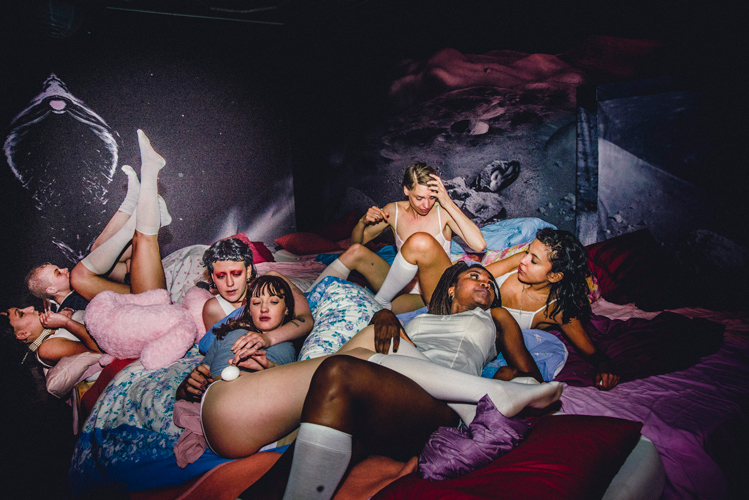
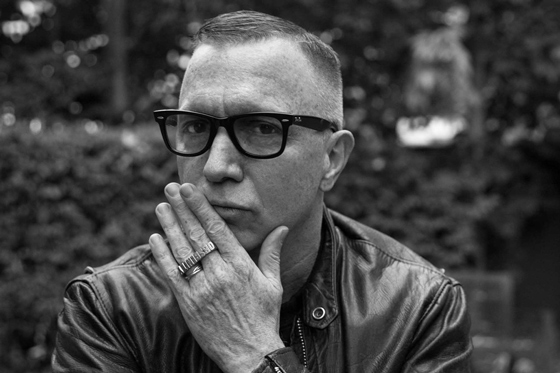
Bruce La Bruce is a radical director of the avant-garde, combining in his works the elements of porn (usually single or perverse), political satire and stylized trash (all this, by the way, did not prevent his film “Gerontophilia” once in the MMKF program). Lyudmila Pogodina met with La Bruce on Berlinal, where the premieres of his two new films took place: “Forum Expanded), Sci-Fi Fantasy about the disappearance of the brain of Ulrika Minhof and the resurrection of Michael Kunen, and“ Panorama ”(Panorama program). Secret Society of Lesbian Separatists planning the overthrow of the patriarchy.
- “The brain of Ulriki” is the sequel of the “raspberry Reich”?
- All this is “meta”, because the “brain of Ulrika” is a film inside the film “The Mushenstnitsa”, which vaguely resembles the sequel of the “Raspberry Reich”. The story with the brain of Ulrika Minhof is partially based on real events. After the opening of the bodies of RAF members who died in prison, the stamp, Minhof, the Rate, Enslin and Baader-their brains were seized for research, the purpose of which was to find out whether there was some innate, biological reason why these people became terrorists. Here, of course, a parallel with the experiments of Nazi Germany is visible. And after research at the University of Headelberg, the brains disappeared, and no one knows where to look for them. All this for me already sounded like the plot of a crazy film B : in the 60s there was such a movie “They saved Hitler’s brain”, in which the heroes retained Hitler’s head and rushed everywhere with her, and she, in turn, proclaimed a new Reich. In my film, Dr. Pfaifer finds the brain of Ulrika and communicates with it telepathically.
There was still an interesting story with the ashes of Michael Kunen, the leader of the neo-Nazis of the 80s, an open gay who died of AIDS in 1991. When his remains tried to bury his remains, no one agreed to bake them on his territory, and the urn and his ash walked in his hands for some time.
 © Saad Al-Hakkak Bruce la Bruce
-And how do you feel about the ideas of Ulrika Minhof?
-To begin with, in the 80s I was a punk. And punk is always against society and the reactionary culture of oppression. I am an anti-capitalist, my teacher at the university was a famous Marxist and feminist, gay critic Robin Wood. There is such a book “Children of Hitler” - the first book about the Red Army faction, which my friends and my friends handed over to each other from hand to hand. We then lived in a squat: something like an anarcho-syndicalist cell with a decentralized government. But I have never been a devoted activist, I was, rather, as Ulrika, an academician. True, he was disappointed in scientific circles when he ran into a number of Marxists who did not practice what they themselves preached. They lived the lives of the bourgeois and broadcast about radical policy. I defended my master's degree in the field of cinema, sociology and political science, but then I threw the idea to become a film critic and became a cinema. At the same time, I was obsessed with serial killers and terrorists.
- In what sense?
-serial murderers-geoi. I was interested in the reasons that encouraged them to behave like that. What is the basis of these actions - the origin, the attitude of society towards homosexuals in a historical context? Is this a response? The same concerned terrorists. They behave in this way in relation to a clearly corrupt society. They want to destroy it in order to build something new. Many people dream about this in today's America. There are enough people who wanted Trump to win so that what happened to happen in the end-they wanted to ruin the old system in order to replace something else. But I never went to marches, I was more interested in the possibility of expressing thoughts - unfortunately, I never got rid of the academic component. I do not call myself a revolutionary, I do not even call myself an activist, to be honest. I am exclusively an artist.
“But when you bring a movie to the cinema, do you feel that you are laying a bomb?”
- Yes! I give people a challenge. When Gudrun says in the Malin Reich: “I am not worried about all these wars that constantly flare up around the world, in Chechnya and Afghanistan; Everything that worries me is my orgasm ”is the philosophy of Wilhelm Raich. More and more often I hear about this recently not so much to sex as for love. People say: start with yourself, put things in order in your own home, to add a connection with your own body, with your own sexuality, and then this can change something at other levels. Reich believed in the liberation of energy capable of healing. To some extent, I believe in personal responsibility, in awareness and awareness. The 60s were completely devoted to the expansion of consciousness, and now people do not even use such terms.
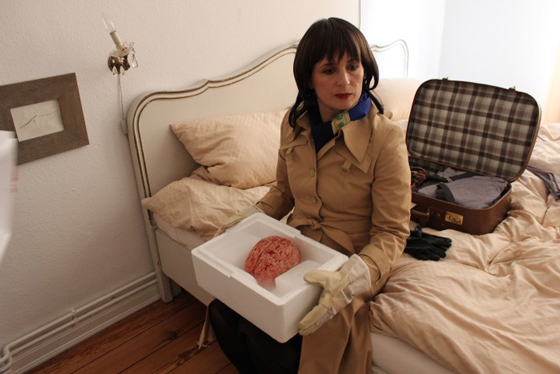 © Bruce Labruce Frame from the movie "Brain Ulrika"
- You are usually represented by a radical pornographer, but your films, strictly speaking, are not porn.
- Yes, it all depends on the meaning that you put into the word "porn." The most popular use is the synonym for everything that brings you great pleasure. So the terms "Food Porn" or "Fash Porn" appeared. In addition, it can be used in a derogatory sense, as, for example, in the case of the image of Donald Trump - it is quite pornographic, because it is rude and completely vulgar. Something extremely manipulative can be considered pornography, as in the case of Hollywood "happy ends": the illusion that good always defeats evil, myths that everyone should reunite with their nuclear family is also pornography.
I use the idea of pornography as a form, as a genre. At the same time, I am really antipornograph, like Antiga to a certain extent, because 90% pornography, especially mainstream pornography, I consider it uninteresting, like 90% of gays in the mainstream, I consider uninteresting bourgeois, assimilated in gay-patriarchy. I am fundamentally always on the side of outsiders, marginals, people who do not fit into existing categories, people who were oppressed because of their race, class or gender. It is now fashionable, almost popular, to be apolitical, even immoral, which fits very conveniently and easily in the dominant ideology. This state of affairs causes boredom.
-That is, a revolution with the help of pornography is possible, as believed in the 1970s?
- Pornography for me has always been wasted a wasted opportunity. If you think about it, then porn can be the perfect form of propaganda. This is what everyone is watching. What seems harmless is perceived as a given, in the era of the posttinernet it is really everywhere. But in fact, this is a rather powerful tool of influence: after all, everything related to frank sex always makes a strong impression. In addition, porn moves people into a state of openness for hints and sentences (laughs) . I never understood why no one uses such an instrument to suggest. And, of course, in the 60-70s, when the plot was present in pornography, it was much more interesting. The task of the pornographer was to interpret and contextualize sexual intercourse and an object of attraction and formulate this for the viewer with the help of stories, characters and scenarios, some of which, of course, turned into a frank cliche. True, in such films there were very few politics and direct action. It always seemed strange to me.
The character of Suzanne Sax in the Malin Reich says: "There will be no revolution without a sexual revolution, there will be no sexual revolution without a homosexual revolution." In the "Muzenovitniki" I go further and portray the world in which women-feminists and lesbians-saps are removed. Then they make people watch their film - almost like in a “clockwork orange”. You know that for heterosexual men, lesbian sex can be a fetish. But in my film, when the heroines showed their film to the audience, mostly women began to enjoy what they saw and stretch to each other. Here is my "Pornoutopia".
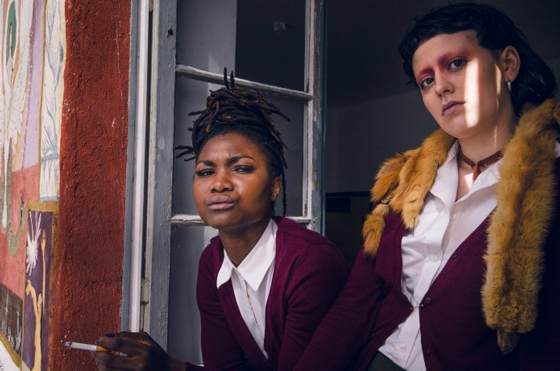 © Jürgen Brüning Filmproduktion Frame from the movie "Muzhenovitniki"
- But in this film you portray women prone to extremism, intolerance and violence - just as men see in radfem (and condemn them for it)!
“But if you really want to do hardcore-a revolutionary struggle, it is difficult to imagine without violence.” The characters of the “muddyans” say so: “In principle, we are against violence. But when violence is used in relation to us, we have no choice but to answer the counteratry. ” This is a quote from Ulrika Minhof. In preparation for the film, I mainly relied on the work of Simona de Bovoir “The Second Paul” and the book of Minhof “Everyone is talking about the weather, we are not”, which consists of articles written by her for Konkret magazine from 1960 to 1970. In them, she sets out her system of beliefs and says that a revolution is impossible without feminism. In my very first film “This doesn’t concern me”, the radical director-Lesbian who makes the film “ Girls of The SLA ” , listening to Angela Davis, an American activist, Marxist and feminists, who talks about the experience of black people in America then and now:“ If you accept the idea of non -violent protest, you accept the idea of suicide. ” That is, we are talking about perception in which the political struggle is regarded as military operations. They justify themselves with the rules of war, asymmetric war - since they sincerely believe that there was a war. The problem is that they live in a society that does not believe in the existence of this war: hence the losses among the civilian population. Thus, they find themselves in a situation of moral ambivalence. I am very interested in the moment when terrorists drive themselves into a corner and cross a certain line, after which they begin to betray their own leftist ideals.
- Why, in general, in your films the most politicized, revolutionary characters are women?
- This is personal. I have three sisters. My older sister is a genius, poet, she had a great influence on me. In the 80s, when I was a handle, I founded a fenzine called J. D. S , and my colleague-editor was Ji Bi Jones, who was seven years older and smarter. Despite the fact that she graduated from only the school of art, and I studied at the university, she taught me everything. I always had senior mentors.