
Translated material
Emperor and Barons: What is the exposure of Medvedev teaches us
Alexey Navalny and FBK are wrong. Usmanov’s contribution to “charity” is not a bribe. This is a tribute. The parallel state has its own budget, and Medvedev is at the very top of the pyramid. Do his income should be less, and palaces - more modest than those who are lower?
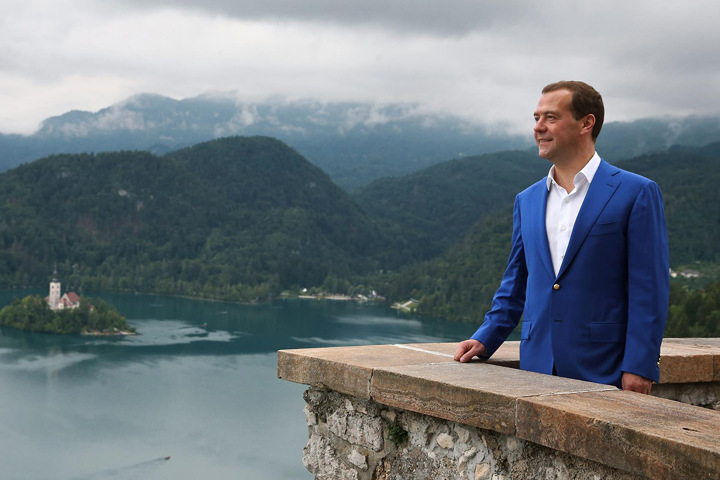
The head of the analytical taiga.info Alexei Mazur about the Medvedev case.
Taiga.info is now in Odnoklassniki . Join , our texts will become even closer
The scale of the empire
The film-investigation of the Corruption Fund with Alexei Navalny as the presenter has already collected 10 million views on YouTube, and another 2-3 million in Odnoklassniki. That is, it was watched by about one tenth of the Russian population, which should be captured by sociological surveys.
Judging by the absence of revelations and refutations - both from representatives of the authorities and a large ideological service service in the person of experts, political scientists, and so on, the film tells the truth. This is confirmed by resentment at Navalny by journalists - the film mentions many facts that were previously published in the media, in particular, in Novaya Gazeta. And links to these articles in the film - no. I must say that the FBK is not the media and is not obliged to follow journalistic ethics.
Publications in Novaya Gazeta and other media did not go beyond their traditional audience, which already belongs critically to the political system built in Russia. The FBK film turned out to be intelligible and showed the scale of the Medvedev Empire, which belongs to charitable funds, whose property is sometimes used by the Prime Minister.
It is the scale of the Medvedev Empire that is most amazing. As it turned out, many do not understand - why does he need so many palaces and estates? Why can not you get by with state residences? Some of my interlocutors believe that this is a question for a psychologist. In my opinion, the phenomenon has a purely political science explanation, and if there is a psychological component in it, then it concerns the psychology of Homo sapiens in general, and not Dmitry Medvedev personally.
So, let's move on to political science. I must warn that everything that is written below is only a theory, and the reader himself is allowed to decide how plausible it is.
Who is the people
Our society is divided into two unequal parts. One (smaller) is included in the political system of Russia. The system lives according to its rules and unwritten laws that do not coincide with the laws of the written. This tradition was inherited from the USSR, in which, according to the Constitution, the Soviets were all power, a-de factor of the authorities of the district committees, regional committees and the Central Committee of the CPSU, supplemented by power structures. In the form, all decisions were made “on the initiative from below” and met with a hot approval of the working masses, but in fact there was first the will of the party leadership, and only then “initiative” and “hot approval” were organized.
In exactly now, to everyone and everyone, it is clear that most of the bodies of the People’s Representation and the institutions of democracy in Russia are profanated and play the role of the screen. The device of the real political system cannot be understood by reading the Constitution.
As a result, we have an interesting situation. Most of the inhabitants of large cities in Russia live in a state of “modern society”, in which there is a free labor market, protected property rights (until it has reached a certain size), there is freedom of speech, the media act and sometimes even go through competitive elections. That is, if you squint your eyes and not ask unnecessary questions, it looks like a “normal” life. Almost everyone who writes and performs in the media and in social networks live in this strategic society, therefore it may seem that it has “all the people”. But this is not so.
The lives of people in small settlements and in a number of national republics (but not only) are arranged differently. There may be their kushchevs, “khanates” or simply collapse and devastation, the most secured layer in which are retirees. This part of the population is little reflected in political life - with the exception that it is it that gives most of the votes of the party in power.
And finally, participants in the real political system. It includes large officials, businessmen, public politicians in the form of deputies, mayors and governors, security officials and judges. And bandits.
Representatives of these professions have a different degree of involvement in the system. Entrepreneurs can afford “non -participation”, but for them the saying “if you are not engaged in politics, it will take care of you” has not an abstract, but quite concrete nature in the form of a risk of raiding and the need to either pay bribes or maintain a staff of lawyers. Small municipal deputies, as a rule, are also not subjects of the system. They “serve the number” in village councils, without affecting the distribution of a meager rural budget. All the rest, if they do not participate in the life of the “system” constantly, then at any moment they can be “called”.
The owners of life
How does our political system arrange? I believe that the best term that determines its character is neo -feudalism. The reasons for its appearance (corruption of elections - voting not by the real merits or misconduct of candidates, but by the resources they use) and I already described the main stages of development, I will not repeat myself.
Naturally, if part of the society exists in a closed (for the rest) system with its own rules of the game, it also forms its own norms of behavior. A great example of this is the “thieves” world. Or, a polar example is the world of the Russian nobility of the time of the Empire. Our elite “cracked” in the 90s on the principle of “who is cooler”, and the degree of steepness was determined, inter alia, with indicative consumption. Go through the Zaeltsovsky cemetery of Novosibirsk (there are such cemeteries in any Russian city)-and you will find the graves of the “authorities” of the 90s with large steles, on which the deceased are depicted against the background of chic cars.
For a modern person, ostentatious consumption looks like wildness, but we must admit that it was and remains an essential component of the definition of the “hierarchy” in our society. They told me a funny (and sad) story about how one middle -class representative was ragged and arranged his son in the “top ten” (the tenth gymnasium of Novosibirsk) with the idea that the offspring will introduce the elite and thereby secure the future. However, the guy quickly turned out to be an outcast in the class on property and in categorical form demanded from his parents so that they landed him over the quarter from the school - so that classmates inadvertently would not see which car he arrives on.
Wildness, but in the Russian Empire the ruling class suffered from the same ailment. The main article of imports were luxury items, thousands of peasants worked for a year so that the master could buy a crew that adheres to his status. The main reason for the ruin of large landowners was the construction of castles and mansions.
And Portos nearly killed d'Artagnan when he found out that his portup is rich only in front, but not from behind. Most of the cyclopic structures of antiquity were just the ostentatious consumption, demonstrating the greatness and wealth of the rulers.
If neo -feudalism lined up in the political system of Russia, why was it supposed to be free from such attributes of feudalism as ostentatious consumption? Shame in front of voters?
The Russians are used to the fact that those who are elected are much richer than those who choose, this has ceased to be a negative factor and became the norm
I think that a real researcher (to which the author, alas, does not belong) will easily find out that the average annual declared income of candidates who won the elections in the 90s, grew up from year to year, far off from the income of the average voter. The Russians are used to the fact that those who are elected are much richer than those who choose, this has ceased to be a negative factor and became the norm, if not even a positive quality of the candidate. “United Russia” is a party in which the super -fighting “represent the interests” of the poor.
Some of the system participants can afford ostentatious consumption without hiding it from anyone. Here is a quote from the 2007 article: “The market is filled in under construction superchants, and the Russians now rule the ball. For them, the most important thing is - who has the longest yacht, the highest mast and the best finish. In my experience, for the Russian oligarchs of the yacht - first of all, a status sign. Often, exquisite design interests them much more than what, in fact, the yacht is used for. ”
At least in terms of the system, ostentatious consumption is the norm. Most likely - this is not an exceptional part, and there is confirmation of this.
If until 2003 the oligarchs could consider themselves the “owners of the situation” in Russia, then the hierarchy then changed. The main ones were officials and security forces. And the problem arose. On the one hand, the increased status required more indicative consumption. On the other hand, there was a risk of revelations.
We see that officials, even the middle hand, have nothing to be gloomily acquired by suburban real estate of varying degrees of elite.
Significant steps were also taken to whitewash income. According to rumors, in the zero, the practice of surcharge was introduced “correct” deputies of the State Duma in envelopes. In general, then ideology appeared - let us (that is, the state) will pay a lot to key people so that our enemies cannot bake them. Later, the same ideology was widespread at NGOs. And earlier - on the media.
Gradually, these payments were legalized. You can trace the dynamics of the salaries of State Duma deputies. Only for the previous convocation, she almost doubled. The government also had additional, quite legal tools. Key officials were sent to the councils of directors of certain companies, and they received considerable payments due there. In addition, to solve the financial problems of a useful person, they could also make the head of the state corporation.
So the huge salaries of the heads of state corporations, most likely, is another evidence of this phenomenon.
126493 Putin's electorate - not yet people
Other “useful people”, who for some reason could not leave the civil service, in the state corporations in the top management were close relatives. For example, children. Therefore, when asked where the mansion or yacht came from, it was always possible to answer - and this is a son, he earns well with me.
A similar practice was not under Putin. Back in the 90s, my father, who worked at the Academy of Sciences, noted that in recent times, the ratio of salaries between managers and ordinary employees had significantly changed. We know that the legal income of university rector is millions of rubles a year. And this is not due to the success or failure of the university.
One of the principles of the system - all key people should receive more than they deserve. This will make them be active supporters of the system or at least "keep quiet in a rag." With mass passivity of the population, the method was very effective. The reform of science is confirmation of this-the wounds in its former form, de facto was eliminated, but the academics received a lifelong synecuru.
There are many steps in the neo -feudal hierarchy, and the ratio of income between each should be approximately the same. Dmitry Medvedev is located at the very top of the pyramid. What do you want his income to be lower, and palaces are more modest than those who are below? And there, I remind you, both the oligarchs and the heads of the state corporations.
Here Alexey Navalny and FBK are wrong. Usmanov’s contribution to the charity fund is not a bribe. This is a tribute. A parallel neo -feudal state has its own budget. And this also did not begin at Putin. Let's recall a photocopy box full of cash dollars, which was detained at the exit of Yeltsin’s headquarters in 1996.
At that time, the system solved its problems in competitive elections against the backdrop of the growing discontent of the population. The tribute, in particular, was formed in the form of donations to the election campaign. And the oligarchs were attributed to parties and candidates to finance them. According to some reports, later the system was modernized - the money was handed over to the responsible for the elections, and they were already issued to parties and candidates.
In this system, calculations in large cash are the norm. Everyone is doing that. Therefore, caution is dulled
That is, the system has a parallel budget to solve specific problems. What is its size and how large the spectrum of the tasks solved is - we do not know. But the voluntary donations of the oligarchs and state corporations, apparently, are not the only source of replenishment of this budget. In the nineties and zero there were stubborn rumors about the cost of certain posts - both receipt and preservation.
This is partly confirmed by the criminal cases of Oboronservice, Magnitsky's cases. The amazing softness of the sentence in one case, the “closing of the eye” to the withdrawal of gigantic amounts through tax returns is possible that from the point of view of the state it was not about theft, but about transferring from one budget to another.
In other cases, we see a strange, which is not succumbing to the logical explanation of the behavior of the defendants in criminal cases caught in the receipt or storage of large amounts of money. How to explain the strange behavior of Nikita Belykh or Alexei Ulyukaev? Their statements about their honesty look strange in the absence of clear explanations. How did it happen?
The version suggests itself: in this system, calculations in large cash amounts are the norm. Everyone is doing that. Therefore, caution is dulled, and therefore sincere confidence in its decency. After all, in their system of "morality" - everything is fine.
Or former Governor of Sakhalin Alexander Khoroshavin - note that most of his property was in the form of cash currency (in the amount of 700 million rubles). The question begs-is it his savings or the amount prepared to transfer to someone? We will not recognize the truth.
If a group of people can unlimitedly reward each other for real or imaginary merits, it is unlikely that she will voluntarily refuse to constant an increase in this reward. Neither the Russian nobility, nor Roman patricians, nor church hierarchs (both the western and eastern church) could resist the temptation to surround themselves with luxury and splendor, as soon as such an opportunity introduced themselves.
So this is not at all about the psychology of Dmitry Medvedev personally. The problem is deeper.
Protestant revolution
Consider another aspect - can a participant in the system abandon ostentatious consumption, be defiantly modest? Perhaps maybe. But this carries additional risks. The rest can begin to perceive it as a threat - "he wants to surrender us all." And bam - career did not set, you were sent to the periphery.
The Protestant revolution was a restriction of the rash of ostentatious consumption. The Dutch word "hez" is translated as a "beggar", the Dutch nobility has become defiantly modest in clothes and jewelry - in the peak of a luxurious Spanish aristocracy. In other countries, this role was played by social revolutions or their threat, as well as the growing pressure of public opinion.
Similar pressure has now begun to experience the inappropriation of Russia. The crisis gives rise to a request for justice.
Alexey Mazur
Taiga.info is now in Odnoklassniki . Join , our texts will become even closer