
Translated material
Lisbon to the disaster
In the Lisbon National Museum of Old Art (Museu Nacional de Arte Antiga) is the exhibition "Global City: Lisbon of the Renaissance". The central subject of the exposition was a picture, which depicts one of the streets of the Portuguese capital to the catastrophic earthquake of 1755, when the city was almost completely destroyed. Previously, only images of the general plans of the city were known, but not its specific streets.
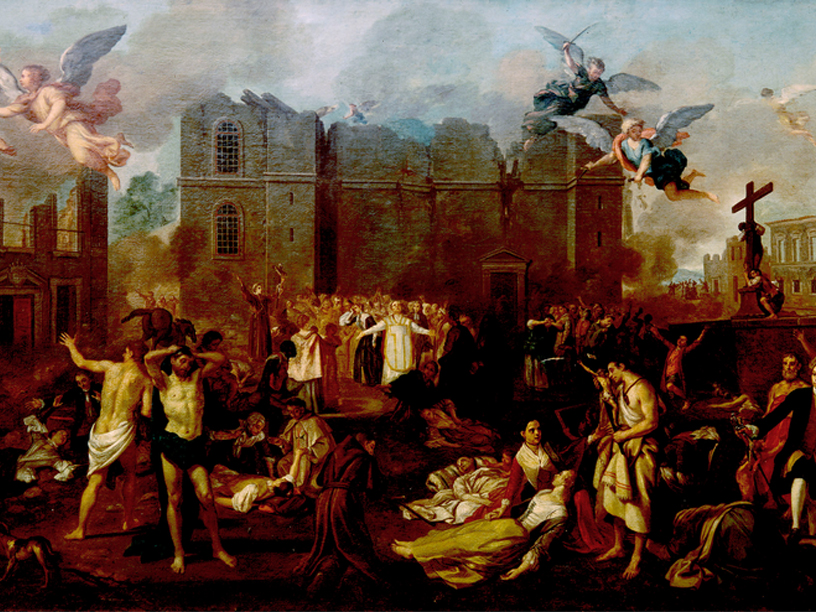
The Lisbon earthquake occurred on the morning of November 1, 1755, when the Catholics celebrated an important holiday - the day of all saints, and pious parishioners gathered at worship. The first impetus occurred at about 9 hours 40 minutes. The earthquake, according to eyewitnesses, lasted no more than six minutes, but during this time it brought significant destruction. The churches, as the highest and, therefore, the most vulnerable buildings, collapsed all, destroying the prayers. Subsequent tremors at ten o’clock and at noon completed the destruction.
Immediately after the earthquake, the city was covered by fires, which began simultaneously in many places. It is believed that they were the cause of the candles in the destroyed temples and chapels. Three waves of the tsunami hit Lisbon one after another. Residents were not able to put out fires, and the city was burning for five days.
Lisbon earthquake in the engraving of that time
When the fire finally went out, 85 % of Lisbon buildings were destroyed. Modern geologists evaluate the magnitude of the Lisbon earthquake of 1755 in 8.7. The number of victims, according to scientists, could reach up to 100 thousand people. The news of the Lisbon tragedy, which has been around Europe, intensified the debate of philosophers about why God allows such terrible disasters. This question was asked, for example, Voltaire in a poem to destroy Lisbon and the philosophical story “Candide, or Optimism”.
Come, take a look at this devastated city,
On this unfortunate dust of the fathers, and wives and children;
Take a look at these destroyed walls,
Under which their members are crushed, -
Here, thousands of the land of the unfortunate devoured;
They tremble there in the blood scattered bodies,
Their houses are beautiful to do them, coffins,
And, tormented, they end in life in the middle of the earth's womb.
Their languid hearing a cry in the underground country there,
The jacket is in vain, will you tell me
What was so that this city was unhappy,
And do the creator who is good and powerful need?
From the “Poem to the destruction of Lisbon” by Voltaire (1756) in the Russian translation of Hippolytus Bogdanovich (1763)
The recovery of the city was led by Portugal Prime Minister Sebastian Jose Dee Carvalo-i-Melu Marquise di Plast, who went down in history with the phrase: "Bury the dead and heal the living." The burial of the dead really became one of the priority tasks, since otherwise the city would be threatened by the epidemic. Therefore, contrary to the customs of the Catholic Church, many bodies were immersed on barges and flooded in the ocean behind the mouth of the Tezh River. Cases of looting were severely suppressed. Pragbal ordered to supply the population with food from military warehouses and to defeat tent camps for the remaining residents. Residents and the army began recovery work. The family of King Jose I with courtiers and the government lived in a special tent camp, because the king’s palace was also destroyed. However, the king after the earthquake did not feel much desire to live in a stone house and the new palace in Lisbon began to be built only after his death.
Lisbon ruins
Manuel da Maya, the chief engineer of the kingdom, proposed several options for restoring the capital (in one of them it was proposed to build a new city in another place at all). As a result, they chose a plan that provided for the complete demolition of the lower city (Baixa) and its radically new development, and in the remaining quarters the old streets were restored. The rebuilt lower city began to be called Baixa Pombalina. For the first time, anti -seismic architectural elements were used in it - wooden frames around the houses and individual structures, nicknamed “Mombalevsky cells” (Gaiola pombalina). They even conducted experimental tests of the stability of new houses, constructing small wooden models and forcing the troops to march to simulate the earthquake. The characteristic architectural style of new buildings, characterized by the abundant use of decorative tiles, has become known as tombalino.
Model "Pombalevsky Cell"
The rebuilt city in 1760
The medieval buildings of the old Lisbon were irrevocably lost. On the images of the city that have reached us until 1755, he, as a rule, was painted from afar and given only the most general appearance with the inclusion of individual basic landmarks.
View of Lisbon to an earthquake on an engraving of 1598
Only recently, the researchers found that the picture of an unknown artist stored in England depicts one of the central streets of Old Lisbon - Rua Nova Dos Mercadores.
The history of this picture has been traced since April 3, 1866, when it was acquired in a small antique store by the famous English Presrafaite Dante Gabriel Rossetti. He wrote about his purchase to the watercolist George Price Boyce: “A large landscape with about 120 figures of the Velazquez school, but not the greatest V.”. A few months later, in a letter to his other colleague, Edward Burn-Jones Rossetti was more optimistic in assessing the acquired picture, calling it "undoubted and amazing Velazquez." Rossetti was a passionate collector of the works of old masters, but then he was mistaken. Now art historians are sure that this is not Velazquez and not his school, but the work of an unknown master of Flemish origin. But Rossetti guessed at least the Iberian Peninsula, where the picture was painted. It was created in about 1570 - 1619.
Rossetti took this picture with him by moving from London to Kelmskott-Manor-the estate of his friend poet and artist William Morris. Rossetti lived there twice, a couple of months in 1871 and from September 24, 1872 to July 11, 1874, when he was forced to leave the estate due to a quarrel with Morris. The picture, for reasons unknown to us, remained in Clement-Manor.
More precisely, there were already two paintings. Rossetti enjoys unkind fame among art historians because of the usual “correct” pictures of old masters who fell into his hands. In particular, he was accused for a long time of making changes to the “Portrait of Esmeralda Brandini” by Botticelli, making the red -handed woman red. Only in 2015 it turned out that she was originally reddish, and Rossetti only very delicately detached the small damaged sections of the portrait. But in the case of this landscape, Rossetti seems to be not able to justify himself: he simply cut the picture in half. Each of its parts was inserted into a separate frame and hung on the Kelmskott-Manor wall.
"View of Lisbon", the first part
"View of Lisbon", the second part
Now the Kelmskott-Menor estate belongs to the London Society of Antiques and is functioning as a museum. Both half of the Lisbon landscape are also stored in his collection. Identified as part of the Rossetti collection, they were in 2015 by historian Julia Dudkiewicz, which published an article in The British Art Journal. She found the will of May Morris, the daughter of William Morris, where a list of 220 art objects was attached with a projection. About “Two paintings with city scenes” it was said there that they were coming from the Rossetti collection.
To establish that Lisbon is depicted in the paintings, scientists were able to earlier, in 2009. This was done by historians Anna-Maria Yordan Jordan GSCHWEND from the New Lisbon University and Kate Lowe from the University of Queen Maria. The first clue for them was a large number of black people depicted in the picture. In Europe, the 16th century could only be found in Lisbon and in a pair of Spanish ports. For more than a century, Portugal has dominated the slave trade, and thousands of blacks got into Lisbon. By 1551, the city totaled about 100,000 people, of which the blacks were up to 10 %, in 1578 the population of the city reached a quarter of a million, and the Negro Rabes already had about 20 % of its inhabitants.
African slaves on the streets of the city
Architectural details, such as tall and narrow houses, roofs, covered gallery with many marble columns and a metal fence forced scientists to choose Lisbon. The depicted street scenes led scientists to the conclusion that the picture has a large trading street Rua Nova Dos Mercadores, well known from written sources. Now in its place there is a plot of Rua de Comércio Street between Rua Dorto and Rua Dos Fanqueiros.
According to the notes of 1552, there were more than ninety houses on this street, on the first floors of which there were numerous stores. Among them were 20 fabrics stores, 11 bookstores, six pharmacies, and six stores traded porcelain, which was delivered from distant China.
The metal fence covering part of the street is noteworthy. You may notice that behind it are only people dressed in black. These are aristocrats, rich merchants, bankers who could walk around, go to shops and conclude transactions without pushing among other people. Commoners, servants, slaves, peddles, street traders, peasants, homeless children and all others are on the other side of the fence.
The picture even has evidence of an already open New World. In the lower left corner of the second (left) half of the picture, we see a dog that dragged the bird. Looking, you can find out the turkey that the Spaniards and Portuguese have already managed to bring from America to Europe.
The dog stole a turkey
An exhibition at the National Museum of Old Art in Lisbon, where you can see the picture, will work until April 9th.