
Translated material
Time after freedom
The weekend for a tourist in Riga is not only cathedrals, streets with gingerbread houses and a national library, popularly nicknamed the “crystal mountain”. Considering the sights, you will most likely fall on something that is related to the Soviet past-even if the Barricade Museum itself, which is hidden on the second floor of an inconspicuous residential building, but certainly it will be flyers of the Museum of the occupation of Latvia. They lie everywhere-in galleries, cinema halls, even restaurants of the Lido network, the local analogue of Mu-Mu, only with a much more appetizing menu.
As in many former Union republics, the exit from the USSR is positioned in the official rhetoric of Latvia as national liberation. At the same time, Latvians are shown for the most part as a victim of the regime (or regimes - Soviet and nationalist), which is not far from the truth, although we can recall the famous Latvian shooters or participants of the Latvian SS division. In fairness, it must be said that both are mentioned in the expositions.
I do not want to go now in the discussion about the Latvian history of the 20th century as such. I propose to pay attention to something else: how the historical process is presented in museums dedicated to the Soviet past.
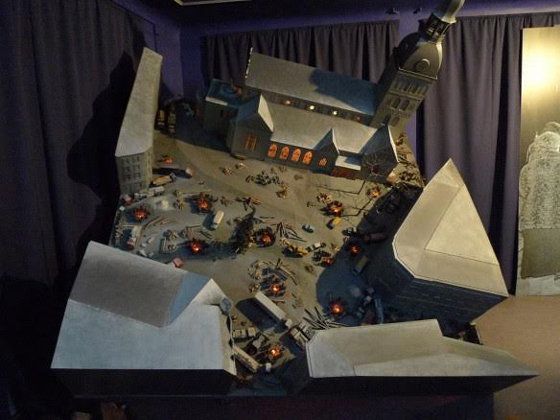 Matcage in the 1991 barricades Museum
Three museums about "Soviet"
In Riga there are three central museums dedicated to the Soviet past - or, rather, overcoming it. This is the Museum of the occupation of Latvia, the 1991 Barricades Museum of the KGB, or the Corner House, as the inhabitants of the city called it. The KGB Museum is actually a division of the museum of the occupation, and the barricade museum is its logical continuation, so that they can be called two “hypostases” of the center, which in Soviet times was the Museum of Latvian Red Riflers. This holy Trinity will be discussed.
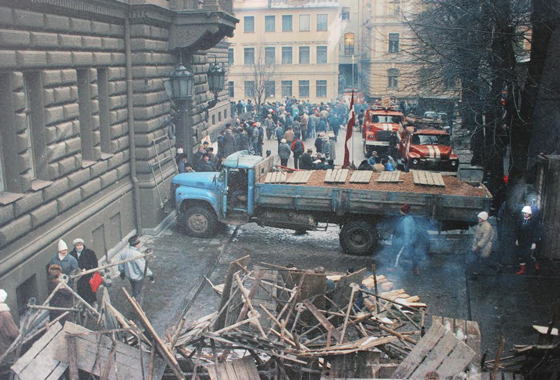 Barricades in Riga, January 1991
The Museum of the occupation of Latvia is now reconstructed, the building ( Building for the Future ) will be opened for visitors only in October 2018 (although in the old news on the site they promised to do this back in 2014 ). I got acquainted with his exposition only virtually. It refers to two “occupations” of the country - “fascist” and “Soviet”. Both of these periods are shown as the time of the “lack of freedom”, which ended for Latvians in 1991. The former interior of the museum was very gloomy: terrible exhibits, like various evidence of the survivors of deportation and repressions, were set in a red-black half filled with curved geometric structures.
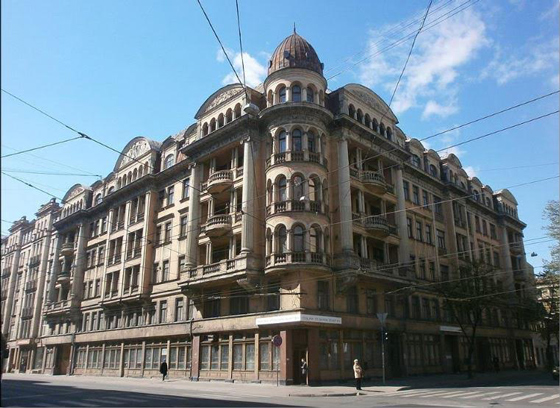 "Corner House"
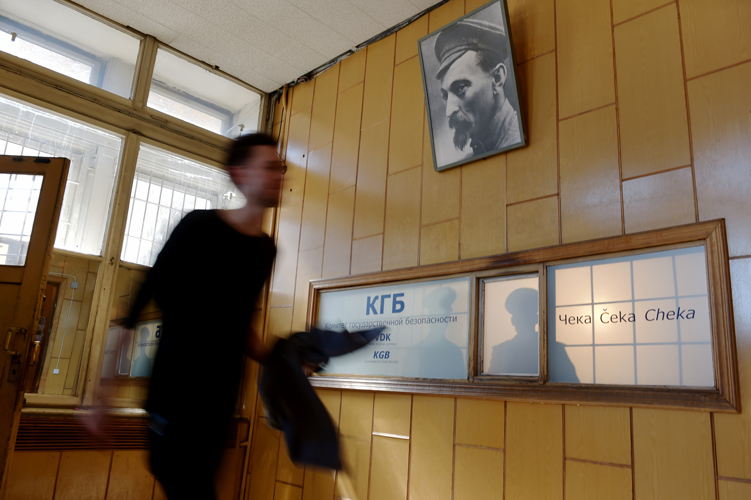
In the "Corner House" on the Bouvibas Boulevard (freedom) since 1940 the Main Directorate of the NKVD, and then the KGB, has been located. He was called the corner for the reason that his checkpoint is located on the corner of a pompous modern building built at the beginning of the twentieth century. A visitor to the museum goes through this entrance and can see the main part of the exposition for free. In the basements of the building - tiny dark cameras with prisoners scratched on the walls - you can only go for money and together with the guide, which during the excursion, to show what the prisoners of these basements, briefly covers visitors in one of the rooms. At the entrance to the museum, the passes are issued, they were received by employees and citizens admitted to the management. The control interior is completely preserved (a strict corridor, upholstered by wooden panels, no excesses) and complemented by stands with a description of the history of the house and its victims and explications on the walls.
The 1991 barricades Museum is a small four -room apartment. According to legend, in this apartment, the defenders of the barricades during the couch could eat and rest. The uprising that occurred in 1991 was relatively bloodless: five people were killed, now they are national heroes. Their portraits can be found in one of the rooms. In others there are photo and video documentation of performances, a barricade layout and even a large installation in the form of a building made of stones, a huge “fire”, near which the rebels were warmed, and the figures of a person with an automaton, looking at visitors from a dark angle. All inscriptions in Latvian, but you can take a sheet with explication in English, Russian and German.
God died, and eschatology lives
Three museums have one in common-Soviet (but actually, of course, even more ancient) way of presenting historical material.
To show what exactly I mean, I will turn to the theory of chronotope Mikhail Bakhtin. This thought occurred to me after I read the study of Slavist Jonathan Platt “Hello, Pushkin! Stalin Cultural Policy and Russian National Poet. ” This year it came out in Russian.
The Soviet time in these museums is eschatological, this is the era of suffering, which should be redeemed when the time of the “great court” comes.
The author of the monograph analyzes the events in honor of the 100th anniversary of the death of Alexander Pushkin, which organized throughout the Union in 1937. Throughout the year, in schools, libraries, houses of culture, museums there were conversations, exhibitions and performances based on the works of Pushkin - against the backdrop of mass repressions and daily messages about the “enemies of the people”. A competition of works, broadcasting the opera Eugene Onegin on the radio, a competition among artists for the best monument to the poet and many other events were organized. Among the authors of the idea was Stalin himself, as well as Kamenev, Kirov and other high -ranking persons, many of whom were repressed in the process of preparing the program.
The scope of the festival demonstrates not only the desire of the new government to collect the materials of the new hero from the “improvised” materials. Among other things, he was called upon to overshadow another event - Goethe's Day, which was widely celebrated in Germany a few years earlier. It was a competition, who more monumentally celebrates the day of the death of the “most important writer of the country”, the next “socialist competition” in the style of “racing on chariots”, but so far people who died for a very long time, too, were honored, but in a metaphorical sense.
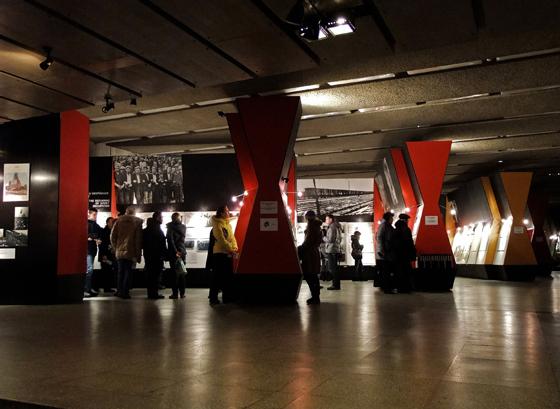 © vladimir kezling Interior "Museum of occupation of Latvia"
Jonathan Platt offers a new approach to publications, films and rituals that surrounded this date and previously studied. He turns to the theory of Chronotope Mikhail Bakhtin and tries to understand how new ideas about Pushkin were formed through images of time and space. Platt analyzes the attempts of the Soviet government to connect the past and present in the events around Pushkin’s death, reaction to reaction his texts and statements in a new, post -revolutionary, world.
An analysis of the ideas about the time in the expositions of the mentioned Riga museums from the point of view of the chronotope allows you to highlight their important line. The Soviet time in them is eschatological, this is the era of suffering, which should be redeemed when the time of the “great court” comes, and after it - liberation and paradise on earth (just like the 1917 revolution in the culture of the Stalinism era gave the meaning of the entire pre -revolutionary history). 1991 is served as a transitional moment, it makes sense to suffer from previous generations. But what follows this point? The experience of earthly life does not allow to imagine what awaits on the other side of the second coming.
When will the “fire”, always flaminating, surrounded by cardboard barricades of 1991?
When asked what is happening to Latvia after 1991, as this is due to the previous history and what will happen to her further, museums do not give an answer. The time after independence seems to stop, the era of absolute freedom comes, an infinite life, for which the very concept of time is irrelevant, how irrelevant it is now for the halls of the former KGB Directorate. At first, this museum makes a strong impression, it is Empowerment : everyone can pass freely and at any moment get out of the den, where so many people have perished and terrible, unknown things took place. But after a short walk around the hall, you begin to feel: now this building is opened and cleared of the monsters inhabiting it, the “dragon” is defeated. But what's next? What will happen to these rooms, with people who live in the neighborhood? What to do with this irreplaceable dust? And when already (in another museum) the “bonfire” will be burned out, forever flaminating, surrounded by 1991 cardboard barricades? Latvian cultural policy in these museums creates a temporary obstacle, “blocks” the present, and this block cannot be overcome with the help of emotions that form the basis of this policy.
And what about contemporary art?
It is interesting how Latvian contemporary artists who seem to be comprehended by the current situation, who should just look for a way out (symbolic) from this kind of dead end. In the Riga National Art Museum in the art exposition of 1985-2000, you can see a lot of works in which artists reflect on Soviet injury, but it is difficult to find something about the future. Although I still succeeded.
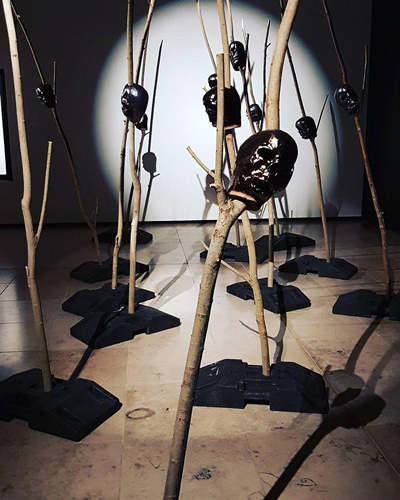 Fragment of the exhibition Christian Brekte "Arsenal"
From December 2, 2016 to February 12, 2017, an exhibition of Riga artist Christian Brekte, which was also called Arsenal, was now in the Arsenal exhibition hall (a former army warehouse, which was also called Arsenal . She was a kind of “horror room”, an echo of the Museum of occupation. In the two dark halls there was a whole “bestiary” of frightening exhibits: bone installations strung on stakes of skulls, guillotine. On the floor at the entrance to the second hall is a strange figure that turns out to be a skeleton in a canvas sleeping bag. In the second hall, massive fuel tanks (from military equipment?) Were suspended under the ceiling. They slowly turned around their axis and threatened to fall to the visitor, crush him with their weight. Most of the objects are non -protruding, and this holds the viewer in tension from the thought that objects can suddenly begin to move, “step on” him. The exposition is thought out to the smallest details, even the shadows on the black walls seem to be stripped.
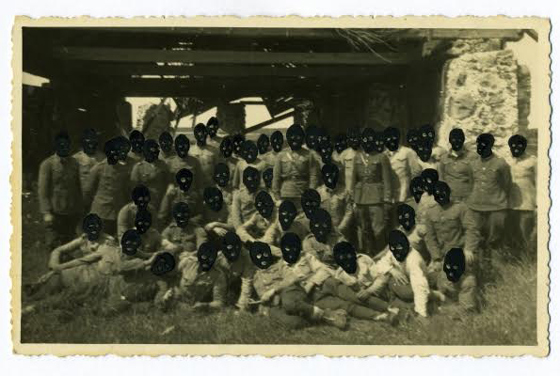 Photo from the exhibition "Arsenal"
In these objects, the artist turns to the traumatic experience of the current residents of Latvia, and to the Nazi and Soviet periods. But another topic arises - dead time. Closure or, rather, the looping of history: photographs of fascists burning books are adjacent to the attributes of modern right-wing groups and black metalists, faces in balaclavas with images of Jesus. The time “Zado”, it failed, worn out, it is doomed, events are constantly repeated, and after the point of liberation (resurrection, victory ...) it all starts again.
Christian Brekte fixes this chronotope, but does not give us an answer what to do with such a dead end idea of history. His exhibition, as well as the expositions of museums mentioned, again works more at the level of emotions than reason. The artist is trying to cause the viewer aversion to temporary repetitions of the type of reflex, but not a detached thought that seems to be not superfluous here.
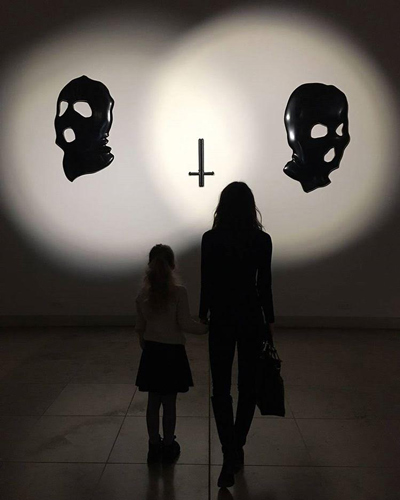 Object from the exhibition "Arsenal". The cross is composed of two police batons
How to melt the ice?
“Crystal Mountain” - the building of the National Library, mentioned by me at the beginning - is called in memory of the old legend. She was a place where the evil sorceress imprisoned the beautiful princess. The girl had been waiting for hundreds of years when the Savior appeared to her and melt the ice, free her from this immobility.
It seems to me that the legend can be compared with the state of memory culture in modern Latvia and in many other countries that have recently received independence. If the term “conservatism” means not only an appeal to the reconstructed values of the past, but also a desire to return to the already played scenarios more than once, then this memory is conservative, it is “frozen” into a conservative discourse built around a certain chronotope. The focus is again the moment in history, but not its further deployment. The question of the near future of the country and its citizens has no place in this discourse. How to comprehend this impasse and get out of it, to break this trend is a question that is relevant not only for Latvia.
Download the entire issue of the magazine "Disagreements" (No. 13) "Eternal Values": PDF , MOBI , EPUB