
Translated material
A sketch method
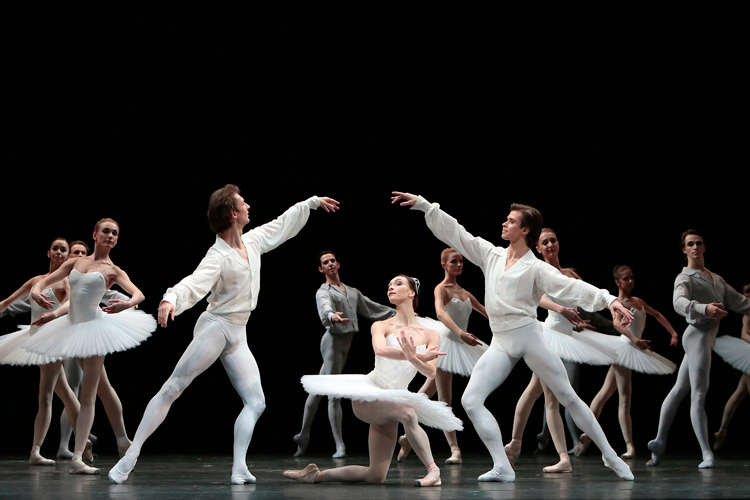
The Bolshoi Theater for the first time danced the " sketches" of Lander - one of the key ballets of the twentieth century. This is the first independent project of Mahara Vasiev as the head of the Bolshoi Ballet. Why is the “sketches” so necessary to dance and watch, thinks Sofya Dymova.
1.
Explain the pathos of "sketches" today seems unnecessary. Harald Lander’s ballet in Russia for the first time danced fourteen years ago at the Mariinsky Theater. People who initiated the domestic premiere of “Etudes”, at that moment as if they were shaking the Russian (and in the image of thinking and tastes - deeply Soviet) ballet by the breasts: you have moved, enough to reason about the soul and spirituality, first put your feet in the right position, dance in the ballet with your feet! Then, a classic of the twentieth century appeared in the Mariinsky repertoire, without which the full diet of a classic dancer at the beginning of the XXI century was no longer possible: so hated by some, uncertain balanchins , soulless forsytes - including Lander's “sketches”. The plot of this performance is the brilliant performance of the ballet class. A perfectly learned lesson - and nothing more.
And it seems that since then in Russia they again learned to dance with their feet and with the whole body, and not just a soul. It seems that the pathos of the “sketches” - a high pathos of craft skill, the pathos of the school, was learned by artists and spectators. We learned to admire the design and mechanism in the dance, catch the buzz from the movement as such, to find a strong emotion not in the torn literature, but in the very mechanics of ballet, an impeccably executed movement of the traded bodies - in fact, the meaning of the “sketches”.
In fact, of course, no, did not learn - and did not understand anything. Look at the Mariinsky poster: when there is the closest performance of the “studies”? And if they are not at all, what are they dancing today? In Russia, they just really do not like to learn lessons.
The classic ballet is rooted in its own craft more than any other type of theatrical art, without daily lessons it dies. School and craft in the ballet in a sense are self -concerned. Therefore, again - "Studies", only now in the Bolshoi Theater, which adds the plot of piquancy. Therefore-the second time to the first grade, so it makes sense to repeat again how the ballet is arranged, the name of which is pronounced in the whole world in one breath: "Landder's Studies."
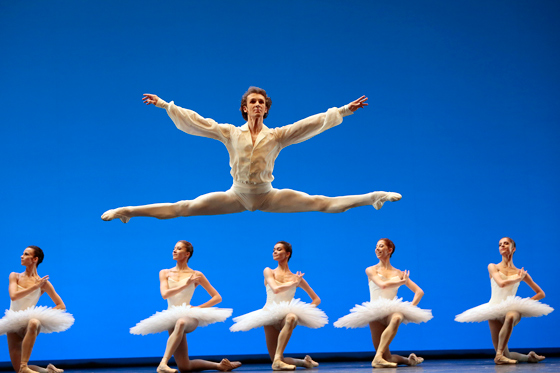 © Damir Yusupova/ Bolshoi Theater
2.
Simply put, the “sketches” are a theatrical exercise. The one from which dancers around the world begin the working day. The order of the lesson has been verified for three centuries. First, a set of exercises at the stick (otherwise they say - at the machine; factory connotations are quite appropriate here). Then the same exercises - in the middle of the hall, no one holds on the machine with one hand. Then a large block of rotation and jumps. Logic: Learn to stand tightly on your feet - and then you can fly, per aspera ad astra . Banality, erected in the degree of high truth and high art.
"Studies" begin as follows: the dancer in a white pack shows five averts of legs. This A, B and C, and this (deeply squats apart) Grand Plié - there can be no classic ballet without them. This is a ballet gamut to Major - in the first episode of “sketches”, it sounds in the orchestra by no means by chance. Thank you for your attention, we can start (making a jump in the curtains).
Harald Londer came up with the way to launch the piano sketches of Karl Cherni as an accompaniment - both the choreographer and the composer used pedagogical material, the food of everyday life, something not for sale . The sketches of the ink orchestral of Knudag Riisagger : this is the last edition of musical neoclassicism with his love for severity and laconicism, the contemplation of the structure, the exposure of muscle effort. The best music for ballet ode to daily muscle effort could not be invented.
Lander is not the first to stage a ballet lesson. A century earlier, his great compatriot August Burnonville made the same trick in the ballet of the Conservatory. The black work usually hidden from prying eyes became the property of the theater: it turned out that the daily training itself is already a finished performance, in which expressive means are selected extremely delicate and strictly.
“Studies” can be perceived as a troupe exam for maturity, public clarification of the last truth - a fairy tale about what we can and what is not. The experience of the Mariinsky Theater allows you to argue with this: eyewitnesses argue that the first performances of the “studies” in St. Petersburg were far from ideal. The talk that the Bolshoi Theater does not need the talk that the “sketches” is not quite fair, where the suede-Soviet heroic spirit and the sweeping-tagging manner of dance are still revered by the highest virtue. In order to successfully dance the classics, you need to visit the lesson every morning; In order to successfully dance the “sketches”, they need to be started once - as, in fact, any classic ballet text.
The last edition of musical neoclassicism with his love for severity and laconicism, the contemplation of the structure, the exposure of muscle effort.
3.
“Studies” were first delivered in Copenhagen, then transferred to the Paris opera. In 1958, Parisians showed “sketches” on tour in Moscow-and all the cards were confused to the Aborigines. After the performance, where the purest ballet speech has burst a crystal stream, it became clear that the cash Soviet repertoire is embodied tongue-tied words: composing endless comics based on novels of poems, Soviet choreographers have learned to compose an arbitrarily complex text and turned into ellocals-ears. Speaking with pathos, that year the Soviet ballet was conscious of the failed betrayal of craft.
"Studies" became a vague object of desire for Muscovites. In 1960, the Bolshoi Theater showed its own “sketches”-the bravura “class-concert” Asaph Messerer, an exhibition of achievements of ballet economy, an attempt to convince ourselves that the Parisian opera is not in front of the planet, but we, we, we. The class-concert was resumed in a large ten years ago. The project of the current head of the large ballet Mahara Vasiev - just one of those who brought the “sketches” to Mariinsky - seemed inappropriate: why someone else’s, if there is the same, but her own (here it is, a quiet virtue of import substitution).
Not the same. “Class-concert”, no matter how hard it is to be a performance, remains an open lesson with all the flaws of this type of class: students really want to appeal to the school director, joke stray and instructively. The soundtrack - a light Shostakovich, Glazunov and Lyadov - and a number of game scourges like the shy manifestations of love between boys and girls root a performance in a particular chronotope, inescapable Soviet sixties.
In the "Studies" the same ballet lesson is cleaned to timeless - to the diagram, function, symbol. This is to a much greater extent the theater - performed by classician pathetics, seizing dancers and their contemptuous crafts from household reality. Then the beam grabs out of the darkness only the legs of the dancers working as the details of a huge mechanism; Then, on a blue background, silhouettes, the theater of shadows move. The art is depersonalized and is to you without the mediation of anyone's personal charm. On Russian television in the 90s there were transfers, where someone's hands deftly folded Origami figures from sheets of paper; In some culinary shows, the camera does not show the cook's face, but someone's hands masterly chop vegetables and beat the sauces. It doesn’t matter whose: the ritual action is fascinating, and you yourself, a naive watching one, will never be able to repeat it like that - and you trust the nameless medium. The troupe of the Bolshoi Theater, which is considered the guardian of acting traditions, and theatricality usually interprets in a fat and expression plan, the vaccination of such an instrumental theater can be very useful.
The structure of the classic lesson is destroyed to the finals of the “sketches”, and purely theatrical laws come into force: belligerently orchestrate mazurka and tarantella beat along the nerves, jumping combinations turn into a spectacular survival test, final plastic tutti leads an emotional degree to the extreme. The ballet class ceases to be the subject for emotion or patriotic pride. Before the viewer is not a Russian ballet and not the ballet of the Bolshoi Theater, but a spherical ballet in a vacuum is an excellent and absolutely impractical art, with the problems of modernity the corresponding do not understand how. No: “Studies” is a beautiful ritual from the past, something like a guard of the guard at the Buckingham Palace, or the rite of initiation into the Korolev knight, or the very presence of the Queen in the UK. The United Kingdom could do without them well-but for some reason he carefully stores to this day, and, of course, not only for the sake of tourists.
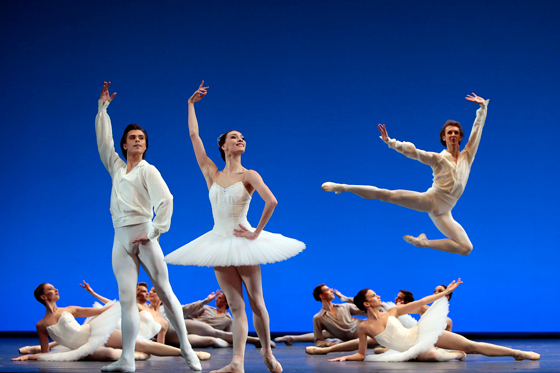 © Damir Yusupova/ Bolshoi Theater
4.
An eyewitness wrote about one of the first court ballets in the history of the court ballets: “If mathematicians suddenly lost a sense of proportion, here they would have found him again.” However, this is the explanation of the meaning of “sketches” to finally stop: the annotation of such ballets is an ungrateful occupation and generates only laughter and bewilderment. The meaning of Lander’s masterpiece and after viewing may turn out to be unobvious: after a while it should be reviewed again, it is possible to compare with the recent record from the Paris Opera . If even then the “Studies” remain a closed book, in extreme cases the Bolshoi Theater resumed the Ballet of Alexei Ratmansky “Russian Seasons” in the premiere program : there the choreography is deprived of open pathos, and the viewer is pleased to think that six pairs are dancing about the music of Leonid Tapetnikov not about some kind of high craft, but about the so-called simple human happiness.