
Translated material
"Doctrine Sechin"
Take-off and fall of state-oligarchic capitalism in Russia
I promised you to tell you what my mother had in mind when she said that God was sending healing to brushwood.
Sholom-aleichem. "Boy Motle"
The mole of Russian history is extremely hardworking, but since it grows blindly, the paths of Russian history are not incredible ...
The regime created exclusively with protective goals and set the task of freezing Russian society for decades to come, without wanting it, produces the deepest revolutionary plowing of this society, bringing its inevitable finale. Russian society entered the era of Putin alone, and will come out of it completely different. And all this is not due to the “subversive” work of enemy forces, but due to the action of objective laws of history, the severity of which in Russia, unlike legal laws, cannot be softened by their non -fulfillment. God sends the healing to the brushwood, immediately laying the mechanism of its self -destruction into the design of the next “Russian world”.
The unhealthy way of modern Russia, inspiring some and frightening others with its invulnerability, is actually internally unstable. This is a “political isotope” with a rather short (by historical standards) period of half -life. Being the highest and last stage of development of post -communist oligarchic capitalism, he should in the final phase of his evolution decompose naturally into two constituent elements: state capitalism and police state. From this material, in the remote future, an economic and political platform will be formed for some new “revolution from above”, which, finally, capitalizes all those qualitative changes that occurred in Russian society after the collapse of the USSR.
Russian political cycle - reformation, state terror and police state
In the right, an important role is played by the category of “ implied meaning ” - something not uttered, but present. In history, an equally important role is played by the “ implied goal ” - a certain ideal, but in fact an unattainable point at which society seeks to return “by default” after each deviation from a given historical trajectory. Over the past hundred years, such a “ implied purpose ” for Russian history is not a move forward to liberal democracy , as the progressive public believes, but a return back to the police state.
The political cycle in Russia consists of three main phases: a rapid take -off, a sharp fall and a long smooth set of height to make a new rise, but from another historical “mark”. Usually, a powerful reformal jerk towards “Europe” (Russian dream), then the same strong “rebound” back to tradition (Russian fear) and, finally, the painful attempts to “fly out” from this hybrid “regular” bureaucratic state (Russian happiness) from this hybrid. At the end of the last phase, the regime, as a rule, falls into the "decadence", preparing the change of eras. Today, Russia is located inside the “post -communist” cycle at the stage of transition to the final phase - the formation of a police state.
The third phase in this cycle, as a rule, is given little attention. However, I would not be arrogant to be arrived in it as some intermediate goal. The police state is so far the best that was in the history of Russian statehood, because there has never been real democracy, especially liberal. Although the police state is hostile to the spirit of liberalism, but, unlike ordinary Russian despotism (autocratic, communist or post -communist), at least illegal laws apply in it. It is an important transit "orbital station" for future flights to distant "liberal cosmos".
Twice over a century, Russian society tried to deceive its history and jump after a few historical steps up, immediately into liberal democracy. Twice after that it broke down and ended up in a stone bag: first in the “totalitarian” under Stalin, and then in “non -Ototitarian” - modern. It took Soviet Russia a little over thirty years (if you count from 1953) to turn itself from the "extraordinary" into a more or less "regular" state. But then there was a restructuring, which ended with a fall into the same Bolshevik pit, but from a smaller height. Now, post-communist Russia will feel to rise from this “bottom”-first to the mark of the “police state” and only then somewhere higher. This rise will be quite long and, most likely, will be the political content of the entire nearest stage of Russian history.
What will be lifting force: an implacable opposition, “liberal” agents in the government, mass social protests, intrigues of foreign intelligence? By no means, this will make the power itself with its own hands, developing in accordance with its logic. In Russia, a new “ phase transition ” has ripened within the post -communist cycle - from “counter -revolutionary” to “regularity”. It is due to the evolution of oligarchic capitalism, born from the barbaric privatization of the nineties and completely reborn in the course of no less barbaric nationalization of the zero.
The development of oligarchic capitalism in Russia: between “black privatization” and “gray nationalization”
A quarter of a century of post -communist Russian history flowed in a narrow corridor of opportunities, set by “black privatization” and “gray nationalization”.
The fact that the history of post -communist Russia developed under the unhappy star of spontaneous privatization, which has imprisoned the country's negative imprint on almost all aspects of the country's economic, social and political development, I had to write more than once, including on the pages of the Novaya Gazeta. In general, the viciousness is not so much the idea of privatization as her specific scenario, in which it was largely reduced to the “self -seizure” of state property by representatives of the former Soviet nomenclature in the alliance with the criminalite, a lot is said. But the negative consequences of “black privatization” are not compared with the catastrophic consequences of the “gray nationalization” project implemented in Russia.
Nobody planned oligarchic capitalism in Russia, it arose at the turn of the 80s and 90s of the last century “naturally”, not so much thanks to the action of power as thanks to its inaction. The point is not that the state imposed a privatization to society, but that it actually became self -controlled from control over it, relying on a “market element”. In the complete absence of even a hint of civil society in post -communist Russia, “Free Privatization” opened a way for the forced seizure and redistribution of the inheritance of the former Soviet nomenclature in the union with criminals.
It is amazing that spontaneous privatization led to an unprecedented concentration of wealth at one social pole and impoverishment - on the other, and how lightning speed it all happened, the whole process of demarcation actually fit into the “five -year plan” between 1989 (the actual privatization began long before it was publicly announced) and 1994. In the second presidency of Boris Yeltsin, Russia entered the already held oligarchic “pseudo -monking monarchy”, in which the country's economic and political life was controlled by a very narrow circle of persons.
The oligarchic capitalism turned out to be economically extremely ineffective and therefore unstable. The trigger of his first systemic crisis was an unsuccessful combination of internal and external factors - the defeat of the federal center in the war in the Caucasus and a sharp drop in world energy prices, which led to default. The crisis revealed the complete dysfunctionality of the Yeltsin pseudo -democratic state and led to the fact that in 1998 a puzzle of the revolutionary situation developed in Russia.
The famous Operation “The successor”, despite its “peaceful” character and formal legitimacy, was a classic “palace coup” arranged by oligarchs in their own interests. Yeltsin would never have abandoned the authorities, in spite of any health problems, if not for the threat of a revolution. The oligarchs would never dare to a controlled change of regime, if not for the threat of its uncontrolled fall.
Theoretically, from the revolutionary situation that developed at the turn of the century, Russia had two exits - through the elimination of oligarchic capitalism and through its optimization . But there was practically nothing to choose from, because after three state coups - 1993, 1996 and 1999, power in the country was completely controlled by oligarchs. Putin, who became the President of Russia thanks to the “oligarchic consensus”, had no other way to look for a way out of the crisis exclusively through the optimization of the oligarchic regime, and not through its dismantling.
And the system was transformed from oligarchic to state-oligarchic , in which bureaucracy (nomenclature) becomes an equal participant in oligarchic rule. The influence of the old post -communist "boyars" weakened, and the influence of the new post -communist "nobility" grew. The reorganization was made in the interests of the oligarchy as a class, but to the detriment of the selfish interests of individual oligarchs. Some of them were really significantly injured, but the oligarchy as a whole only benefited from these transformations.
In fairness, I must say that not only the oligarchs, but also the whole society, both economically and politically, won from the Putin’s innovations. Optimization led to temporary stabilization, the immediate threat of state disintegration was prevented, and the general standard of living has increased significantly. The memory of these achievements is still the main political capital and the most reliable pillow of political safety of the regime. Everything, however, has its own price.
State-oligarchic capitalism-from oligarchy to favoritism
Today, few people remember that Vladimir Putin, like many Russian “autocrats”, began his mission in the traditional liberal-reformal paradigm-in the sense he wanted to “deepen and improve” market reforms and democracy. But the matter did not work out quickly, including, but not only because of the self-will of the very oligarchs who breathed his life into his presidency. Then an alternative scenario was revealed to Russia, which assumed the “pacification of the oligarchs” and the submission of their “power of the sovereign”, known as the “Doctrine Sechin”, by the name of his chief architect and inspirer.
It took approximately the same time for the preparation of “gray nationalization” as “black privatization”. The acceleration stage has met the historical gap between the first and second cases of Yukos - the first sentence of Khodorkovsky was a start, the second - the line was brought. In 2003, the oligarchs almost lost political influence, but still remained serious economic force. After 2010, they largely lost their economic influence.
The catalyst for “gray nationalization” has largely become the economic crisis of 2008-2009, which made the Kremlin go into the “manual management” regime of the economy. Normal practice was the “coordination” of the oligarchs of the main economic decisions with the authorities. Since that time, in Russia it is impossible to possess anything essential, use and dispose without the permission of the government. To those who did not learn this rule, criminal repressions began to be applied almost openly.
The example of Khodorkovsky turned out to be so significant-decreasing that no one else tried to resist. Multiplying in the state banks, the exhausted “oligarchic empires” began to rapidly crawl with the state, and their owners - turn into “trusting managers” and “rentier”. The state endowed the “special services” with the function of the “market regulator” and, with the help of a fully controlled criminal justice, began to actively redistribute assets.
In accordance with the “Drive of Sechin”, the fiscal and investigative devices began to be considered as a powerful lever of pressure on entrepreneurs. Criminal cases have turned into an effective tool for resolving corporate disputes in favor of economic entities controlled by the authorities. Special services, in turn, solving the tasks assigned to them, began to actively involve criminal structures to work. The criminal “generals”, thus, finally legalized and became part of the Russian nomenclature-oligarchic establishment.
But, solving one problem, the authorities gave rise to another, even more serious. The holy place is not empty, and new, which arose from an even more unfair nationalization came to the place of the old, generated by the unfair privatization of the oligarchs. In the first quarter of the 21st century, “favoritism” returned to Russia - a shameful phenomenon in Russia, according to the authoritative opinion of Richard Pipe, back in the middle of the 19th century by Nicholas I. In the wake of rapidly state of economics, “caste of untouchables” arose - a group of closely connected by officials who put themselves outside the law (more precisely, “over -“ over - “over” law "). The symbol of this rebirth was Magnitsky’s business, demonstrating the complete defenselessness of both society and the state itself to new “favorites”. The case of Yukos and the Magnitsky case are the two most thick volumes in the “Big Raister Encyclopedia” of the Russian Federation.
Military-oligarchic capitalism-counter-revolution devouring its beneficiaries
When the consequences of predatory privatization are overcome by even more predatory nationalization, the result can only be a return to the origins - that is, to the very revolutionary situation, the fear of which this regime has generated. There is nothing unexpected in the fact that the result of “gray nationalization” was a total corruption, elevated to the rank of state policy. This is not a failure of the system, not an accident, but a programmed result, the “reasonable price” that has to pay for state control over the oligarchy. The trigger of the new revolutionary situation was the parliamentary and presidential elections in 2011-2012, but its actual reasons are in no way related to the elections.
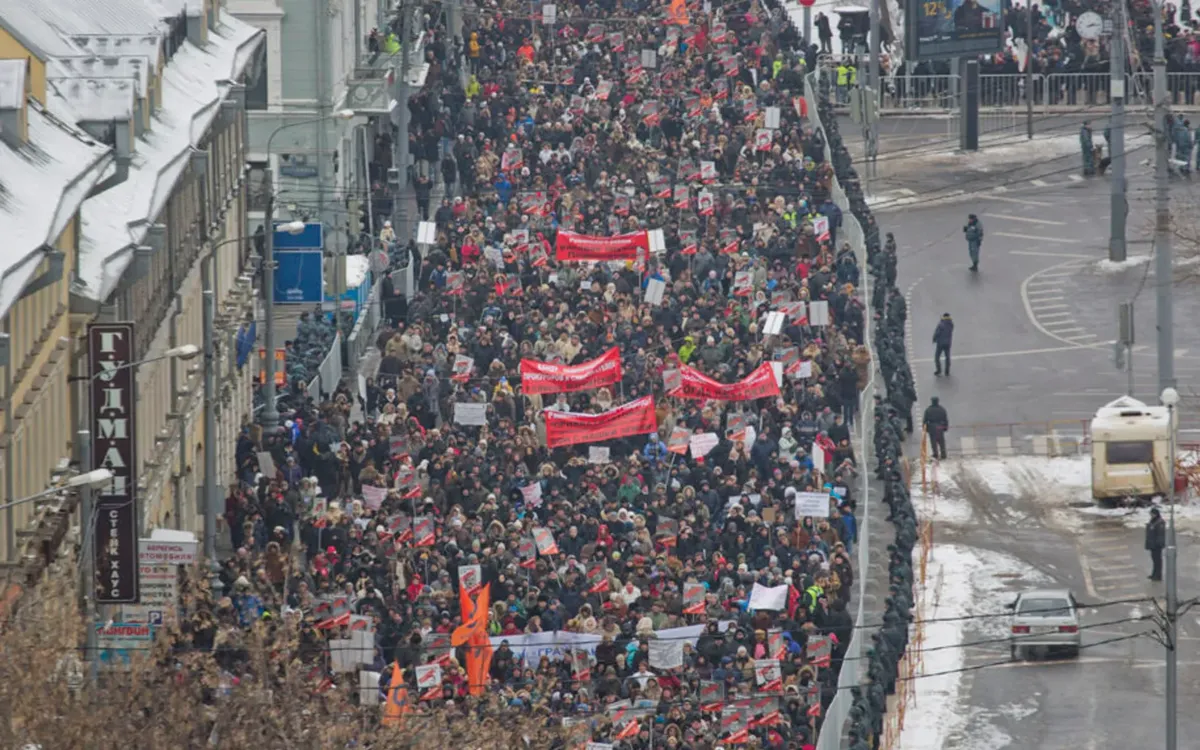
The origins of urban protests (“Swamp movement”) in Russia in 2011–2012 and the second “Orange Revolution” (Maidan) in Ukraine in 2013–2014 the same-the acute reaction of society to the corruption-criminal degeneration of power. However, the results of the performances were completely different: if the “revolution from below” occurred in Ukraine, then in Russia - “counter -revolution from above”. The potential of the Ukrainian revolution was significantly reassessed, while the transformative energy of the “Russian counter -revolution” was greatly underestimated.
The political and constitutional revolution that happened in Russia in 2014–2015 is not meaningful as a counter -revolution that changes the life of society no less than the revolution. The counter -revolution is the revolution, but reaching its goals in a roundabout way, moving towards the "stars" through the "thorns". It ensures the preservation of the regime, but at the same time invisibly changes its nature. From the height of today, we can say that the regime in “counter -revolutionary” Russia has changed much more than in “revolutionary” Ukraine.
The fact is that the counter -revolution achieves its ultimate goals in two stages. At the first stage, it carries out the mobilization of society in order to suppress the revolution, and on the second, without much noise, it realizes a significant part of the tasks of the failed revolution. There is nothing specifically Russian in this, so any real reaction is arranged. And since the immediate tasks of the protest movement were the struggle against the total corruption and the arbitrariness of the “state oligarchs”, it was these goals that over time became part of the “reactionary” agenda.
The main news of the “Russian Spring” is not the return of Crimea at all - this is only an acute seasoning to the dish. The main dish is a change in the relationship between power and elites. In 2014, in order to save the regime, the Russian authorities left the “partnership” with the “nomenclature oligarchy” and set itself over it, actually introducing an indefinite emergency in the country. Despite all the “liberal” scenery, which since then from time to time they are entered on the stage (like the liberation of Ildar Dadin), Russia is now in a permanent mobilization state (in fact at war).
State-oligarchic capitalism was reborn to the military-oligarchic. The final and particularly sophisticated breakdown of the hands with the post -communist oligarchs of both the first and second calls occur to the sounds of “farewell of the Slav”. Россия вышла из несостоявшейся революции в наглухо застегнутом армейском френче. Такой режим жизнеспособен ровно до тех пор, пока действует страх, поэтому террор стал постоянным и необходимым атрибутом системы.
Если в России и есть сегодня что-то по-настоящему гибридное, то это «37-й год». Особенность момента состоит в том, что сегодня машина террора, как и 80 лет назад, начала работать автоматически. Она обрушивает шквал репрессий на общество, не нуждаясь больше в наводчике. Снаряды ложатся в непредсказуемо случайном порядке, в том числе не только на головы политических оппонентов, но и на головы олигархов и чиновников, силовиков и решал, то есть тех, кто является плотью от плоти системы. Никто больше не может чувствовать себя в безопасности только потому, что он находился когда-то в «зоне дружбы» с Владимиром Путиным. Дело Улюкаева стало символом новых правил игры ― если за кем-то еще не пришли, то только потому, что его очередь еще не наступила.
Вертикаль власти больше не пронзает общество как шампур в шашлыке, а торчит над этим обществом как памятник Петру I на Стрелке Москвы-реки. В этой системе нет господ, здесь все рабы на одной галере, все равны в бесправии, но не все еще это осознали. Если революции пожирают своих детей, то контрреволюции пожирают своих бенефициаров. У военно-олигархического капитализма нет иных бенефициаров, кроме обезличенной «системы», которая работает исключительно на свое самосохранение. Пока это лишь тенденция, но «процесс пошел», и траектория понятна.
Полицейское государство и олигархия: Игорь Сечин как зеркало русской контрреволюции
«Доктрина Сечина» исчерпала себя в момент своего триумфа. Оптимизация олигархического капитализма, составлявшая смысл всей эпохи Путина, помимо воли ее архитекторов переросла в его демонтаж. За очень короткий по историческим меркам срок Россия прошла путь от просто олигархического капитализма к государственно-олигархическому и, наконец, к военно-олигархическому. Теперь в повестке дня у нее ― просто государственный капитализм, при котором и олигархи, и фавориты будут такими же, как и все, запуганными обывателями, лишенными политических и даже экономических прав, но которым власть разрешила (пока еще) быть богатыми.
Политической надстройкой над государственным капитализмом является полицейское государство ― регулярное, универсальное, но не свободное. Это государство враждебно олигархам и фаворитам, как и любым другим «нерегулярным» силам. Поэтому архитекторам «государственно-олигархического капитализма» придется определиться, что они больше любят: себя в «системе» или «систему» в себе. Стройка завершена, режиму больше не нужны «инженеры человеческих душ», остались вакансии только для «чернорабочих», готовых заниматься «сервисным обслуживанием» режима. Либо олигархи и фавориты станут винтиками созданной ими машины, либо эта машина их переедет. Или Сечин должен стать Сердюковым, или он рано или поздно повторит судьбу Сердюкова. Так или иначе, но последняя фаза развития государственно-олигархического капитализма обещает быть очень бурной.
Все действительное в русской истории если не разумно, то хотя бы логично. Сначала в ходе перестройки активное меньшинство навязало архаичному советскому большинству правила игры, которые общество не готово было усвоить в силу имевшихся культурных ограничений. Затем, отказавшееся от старых правил, но неспособное жить по новым, общество впало в смуту. Для того чтобы подавить смуту, уже другому, не менее активному меньшинству пришлось положить общество под тоталитарный пресс (не такой мощный, как 80 лет назад, но идентичный по конструкции). Общество, следуя инстинкту самосохранения, легло под этот пресс практически без сопротивления и начало под ним «преть», незаметно для самого себя превращаясь в очень полезные социальные удобрения. Все это создает хорошую почву для превращения деспотического государства в полицейское, а уже полицейское государство, в свою очередь, имеет неплохие шансы для дальнейшей эволюции в нечто более свободное, с помощью очередной русской «перестройки» ― революции сверху. Не очень романтично, очень нескоро, но смотрится как наиболее вероятный сценарий, при условии, если «нормальный» ход русской истории не будет прерван большой войной или серией глобальных катастроф (природных или техногенных).
Третья «перестройка», отдаленная неизбежность которой вызывает мало сомнений, обещает быть более успешной, чем две предыдущие, именно благодаря тому, что историческая почва для нее гораздо лучше подготовлена. Конечно, никто не знает, сколько времени нужно для полной «рекультивации» земель. Библейские сюжеты подсказывают, что не меньше сорока лет. Если считать от начала первой «перестройки», то выходит приблизительно 2025 год. К этому времени у «пресса» как раз истекут все «гарантированные сроки»...