
Translated material
Feminism is a national idea

Lyubava Malysheva, published in February, “ Gender Horror ” dedicated to the Moscow Themfest, aroused great interest to readers and gave rise to a discussion . The participant of this festival Alla Mitrofanov, a historian, philosopher and cyberfeminist, continues to think about relations between the feminist movement and power in Russia.
On March 8, the Kremlin held an action with the slogans "Woman to President", "Woman to Patriarchs" and to top it off, a picture with a slogan on the Kremlin tower "Feminism - a national idea" was published. The slogan was emphasized provocative and unspoken. He challenged and was designed for a wide media discussion, but a strange thing happened. The statement itself, its meaning was not discussed by anyone, discussed the right of activists to use photoshop. The right and left activists acted as fighters for the truth: you must definitely climb the tower, go to jail, sacrifice yourself - then it will be true. Between blindness to the meaning and the requirement of sacrificial behavior, one can notice the connection in the fact that critics know exactly how it should, and do not understand what it was written about. One of the activists said that this can be hung up with "fascism is the national idea of Russia." Yes, it is possible, but the slogan is the application for the meaning, it requires critical consideration, discussion of its relevance, or at least testing for adequacy.
The history of feminism in Russia as a challenge
I paraphrase the name of the famous fundamental monograph by Irina Yukina about the history of feminism in Russia. But what if feminism is really considered as one of the central ideas in Russian history of the 20th century? Let's discuss and test the slogan of feminists on the Kremlin tower. He does not seem to me neither aggressive nor strange. And it is not difficult to find documentary evidence. And although we often hear that Russia is a dark patriarchal country, evidence of history allow us to draw the opposite conclusion.
Is it possible to say that there was a large -scale feminist movement in the country, and if so, how was it organized?
A gender revolution was carried out in giant Russia
Several feminist parties acted at the turn of the century: the populist mass Russian female mutual and blessing society 1894–1918 (the oddity of the name was caused by the fact that society was formed before the creation of parties was allowed), the illegal political party of women for equal rights of 1905-1907, a legal professional, consisting mainly of lawyers and doctors, mainly of lawyers and doctors, The progressive women's party since 1906, the legal party of the League of Equality of Women with Branches in many cities (Petersburg, Moscow, Kharkov, Tomsk, etc.). The 1917 revolution began on March 8 (February 23) with feminist rallies and workers' strikes with the requirements of peace and equality. The strike turned into a general strike, the monarchy fell. In the Tauride Palace, the State Duma formed the Provisional Committee (later the Provisional Government), and the Petrograd Council of Workers and Soldiers' Deputies was formed in the left wing of the palace. Both new authorities proclaimed civil equality, but forgot to mention "and on the floor." On March 19, a female manifestation of 40 thousand women, led by a league of women's equality, approached the Tauride Palace. The legendary Vera Figner and League leader Polixen Shishkina-Javeron filed demands of the deputies of the Duma and the Council of Workers' Deputies. For several hours, the Duma and the advice surrounded by demonstrators held the debate before deciding to accept full civil and political gender equality. Passive right (vote, but not to be chosen) and property qualifications (the right for women of their class) already existed in New Zealand and Norway. In Finland, not without the influence of the Russian mass feminist movement during the 1905 revolution, women received the right to be elected, but with class restrictions.
So in gigantic Russia for the first time, complete political and civil equality was obtained, that is, a gender revolution was carried out. Another picture of the world and new political requests for the reinvention of society arose.
What did the receipt of civil and political equality for everyday life mean?
Sexual relations have ceased to be understood as natural instincts, where a woman was an object of passion, worship or violence
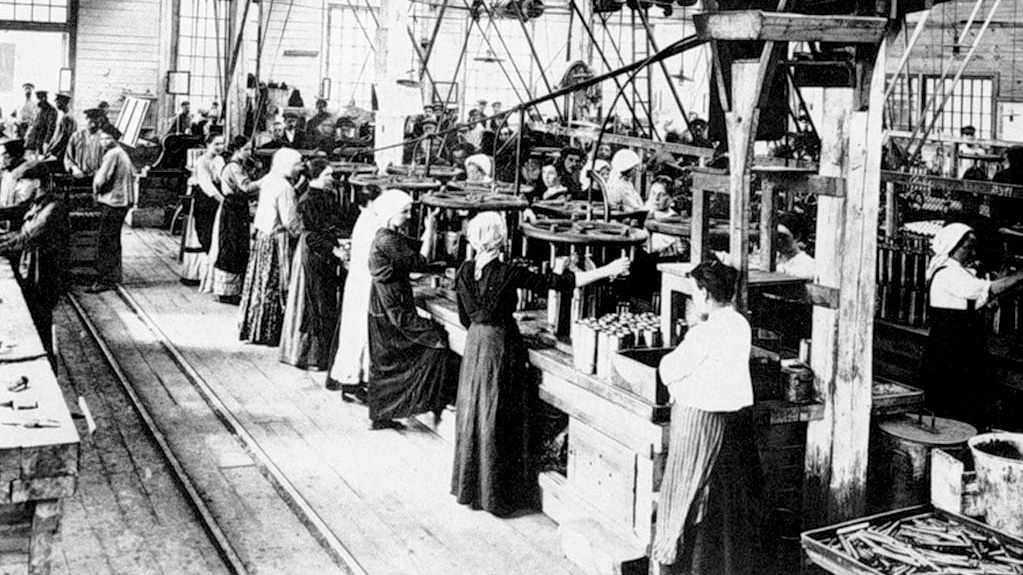
The abolition of gender binary at a political and symbolic level entails a re -description of everyday life. The question "to continue the revolution further or has already" was already resolved in October unambiguously. The gender revolution unfolded, starting from the November decrees about marriage, divorce, legalization of illegitimate children, canceling education restrictions. Then followed free obstetric care, abortion, "the liberation of a woman from kitchen slavery", the opening of nurseries and kindergartens. The model of the Zhenotdel was proposed by Kollontai as a combination of legal proposals of women's congresses and the new constructivist sociology of the Marxist-Machists (A. Bogdanov, A. Lunacharsky). A horizontal network of housing houses with the tasks of the legal protection of women, their preparation for governing bodies, the organization of nurseries and kindergartens was created. As a result, a new social model was invented, in which gender equality was supported by a complex network of institutions. This model was exported to one degree or another to different countries.
Has the change in the gender normative of the understanding of bodily and sexuality affected?
The change in everyday life led to the "sexual revolution" of the 1920s. Sexual relations have ceased to be understood as natural instincts, where a woman was an object of passion, worship or violence. This new situation of the equality of subjects was not simple, it demanded recognition of each other's significance, mutual responsibility, dialogue, psychological and intellectual equality and, finally, similar political views. There were scandals and provocations, so unexpectedly a decree appeared on the socialization of women signed by the anarchist group of Uglich. This document was written by a monarchist shopkeeper, got into newspapers, and distributed in the White Guard leaflets. And although the situation quickly cleared up, she served for a long time both for clarifying the new policy and the accusation of the revolution of debauchery. In endless controversy, litigation, happy and tragic stories, new norms of partnerships were built. After 100 years, we continue to re-claim these relations, we still do not have enough ways to talk about sexual desire and difference, about the new requirements of responsibility, about the non-bureaucity of gender and mobility of gender stereotypes.
Yes, Russia is undoubtedly the country of feminism with experience ahead of time: the victory of gender equality, a painful transition to a new everyday life, the experience of the sexual revolution of the 20s. Hundred Years Cultural Work on the invention of responsible and various gender roles without hidden hierarchies, obsessive phallocentrism.
Why is the rejection of the sexual hierarchy and gender binary important?
Back in the 18th century, when the estate identity was more significant than gender, the female rule was possible, and Countess Er. Dashkova could lead the Academy of Sciences. But liberal law recorded individual law based on private property and gender identity, which led to the exclusion of women from public life, limiting them to "natural purpose": mother, mistress, prostitute. The rigid hierarchical binary nature of nature and culture, private and public, passive and active, controlled and ruling, emotions and rationality, female and male sets such a form of thinking, which excludes the mid -median. But since this abstract forced identification reproduces the hierarchy of gender and introduces forced binary identity, its repressiveness has become a problem not only for women, but also for managed classes. The binary gender model was fixed due to its simplicity, it fit into the metaphysics of classical binary nature and mind . The subjects who were on the side of the subject gained the right to affirm the truth, and those on the side of the object (women, children, foreigners and lower classes) lost the right to say. At the same time, the truth did not require complex evidence, it was given as a political privilege of power. And forced distinguishing between the position of the subject and the object was controlled by strict gender binary, prohibitions and morality. The sexual difference began to reproduce as an empirical confirmation of political inequality. Feminism and class struggle were in the same resistance camp. At the First Women's Congress in 1908 in St. Petersburg, the speakers associated everyday life, family law with the construction of political power. This meant that changes in the system of gender law systematically change the norms of civil law, as well as political rule. If we refuse forced binary, then we allow various and mixed forms of activity in which gender stereotypes may not coincide with the identification of the floor. This, in turn, requires the reconstruction of social institutions and everyday practices.
Even after 100 years, changing reality seems anxious and devoid of reason and stable truths. But attempts to return to the simplicity and “self-evidence” of the “natural law” resurrect not only the gender privileges of a male citizen, but also become the practice of political adventurism, a new populism. We can say that the latter, as forms of "direct" non -critical understanding of reality, can only be held if they rely on a traditional gender binary way. And, conversely, rational decisions, new social institutions are associated with a constant change in behavior stereotypes and adaptation to new circumstances. The feminist monitoring of sexism as forms of statements of a repressive type, the struggle for the introduction of a law against domestic violence, etc. Systematically related to the development of civilian institutions and legal laws. Returning to the slogan, let's say a small correction: feminism is the idea and practice of modern Russia. Feminism returns along with its history and, possibly, on the same scale of solidarity with general civil requirements.