
Translated material
Protest and youth
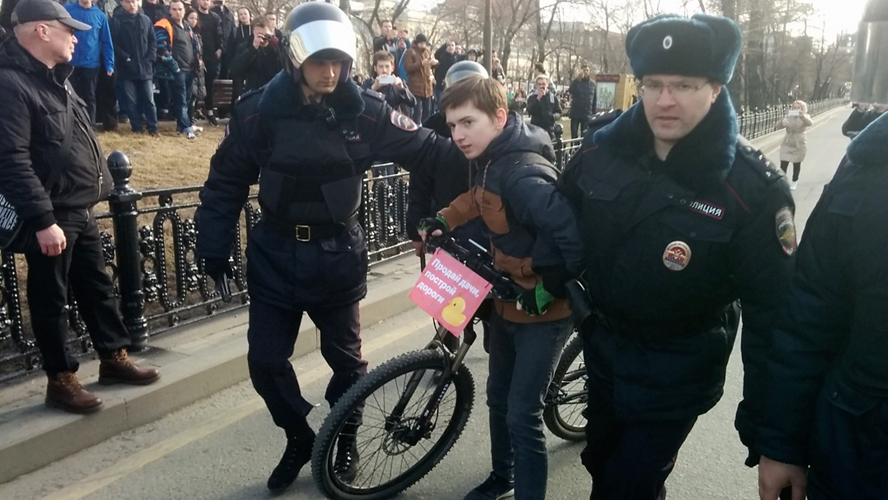
All Sunday, March 26, in Russia, under the sign of mass protests against corruption, was called to them by Alexei Navalny, who did not wait from the authorities to answer the questions posed in his film about the alleged corruption schemes of the Prime Minister. Already now we can say that the most massive protests have passed in Russia since 2011-2012, and, possibly, in general over the past 10 years. Hundreds of detainees throughout the country - from Vladivostok to Kaliningrad, fights with the police, the first for 20 years in a mass protest on Palace Square and thousands, thousands of people on the streets of Russian cities.
Almost everyone is unexpectedly a large number of young people: on the air of the "rain", schoolchildren give an interview from a car Zakak; The young man in Omsk says that when he was small, Oleg Kashin performed “everything is going according to plan” in Bolotnaya - and fulfills after him; Petersburg, Tver, Vladivostok, Perm schoolchildren broadcast to Periscope, showing about the same crowds chanting slogans of protest.
Such mass youth support is completely non -accident for several reasons. Firstly, Navalny, apparently, quite consciously chose young people as their target audience-it is especially noticeable if you carefully watch the video from the opening of the headquarters of the Navalny presidential campaign throughout Russia, as well as on the contingent of the groups of Navalny VKontakte. The current schoolchildren who go out for the first time to protest on the square and the streets are people who in 2011-2012, during the previous wave of protests, were 11-14 years old. We can say that they grew up with stories about Navalny, Udaltsov, “Swamp protests”. These names were fixed in their memory, and they are for present youth that they are a protest. Old stories about Kasparov, Lemonov, NBP and Nemtsov, most likely, do not mean very much for the protesters today - if they know about them at all.
Secondly, youth participation in rallies is wider than just a story about the differences between 16-year-old and 25-year-olds. It is also important that the young people supported Navalny not so much because he is so interesting to them or because he has incredibly successful agitation - although he should give him his due, the methods of working with the audience over time develop and become more interesting. But one cannot fail to notice the fact that in 2011 the authorities knew how and knew how to handle young people: successfully attracting it to various pro -Kremlin movements, it, by and large, solved an important problem. The authorities got acquainted with her youth, painted for her rather foggy and tempting prospects, and somehow tamed.
However, no combat detachment of power from “ours” did not work (and could not work); OMON and political manipulations saved the protesters, and the existence of the Kremlin youth movements simply waved his hand. Other people who enthusiastically implemented a political reaction became leading the internal policy of the Kremlin - they invented new laws, stamped criminal cases and twisted all kinds of nuts. However, 5 years have passed since then, a whole electoral cycle - and new people have grown, completely unfamiliar with the Kremlin machinery that existed at the previous stage. And all this new social community turned out to be left to itself.
It turned out that the authorities turned out to be nothing to offer young people - now, as you know, there is no money, and the mournfully promoted values of the limited Internet and social conformism are not caused by anyone.
And we can say that so many young people came not only because Navalny was sagitized, but also because no one else was sagitized. After the “swamp” protests, a political and ideological vacuum was formed, which schoolchildren and students have nothing to fill in-even a patriotic rise began after 2014, was very poorly converted into some real political movements.
However, the demand for political activity, for the political “movement” - exists, but there are not so many sentences on this field. Navalny has it (it is not so important for what reasons) - and this serves as another factor in such a violent support. It is difficult without any data to judge how seriously the high school students worries the problem of corruption in modern Russian society, but what excites exactly is the opportunity to show themselves, to go, to participate in some great action and, perhaps, to be a detained police-what is not activity?
But we must not forget that the corruption topic served as the fuse of today's protests - and it is not at all worth it to throw it off the accounts. The point is not even in specific "vineyards in Tuscany", yachts or country houses. Corruption in recent years has become an expression and a symbol of ultimate injustice and inequality of today's Russian society, and an expression available to the widest public circles. At some point, many became clear to many that you can play according to the rules and follow the established procedures, but in response you will not wait for either sincere sympathy or at least conditional justice and justice. This symbol is so visible that it is clear to both schoolchildren processed by their teachers and pensioners processed by the TV.
Another feature of today's protests is high activity in the regions. In Moscow, we saw partly a repetition of “strategy-31” (albeit strongly increased), partly repetition of rallies of the previous wave. However, then Moscow was the center of the political process-both protest and anti-Protest. Today is not so. Mass protests in St. Petersburg did not limit themselves to the Marse field - they spread to the palace and to Isaac's square, to Nevsky Prospekt, to the Square of the uprising - the police did not keep up with the actions of the protesters and simply waited for the moment when they dispersed.
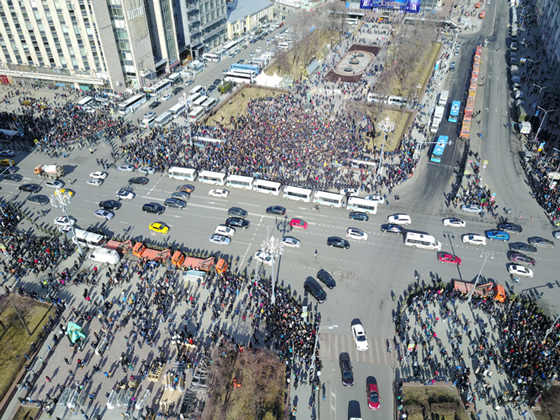 © Borislav Kozlovsky
And this was the most striking, but not the only example at all - people spoke brightly, clearly and noticeably in Tyumen and Vladivostok, in Tambov and Tomsk, in Tver and Novosibirsk, in Perm and Vladikavkaz. They argued with the nodes, they talked about specific claims to their local authorities-governors and municipalities, they were indignant because of social stratification and complained that there was less money in the country, and hopes for career and social growth were melting. There were many local problems on the officially declared topic of rallies - from thieves' officials and expensive housing and communal services to ineffective authorities and low pensions.
The Russian regions turned out to be larger and more serious than the capital. This is also an important difference from protests in 2011 - while the Russian province was filed as a reserve of political conservatism, people who are ready to come to Moscow and disperse “all these protesters in mink fur coats”. Specially selected representatives of regional political movements talked about the fact that "they have everything good, salary and work, and they do not need all sorts of riots and revolutions."
Now everything is completely wrong. Over the past 5 years, the authorities managed to break very much from the interests of those people on whom it has always relied - state employees, small and medium -sized entrepreneurs, and youth. Petersburg can serve as a very indicative example-a ball of internal contradictions that has existed here for several years was only heated by the public activity of the Russian Orthodox Church, related to the Isaacievsky Cathedral and for several years, which was going on for a European University in St. Petersburg. Together, this resulted in the most fierce and mass rally over many years.
So far, for many third -party observers - anonymous and non -anonymous experts, political scientists, journalists (popular and not so), it seems, it is not interesting to understand the reasons. It is more about the fact that the protest was authorized from above, which was “allowed”, that all this was the struggle of the Kremlin’s towers, and either the special operation of the opponents of Medvedev (now he will not be able to become a presidential candidate in the 2018 election), or the rally of Medvedev’s supporters (now the premiere will not change-in spite of the protesters, which will remain in the same way).
All this conspiracyology has the right to life and, perhaps, to some extent reflects reality-after all, we still do not understand about the swamp square. Is it possible to admit that the “green light” was given to the protests against Medvedev to some extent? Why not, but in my opinion, it is completely not as interesting as the question of what movements occur in Russian public opinion, what is their nature.
Someone, of course, wants fights and adventures. But we can talk about fatigue from the system as a whole-after all, when “Down with the Tsar!” They shout on the Palace Square, when “Down with the Power of the Chekists!” Exclaim on the street in Tver, when “tired of Novosibirsk, we can’t think that we are dealing with some narrow history-an oppositionist or prime minister. For the vast majority, this is not only and not so much a story about corruption. Rather, we are talking about accumulated social irritation.
What will be the response of the power to what happened is not yet clear. Does Russia expect a new “swamp business” and tightening the regime, or, conversely, the authorities will try to satisfy public expectations to some extent? And what will be the following steps of society (and it is not worth placing a sign between society and Navalny - a considerable number of people who performed at today's rallies emphasized that they are not for Navalny, but for themselves for their interests)?
So far we do not know all this. But what can we talk about today for sure that in Russia-and not only in Moscow or in St. Petersburg-has grown some new social movement.