
Translated material
Robin Hood from the coast of the Rhine
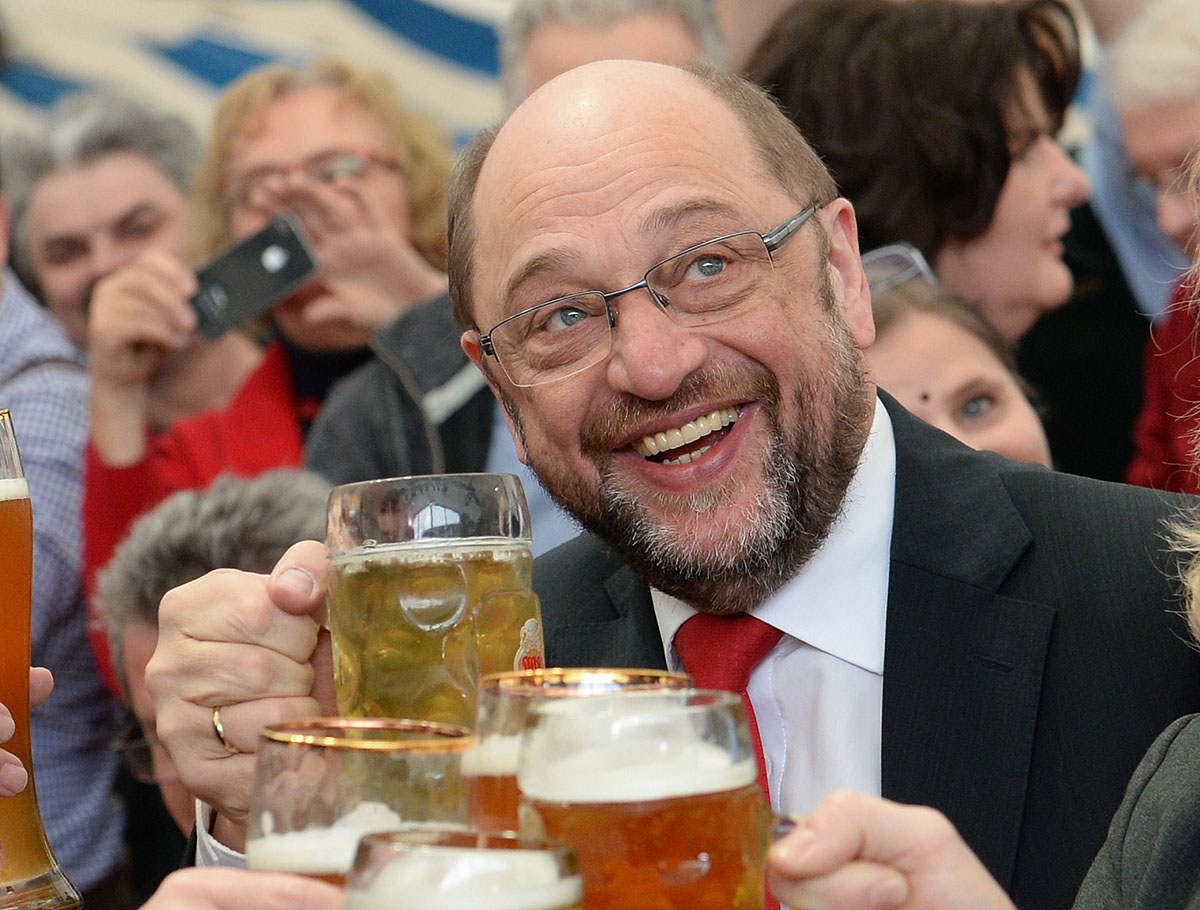
Martin Schulz's career is not typical of a German politician who consistently makes his career, starting from the regional level. He did not pass the period of St. Non -German political maturation and recognition. He was presented to the people a ready -made politician, like a Christmas doll in a package. He never occupied a high responsible post in the structure of public administration (the existing municipal experience is unlikely to be useful here). He can say a lot and well - as a parliamentarian who personally is not responsible for the consequences of decisions. And the ignorance of the German internal policy cannot be replenished until September, when the Bundestag elections are coming in Germany, even active self -education. Nevertheless, it was this person who will have to challenge the Angel Merkel, who worked as a federal chancellor for three terms and going to go to the fourth, on behalf of the left camp.
Man from the street
Few of the citizens of Germany today does not know that at school Martin Schulz was a second year and did not receive a certificate of maturity, that he does not consider the higher education of an important component of a successful political career and that football, in his opinion, is the unifying power of Germany. Therefore, he is his person for regular readers of the largest German tabloid Bild. They learned something from this newspaper about him-before that, any European official could attract their attention only if the European Union forbade beer.
Schulz's path to the heights of power should inspire the hope in the Germans that everyone can repeat it. He was fond of football, wanted to become a professional, but received an injury and was baked with grief. He fell into depression from his worthlessness. Brother Erwin, a doctor, helped: put in a clinic. In the end, Martin was cured of alcoholism and from about 1979, that is, from 24 years old, he has not taken a drop in his mouth. Such a wormhole appears to the German public, they are ready to forgive a lot for it.
The people love self -taught, and Schulz learned five languages during his career: English, French, Spanish, Italian, Dutch. Books helped him, like the young Alexei Peshkov, to the future Maxim Gorky. They say he is reading a lot now. Honor, in particular, John Steinbeck*. He himself is not particularly strong in journalism, although, according to many, he has not bad oratory abilities.
A long stay in the supranational elite has developed a habit of freely to dispose of Eurocannances from Schulz. For example, its closest employees regularly received “special payments” in the amount of € 1300 to € 2200 per month in addition to and so rather big salary
Having learned to be a book trader, Martin worked for some time in publishers and bookstores, until he opened his own shop in the West German town of Würzelene with 38 thousand people. Schulz is known about the commercial successes of Schulz. But it was from the position of the book trader that he went to managers at the age of 31 - he became the youngest in Germany mayor, without abandoning the business.
Schulz joined the youth organization of the SDPG at the age of 19. Having passed a few steps on the party ladder and even falling into the federal government of the party, he quickly realized that with the political crush that reigned in the 1990s in the ranks of the Social Democrats, he could not break up. But in the European structures, which in those years grew like on yeast, there could well be a place. And very decent. And Martin was not mistaken. In 1994, he became a deputy of the European Parliament.
The person of the system
Since then, Schulz’s career has been closely connected with the European Parliament - an inexperienced organization that is designed to be responsible for everything, not responsible, in fact, for nothing. Schulz-parliamentarian was multifaceted: he coordinated the activities of the protection of human rights, was responsible for civilian freedoms, justice, and internal affairs, finally, headed the socialist faction. As the Italian La Stampa wrote, it was on this field that he honed his skills for almost a quarter of a century as a “public demagogue”, tirelessly repeating the social democratic mantras “On Social Justice” and “The pan-European house”.
Schulz clearly caught this “European trend”, which from the very beginning sought to give the status of absolute truth and which, in fact, elevated it into the highest spheres of Euroburacia. It was this trend that he voiced when in 2012, being the chairman of the European Parliament, he accepted the Nobel Prize of the world on behalf of the EU. He said the same in 2015, having received the International Prize named after Charles the Great for a personal contribution to the association of Europe. He believes that the time of national states is leaving and only “transnational democracy” has prospects.
The unprecedented activity of Shulz in the European Parliament was connected precisely with the desire to link - albeit at the virtual level - the interests of ordinary citizens with the supranational level of management, that is, to overcome criticism of the EU bureaucratic isolation from the people. In this way, the cabinet functionary could develop its own political "Eurocapital". In his desire to lead the whole Europe, Schulz - freely or involuntarily - condescended to the level of famous cliches, which the British politician Godfri Bloom at one time: during discussions in the European Parliament, he accused Schulz of the efforts of "leading peoples" along the path of "one state, one currency, one nation." Picking up analogies?
The German press also paid attention to the ambition and power of power. So, in the struggle (as you know, lost) with Luxembourger Jean-Claude Junker for the post of chairman of the European Commission Schulz, as Der Spiegel wrote, shamelessly used the “administrative resource”, using employees and money from the EU funds-for rallies and posters in his support, advertising shares, etc. A long stay in the supranational elite has developed a habit of freely dispose of euro financials. For example, the closest employees of Schulz regularly received “special payments” in the amount of € 1300 to € 2200 per month in addition to and so big salary (for information: there are more than 46 thousand officials in the EU, 4 thousand of them are received more than the German Chancellor, whose monthly salary is a little more than € 17 thousand). And his press secretary, Berlinz, Marcus Engels Schulz, determined Brussels by the official place of work, although he continued to work in the "House of the European Union" in the capital of Germany. Thus, Engels was constantly on a business trip, receiving appropriate allowances for work abroad and even per diem. The chairman of the European Parliament Committee on the budget of Inge Gressle called all this "the favoritism of pure water." Schulz did not forget himself. For example, for each day of meetings of the European Parliament, deputies additionally receive € 304. Schultsu was paid this money all 365 days a year - he worked day and night. More than € 110 thousand, not taxed by tax, ran in a year. The fact that at the end of his European order Schulz refused surcharges, the CSS party considers the CHSS to be a simple maneuver designed for an inexperienced voter.
The person of the party
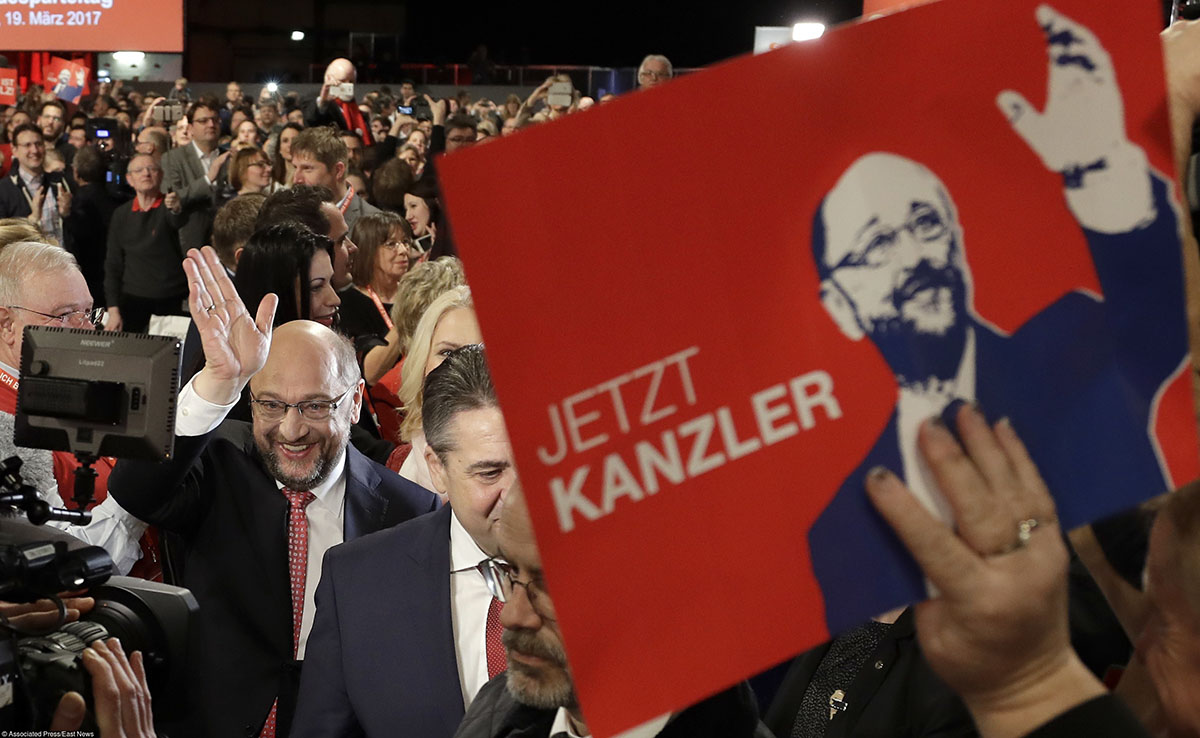
Schulz paces along the corridors of Berlin politics as if he had already become a chancellor. He was really sent by the left European and German establishment to save the idea of social democracy itself from collapse.
Millionaire Schulz is ready to saddle the policy of “left populism” and appeal to the interests of the “little man”, “working”, without thinking about where to get the money. Gabor Styingart, publisher of the Handelsblatt business newspaper, does not hide the irony on this subject: "Martin Schulz decided to act as Robin Hood - the defender of the poor, unfairly offended."
Shulz’s trump card should be the revision of the current labor market-the heritage of a single-party SDPG, ex-Chancellor Gerhard Schroeder. One of the ideas of the new leader of the Social Democrats is, for example, an increase in the terms for obtaining unemployment benefits, which will undoubtedly reduce the level of labor activity, but will increase the costs of benefits.
Schulz calls for fought with poverty. But how? There are no programs, even its tortures. Meanwhile, the annual report on the poverty level says that now almost 13 million people (16% of the population) are considered poor in Germany - this is the highest indicator since the unification of Germany. And here, in many respects, the fault of the Social Democrats themselves, who in recent years have invariably included in the federal government and heads the majority of the governments of land. Schulz will inevitably make it clear to voters that he is not guilty of the country's troubles, that he is a new person, that with his arrival everything should change, that he will take power from the old elite and restore justice. Therefore, any criticism of the ruling coalition on his part will be justified.
However, the SDPG in the elections always beats the topic of justice and social development. And the biography of Schulz will undoubtedly help him in this traditional demagogy for German social democracy. In his favor, the fact that the Germans are clearly tired of Angel Merkel with her failed migration policy. But the shortcomings of the candidate Schulz are also obvious. No matter how many points Merkel lost due to the crisis with refugees, Schultz can hardly pick them up. It is enough to recall his words, said in June last year in Heidelberg: "What refugees carry with them is more expensive than gold."
In general, the views of Schulz practically do not contradict Merkel's views. And in some ways he is even more vulnerable. In today's Europe, where many have fallen under the charm of right -wing populism, it is unlikely that Schulz will bring additional points for his non -criticality in relation to the Brussels bureaucracy (otherwise a quarter of a century of life), calls to save a sinking Greek economy or caustic remarks to the address of the new president of the United States.
In foreign policy, Schulz cannot offer anything new. He is for the free trade zone with the Americans, for continuing confrontation with Russia and new anti -Russian sanctions. He is an ardent anti -Putin. If, as a result of the 2017 election, the “Big Coalition” again arises-CDS/CSS-SDPG, then the duet Merkel-Shulz can only cement the course of Germany and the EU tough for Russia.
Schulz will inevitably make it clear to voters that he is not guilty of the country's troubles, that he is a new person, that with his arrival everything should change, that he will take power from the old elite and restore justice
In the upcoming elected duel Schulz-Merkel, new ideas are unlikely to appear. The emphasis will be made on the tactical alignment of forces, on the current situation. It looks like stagnation.
However, the fresh face of Schulz was already stirred up survey activity. According to various sources, in a personal race to the chancellor’s chair, Merkel’s separation from Schulz is now from 2% to 8%. True, according to Die Zeit, if the elections took place directly, and not according to party lists, Merkel would have gained only 41%, while Schulz - about 50%. But the SDPG as a party has recently added a lot: almost 32% of voters are ready to vote for 34% of the CDU/CSS, although in January, only 21% had social democrats. So the pre -election process promises to be interesting.
* John Steinbek (1902–1968) - American prose writer, author of the famous novels and novels "Bunning of anger", "East of paradise", "On mice and people" and others, Laureate of the Nobel Prize in Literature.
Dossier
Martin Schulz
Born in 1955. In German politics-since 1974, when he joined the Youth Social Democratic organization Jusos. In 1982-1994 he was the owner of a bookstore, from 1987 to 1998 he served as mayor of the city of Wurzelen (Earth North Rhine-Westphalia). In 1999, he became a member of the Federal Board of the SDPG. In 1994, he was elected to the European parliament. He was re -elected as a deputy of the European Parliament three times another three times - in 1999, 2004 and 2009, and on January 17, 2012 he replaced the hedgehog at the post of chairman. In June 2014, he was elected the leader of the Socialists and Democrats faction in the European Parliament, and on July 1, 2014 he again became his chairman-and continued to occupy this post until January 2017. Married, has a son and daughter. Hobbies - reading.
Photo: DPA/AP/TASS, Michael Sohn/Ap Photo/East News