
Translated material
Elite, fake and official people
History with the Academy of Sciences and the review of a license at the European University in St. Petersburg are two examples of the same trend
Two scandalous stories of the last week draw in bright strokes the state of Russian statehood and public institutions. These are the failed elections of the President of the Russian Academy of Sciences and the conflict around the European University in St. Petersburg. Two conflicts are not comparable in scale, but they are very similar in motives, mechanisms and poetics.
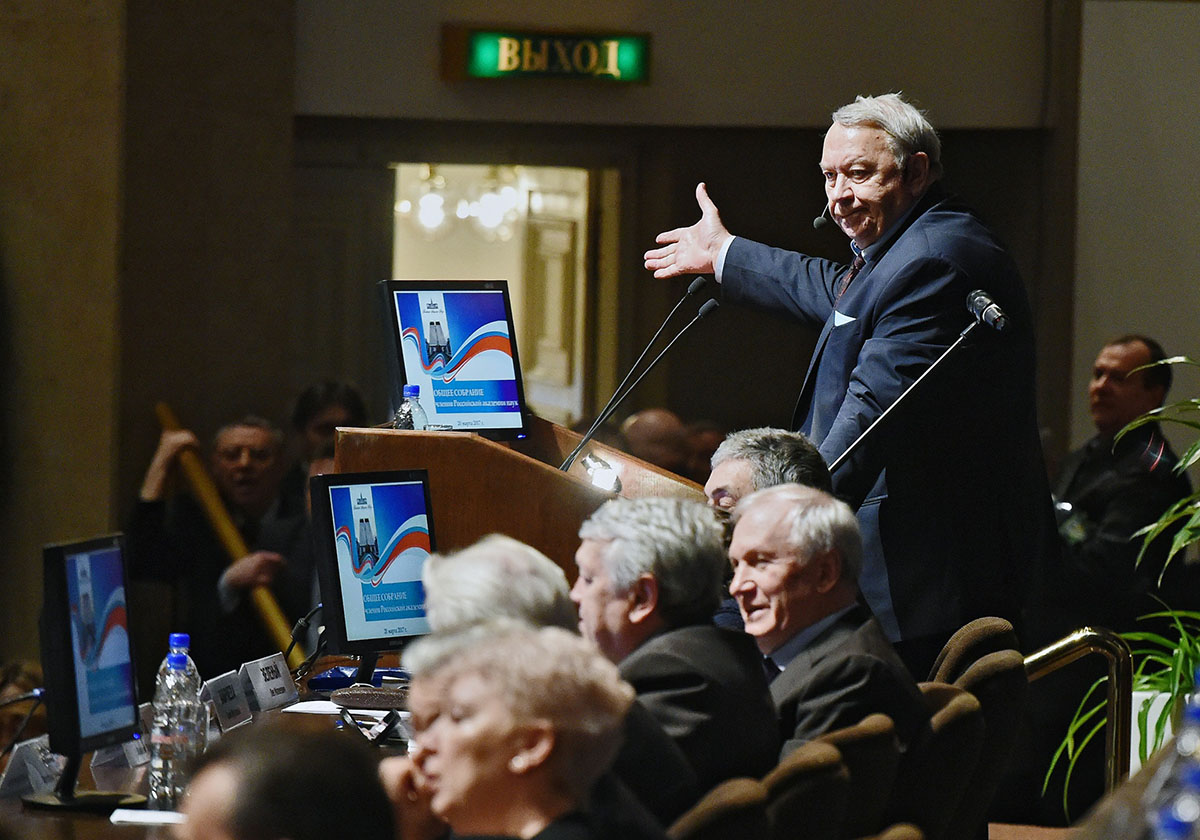
The presidential elections of the Russian Academy of Sciences last Monday were disrupted. On Thursday, March 16, the Academy President Vladimir Fortov* intended to participate in them, but on Friday, they say, he was taken to Vladimir Putin, after which he agreed to postpone the elections for six months under the fake pretext of inconsistencies in the charter. The present reason for such a turn was that Fortov inevitably won the elections with his main competitor - academician Vladislav Panchenko, who is the creature of the friend of the President of the Russian Federation Mikhail Kovalchuk.
Two different ideas about social benefits: in one case, it means the absolutization of personal freedom, in the other - the excretion of "official people"
Mikhail Kovalchuk is not just close to Putin. His brother Yuri Kovalchuk is a member of the famous cooperative "Lake", and together the Kovalchuk clan controls one of the most powerful private oligarchic empires of Putin's Russia. It is enough to say that a significant part of the Russian media sphere is controlled by it, including Russian television, which is one of the key elements of the political management system. The brothers belong to the Bank "Russia", under their control there is an interrao, the money of pension funds, to a large extent, apparently, Gazprombank (through the Criminal Code "Leader") and God also knows that hidden and unknown.
Mikhail Kovalchuk, in addition, differs in specific scientific and political views: he believes that the absolutization of personality freedom undermines national sovereignty, that science should serve security and participate in a global confrontation, learn to “manage thoughts” and engage in the removal of the breed of “official people” based on convertible Nano-Bio-Info-Cognitive-Social-Gomanitarian Technologies. Kovalchuk wants to send up to 10% of all funds allocated in the country for science to the needs of this “nano-info-kogi”.
The fight of Kovalchuk, who is the president of the Kurchatov Institute, has been going on with the Russian Academy of Sciences for more than 10 years. In 2007, he bypassed the charter to the position of acting vice president. The academicians stopped the rapid operation to capture the wounds, having vaguered Kovalchuk - he did not become an academician, and this closed his path to the president. A few years later, academicians did not re -elect him the director of the Institute of Crystallography. As it is believed, in revenge for this, Vladimir Putin, with the filing of Kovalchuk, carried out the reform of the Russian Academy of Sciences, transferring the right to dispose of its money and the system of academic institutions to the government body (Fano).
Today we are observing a new act of drama. The elections of the new head of the Academy are postponed for six months, and during this time the Duma will most likely accept a law that allows the President of the Russian Federation to appoint the President of the Academy at his discretion, as the Russian emperors did. And not necessarily from the midst of academics. As a result, Mikhail Kovalchuk will receive new levers of reorientation of Russian science in the interests of the global confrontation and the excretion of “official people” with “limited self -awareness”, as well as, of course, the levers of managing a rather significant and interesting property of the Russian Academy of Sciences.
In history with the European University, the opposite is true, but all the same. Rosobrnadzor, with frantic persistence under fictional prepositions, takes a license from the university right in the middle of the school year. The university prepares specialists of the humanitarian cycle and is a leader in Russia in such a field as political science (included in the rating of the London Economic School “100 Best European Centers of Political Sciences”). This is one of the few successful non -state higher educational institutions, which, perhaps in its curricula, is somewhat inclined to absolutize personal freedom.
In addition, the university occupies an amazing small palace, the so-called small marble, which once belonged to Princess Yuryevskaya, the Morganatic wife of Emperor Alexander II. In the summer, reconstruction begins in it, the university will temporarily move to another building. Or not temporarily. Any raider in Russia knows about the magical power of the word "reconstruction". Here Rosobrnadzor arrived with its 125 violations.
The paradox of the situation is that one of the founders of the university is Alexei Kudrin, who seems to be also if not a friend, then a very old acquaintance of Vladimir Putin. But here the fact is that palaces that belong to someone who have no personal relations with Putin in Russia, and especially in St. Petersburg, are no longer left. The current proportion of palaces and friends now contributes to the acute competition. Also, however, there were almost no non -state universities in Russia. It can be assumed that according to the results of intrigue, the university can maintain itself by losing the palace and (completely or partially) its non -state status.
So, as we see, these two seemingly different plots are actually twisted on the exchange of the same “currencies” specific for our time. This is a friendship with the president, a legal fake, elite real estate and two different ideas about public benefits: in one case, it means the absolutization of personal freedom, in the other - the excretion of “official people”.
* On March 23, Prime Minister Dmitry Medvedev dismissed Vladimir Fortov from the post of president of the Russian Academy of Sciences - "at his request."