
Translated material
Europeans are not going to leave the European Union
The leaders of the 27 countries celebrated the anniversary with the signing of the Roman Declaration, ordinary citizens - demonstrations
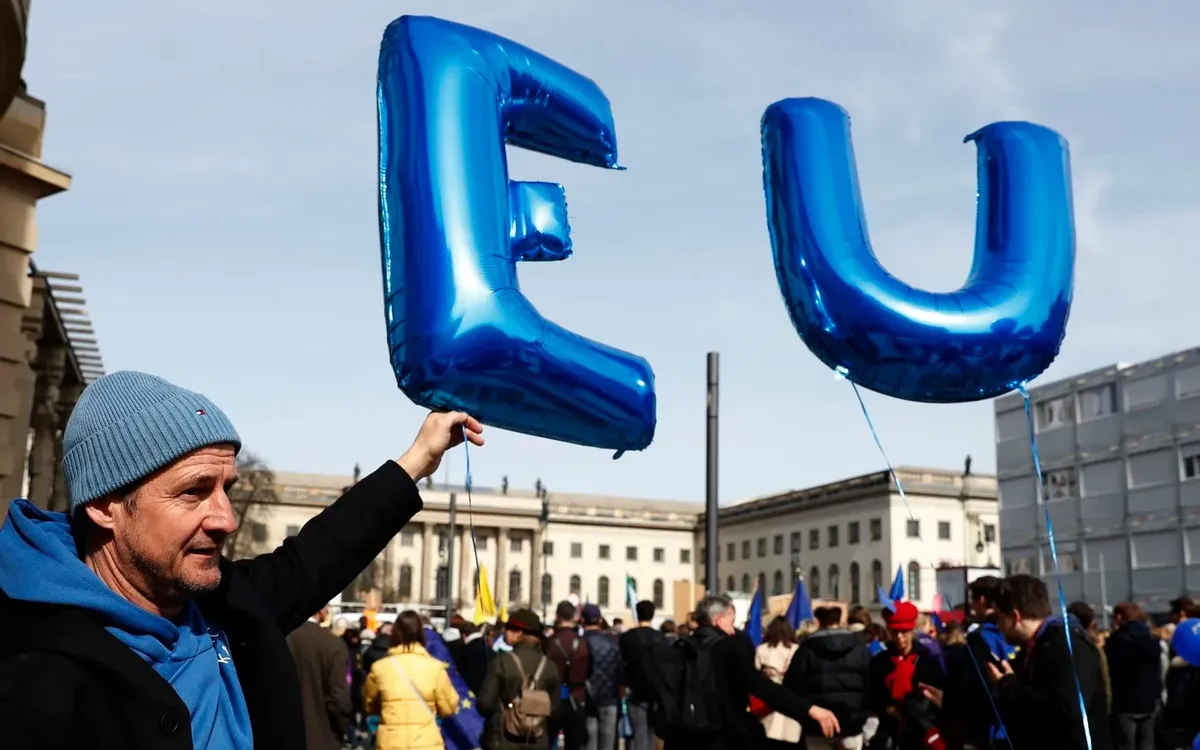
If in Russia on weekends, people went out into the streets with an elementary demand for the authorities to respect the dignity of grabs and steal less, then the participants of crowded processions in Europe excited the existential problems of choosing ways of coexistence of their peoples, the development of their countries and personal everyday comfort.
The 60th anniversary of the European Union was not at the best moment of its history, and from the last Saturday, they expected unpleasant surprises for the solemn day. But the holiday took place on a major note, and the Beethoven “Oda to Joy” - the EU anthem - sounded at the anniversary summit in full accordance with its name.
The leaders of all 27 EU countries (except for the UK emerging from it) gathered in the same hall of the Goratsiev and Kuriacyyes of the Roman Capitol, where in 1957 Roman agreements were signed that created the European Economic Community and laid the foundation of the current EU.
Not only gathered, but everyone signed the Roman Declaration - an anniversary document on the achievements of the Union and the principles of its further development. Although there was a real threat that not everyone would sign.
The head of the Polish government Beat Shidlo, offended by the fact that Brussels criticizes Warsaw for the departure from democratic principles and values, and the main enemy of the ruling conservatives in Poland, the Polish liberal Donald Tusk was re -elected head of the European Council, threatened not to sign. Greek Alexis Tsiprase had resentment against the rich countries of the EU, especially Germany, which ruthlessly and, according to Tsipras, unjustly knocking out the accumulated debt from Greece. We also looked at Victor Orban Hungarian, who also has something with Brussels, primarily about refugees.
The governments of the countries of Central and Eastern Europe, including the same Poland, the Czech Republic, Slovakia and Greece, have closed the alarm in connection with the strengthening of talking about the “Europe of two speeds”. This idea became popular among the ruling elites of Germany, France and other “old” EU members even before the UK voted for Brexit, but sabotaged the strengthening of the political integration of the Union.
Supporters of the equipment of Europe with a multi -stage gearbox insisted on the official recognition of the right of the most advanced in the integration of countries to move forward, without waiting for those who cannot or did not want. The British do not want to abandon the pound of sterling, open the boundaries of Schengen, build a defense union in Europe in addition to NATO - this is their right, but even if they do not interfere with those who want.
Britain leaves the EU, but the problem remains. Those who “cannot or do not want” are afraid to stay on the sidelines of the EU, in the second league, to lose influence on decisions made by the “advanced core”.
In the anniversary declaration, in order to avoid an unnecessary, the inferior softened the wording, removing obvious references to the “two speeds”. Potential refuseniks reconciled and even, like a widlo and Tsipras, arranged a playful performance, signing a document. The signing ceremony and the completion of the summit were held in a relaxed and festive atmosphere.
The head of the European Commission Jean-Claude Junker, the former Prime Minister of Luxembourg, has introduced a revival, announcing that he signed a fountain pen with the same pen, which was signed on behalf of his country of the 1957 Roman Treaty. “Some signatures live for a long time,” he remarked meaningfully.
Even if the “Europe of two speeds” did not become the official doctrine of the European Union, it really exists and, most likely, will be more and more manifested.
Not all EU countries today are in the Schengen space of open borders. With all the strains of the migration crisis, which revealed the inability of the EU structures properly control the external boundaries, while it is poorly believed in the decay of the Schengen system, even if someone can get out of it and restore passport control on their national boundaries. Also, there is no serious reason to believe in the collapse of the Eurozone and the disappearance of the euro.
But the countries of the eurozone one way or another will have to agree on compliance with the rules. The head of the euro group, the Minister of Finance of the Netherlands Yerun Deisselblum last week, incurred the anger of many politicians in Greece, Spain, Italy, officials and European parliamentarians in Brussels. They accepted him to his interview with the German newspaper, where he figuratively expressed the idea of the rights and obligations of the countries: “If I spent all the money on the schnapps and women, I am inconvenient for me to contact the mutual assistance cashier.”
Deisselblum expressed regret in connection with an unsuccessful joke, but, as the head of the euro group, did not change his position on the merits.
These problems within the EU are, they are recognized in allied institutions and national governments, but still, they do not consider a good reason for the collapse of the EU. In European integration, too large a positive detrust is accumulated to cross it today.
In Rome, on the day of the summit, increased security measures have been taken. Around the Capitol and in popular tourist places of the eternal city there were many police officers, carbines and even the military. Helicopters hung in the sky. The organizers of the demonstrations were to coordinate routes with the city authorities, which were obliged not only to ensure the security of 27 chapters of state and governments, but also to participants in six different manifestations, correctly distribute 5 thousand law enforcement officers, to disperse the EU defenders and its opponents. According to the police, about 30 thousand people took part in the demonstrations.
The first (liberals, centrists, left, “green”) began a march from the square at the “mouth of the truth” plate (Bocca Della Verità) and ended with a rally in the support of the EU near the Coliseum. At the Temple of Vestals, they spread a huge blue with the yellow stars of the EU panel.
The second, nationalists, but not only them, were expressed by the Kavur metro station and to Spain Square. Far enough from the first. The organizers warned their contingents so that they would not go to the "alien" territory.
On the same day, the 50,000th march in support of the EU and against the exit from it of Great Britain walked along the central streets of London.
The safety of the anti -government demonstration was ensured by the London police. The authorities of another country would have an acquitted temptation to ban the procession, having a good preposition: on the eve of the building of the parliament in Westminster, a terrorist attack was committed, the responsibility for which was taken by IG (the organization prohibited in the Russian Federation) .
But this is not Moscow, but London. The anti -government march is not an offense. The position of Teresa May and her office is not a decree for all citizens. Participants in the procession believe that the Brexit referendum was advisory. Given the slight gap between the votes “for” and “against”, the government should have thought and weigh.
In London, people walked with the Junion Jacks and the Blue P canches of the EU. A friend of my friend from Windsor said that he had come to a demonstration because 62%voted in Windsor against Britain’s exit from the EU. The demonstration will not change anything during the events: on Wednesday, the government officially involves Article 50 of the Lisbon Treaty, and the British divorce proceedings with the EU will begin. But the exit from the Union will be an injury for almost half of the British, and then, “when everything goes awry,” the government will be difficult to defend itself.
The signatures of the Roman Declaration recognized the mistakes of recent years in managing the financial crisis, the problem of migration and in protecting the external borders of the Union, in the bureaucratization of the EU, and annoying citizens. On the occasion of the anniversary, there is a reason to sprinkle the heads with ashes.
But the Roman declaration says more than about the problems of a decade. It is difficult to argue with the fact that the European Union due to the refusal of its members from part of the national sovereignty and control over resources managed to solve the main problem of the continent: the problem of war. He provided citizens unprecedented in history as a 70-year period of peace and growth of well-being, the right to life, while the rest of the world fought for national interests, exhausting himself in conflicts and arms race.
In Europe, the priority of national interests is a war. The witness is history. Marine Le Pen with her cries on the national sovereignty of France is the risk of war. The Alternative for Germany party is not quite Nazism, but still the risk of war. This threat really hung over Europe, and much depends on the outcome of the presidential election in France. Elections in Germany are still less concerned.
But I have the feeling that Brexit had the opposite effect on moods than it was expected. This one is like a cold shower. In Rome, none of the leaders of the EU countries, even euroskeptic, said that he wanted to leave the Union. No, no, we want to improve the EU, but we will not leave it, we do not want to do what the British did, they say. Everyone swore that they intend to go and further together. Only the EU has a chance to play a role in the changed world. Sovereign Italy, not to mention Greece and Slovakia, will not be remembered on the world arena tomorrow.
Roman agreements signed chapters 6 countries; The Roman Declaration is 27. The European Union has become an attractive place for the life of people who forced politicians to join it. From the ashes of the ruins of the Second World War, he went from the world of states with national interests to the world of citizens with personal interests. Created an attractive space. European youth considers it to be a given that they can choose a place of study, work and life, without looking around at state borders.
The EU has social injustice, unemployment, but much less than in the rest of the planet. I do not know the statistics of refugees from the EU to Africa, to the Middle East, to Russia or even in the USA. I don't think there are many.
Brussels colleague from Liberaseion, Jean Katremer, who published the Backglass of Europe, in 1999, while still a young journalist, dumped the European Commission’s office led by Jacques Santer, denouncing in the corruption of one of his members-the former Prime Minister of his native France, Edith Kresson. “People are not fools,” he says. “They will not change the world and well -being to the ghostly slogans of national pride.”