
Translated material
"A lot of questions arise to Ostrovsky"
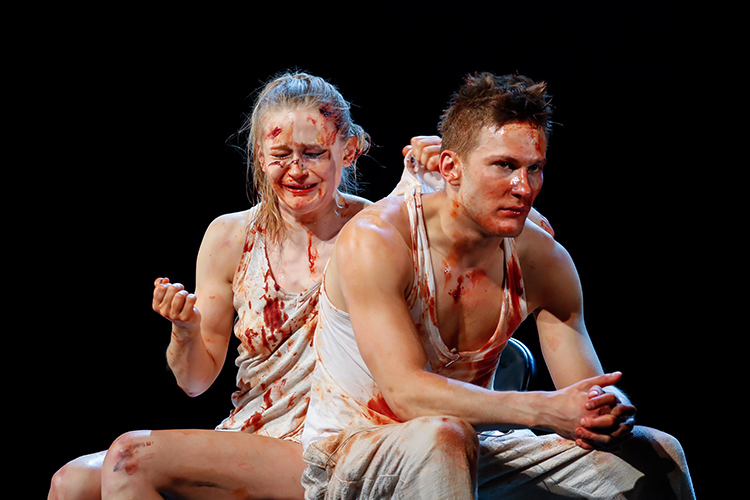
In the theater of nations, the premiere shows of the play “ Glazagrosis” continue in the production of Evgeny Marcelli. Read the review of the almost most expected premiere of theatrical spring next week, but for now to Colta.ru publishes the conversation of one of the best Russian directors with Dmitry Renansky - about the work of the Jaroslavl Volkov theater in Moscow, about the most unsuccessful play by Ostrovsky and about working with Julia Perezld.
- Do you feel more freedom, working as an invited director in the theater, for which, in essence, you do not bear any responsibility?
- In truth, I am even more clamped than when I work in Yaroslavl, although it would seem where the theater of nations with its resource is, and where the poor provincial troupe ... But since I have been handing the theaters for so long, to overcome the blocks that have formed over these years. This is a purely psychological moment: I understand that since I was in a new space for myself, it should be laid out to the maximum. Well, then, at the present time, any theater, inviting the director for production, secretly hopes that the project will be commercially successful. Even if they tell me: we, they say, do not need a spectator performance - I understand well what exactly the theater awaits him, but also myself. Although, in a sense, the circumstances of the work under the contract nevertheless untie the hands-the leader of any theater is clamped in the grip of the planned situation: when you have a huge troupe, you will have to make sure that it is uniformly busy in the repertoire (let it and utopia). And here I can not think about such production nuances.
-The context of today's Moscow scene, no matter how colorful it is, somehow affects your work in the theater of nations?
- The influence arises by itself, even if I did not do anything specially for this. So it was in the early 2000s, when I twice collaborated with the Vakhtangov Theater-although then, of course, everything was completely different. This was my first departure to Moscow from the small city of Sovetsk, where I then headed the theater - experience at the same time both difficult and very important.
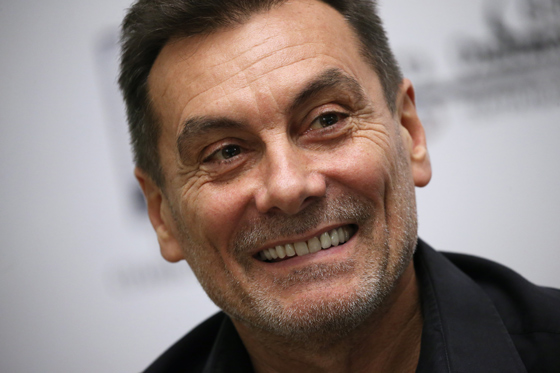 © Artem Geodakyan / TASS Evgeny Marcelli
- In one of the interviews, you said that then in Vakhtangovsky you had to deal with the artists who wanted the directing to serve them, and this is not your cup of tea ...
- At that time, the Vakhtangov Theater has been working without the main director for many years - and this is a situation in which artists gradually capture more and more territories: they are completely not to blame, such is acting nature. Of course, they wanted the directors to work for them, and the more talented the artists were, the more difficult the director was to organize them to the team, to achieve a choral sound. I was then relatively young, and for me it was an excessive task. Something happened, something was very useful for me from a professional point of view, but in general I was, of course, suppressed.
- Now you are returning to Moscow in a completely different status ...
- ... and in a completely different theater, with another model, which is ideal to me. The theater that does not have its own troupe is a theater that has no traditions, and this is great. Theatrical traditions, as a rule, are ninety percent - the traditions of massacre and murder. The theater is a competitive environment, there can be no talk of any “internal friendship”, so traditions carry a lot of negative energy. In the theater of nations, there is nothing like this by definition: the cast is going to the project, and completely different relationships arise, much more human and independent.
- But in such a situation, the process of writing the performance inevitably changes: when it is one thing when you can rehearse a new production at least a year, at least a year and a half, allowing the material to ripen - besides you are familiar with artists, there is a certain chemistry between you ...
- The process, of course, is changing. Of the two and a half months allocated to work in the theater of nations, about a month - and this, you see, is a very long time - we just talked about anything: about life, about the weather. At some point, the artists began to worry-time goes on, we need to work, I saw this inner question in their eyes: will we rehearse? And for me these conversations were rehearsals. If the director is ready for work - and I think about the “thunderstorm” for a long time - any performance can be done in a week: if a common language is found, if everyone who works on the production is turned into one faith. This is not a word too familiar to the theater, not too accurate, but I think it is clear what is about. It is important that mutual trust arises, it is important that the artists are relaxed and not afraid to be unprotected. It is necessary to create a situation in which they could go to the end, and even if the performance fails, this will be possible to admit to each other with a smile at the banquet. In general, the possibility of failure is the greatest pleasure in the theater. Of course, in a situation of work of the invited director, it seems that there is no time for experiments, although art is always a test, search, risk.
Traditions carry a lot of negative energy.
- “Thunderstorm” was your proposal - or is it the idea of the Theater of Nations?
- Evgeny Mironov and I had a very long negotiation period. The first conversation took place three years ago, when, after meeting with the president at the opening of the theater in Pskov, we found ourselves in the same plane. Mironov asked if I wanted to put something in the theater of nations, I replied that not especially-I have a theater in which I work well. Then the proposal followed to do something specifically for Julia Peresild-and here, of course, it became terribly interesting to me. I always love specific sentences, and perephyld is a rare actress for today's times, I perceive a meeting with her as a miracle.
- What property of the acting nature re -praise struck you the most?
- She is ready to comply with any proposal of the director, and not analyzing it too much - but I really like it when the artists do not go from the mind, but instantly join the work. Julia is able to immediately give out even one hundred, but one hundred twenty percent of the result, so I even had to restrain it a little at rehearsals. Although this is impossible: it flashes like a lighter, and gives out some fantastic moves. A couple of years ago, I only foresaw all this, searched for a play for a long time and somehow found nothing, fooling his wife (Mironov.- Ed. ) A head. Then we met at the next meeting of the Presidential Council, and he invited me to think about Ostrovsky. In fact, I put this playwright very rarely, my author is Chekhov, but then I caught fire and offered the most condo of the possible options-a “thunderstorm”, which I consider the most unsuccessful play by Ostrovsky.
- Why is the “thunderstorm” so does not suit you?
- She is very untruthful. There is too much pathos in it. Infinitely clean, it seems, Katerina changes her husband - the situation itself is very curious, but why is she so straightforwardly prescribed by the author? Everything boils down to the fact that bad people surround the heroine, it was stuck - if you remember, Katerina has a monologue addressed to the hall, in which she justifies her desire to secretly meet with Boris on a night intimate date: the mother -in -law, they say, is to blame. And with Boris himself the story himself is quite strange: on the one hand, he declares that he madly loves Katerina, but when his uncle sends him somewhere far, and she asks to take her with her, he refuses. Why? There are a lot of such questions for the “thunderstorm”. Or take, for example, the structure of the play - there are several very strong main roles, but the rest of the characters are completely not developed: Kuligin, Kudryash, wild - these are not roles, but small episodes in which the artists have nothing to offer. I still prefer to deal with a rich, psychologically more complex drama.
- Storms of literary criticism of the XIX century interfere with the perception of the “thunderstorms” - all these Maxims who were dumbfounded about the “Ray of Light in the Dark Kingdom” ...
- ... only a steady aversion to Ostrovsky’s text were able to cause. The textbook interpretation of the thunderstorms repelled any desire to work with this play - I well remember this feeling since school times. The Dark Kingdom, the terrible boar, which presses everyone, and Katerina, who rebelled and sparkled with a ray - and what, I want to ask, beam? Why did she flashed so much - what she changed her husband and put her hands on herself? And well, in the end, the ideal of love would triumph, as in Romeo and Juliet,-but Ostrovsky doesn’t have this, the story turns out to be some kind of darkness ... All this, of course, caused me a wild excitement: what if it would be possible to overcome the resistance of the material?
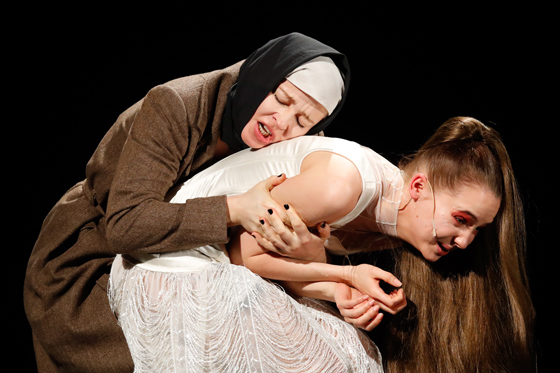 © Artem Geodakyan / TASS Scene from the play "Thunderstorm"
- Do you remember the initial impulse from which your work on the “thunderstorm” began?
- To begin with, I had to shave the beards - it was important to treat the “thunderstorm” not as a cut of merchant Russia, not as a play about people who came down from the canvases of Kustodiev, but as to the drama of the Chekhov type. We reacted to the author very gently, but for starters we removed endless Russes-all these “non-p”, “already”, “ura”: it turned out very quickly that Ostrovsky’s speech was quite easily led to some kind of today, human sound. After that, one could finally deal with the main thing - the internal life of the characters: for a textbook plot, we seemed to be able to make out a psychologically very rich story with a complex intrigue. It is important to note that we did not try to break the playwright drama, as often happens when the tragedy, say, is put as a hard satire or as a farce. We were interested to try to decrypt and correctly read the story that the author wrote. It is very difficult to say: I saw a lot of interesting productions of “thunderstorms”, but, no matter how the directors tear the veins to break out of the traditional coordinate system, I never met a solution that would convince me.
- The program program, strictly speaking, contains a spoiler that fuels interest in the directorial decision: the husband of Katerina and her lover, Tikhon and Boris, the same actor plays you.
- Once, when I read a “thunderstorm”, I dawned on me, I caught on this idea and could no longer dissuade myself from such a decision. Katerina’s most of the play resists her feeling, but she, in addition to everything, is also a believer, and treason is a terrible sin for her: it means that she completely demolished the roof. Of course, the first thought that comes to the head is the opposition of a sluggish, good husband, a mother’s son, whom Katerina does not fully hold a man, and Brutal, embodied the male self of Boris. But this is too simple, in life it is almost never: the matter is not in physical difference, but that the emergence or extinction of feelings does not depend on a person-at some point I realized that two men whom Katerina loved should be very similar. I even wanted to look for twin artists, but it would be too artificial move, and we complicated the situation. Of course, Pavel Chinarev in the role of Tikhon looks softer, and in the role of Boris-more courageous, but in fact they are almost the same. The only difference is that Tikhon loves Katerina for real. It was very interesting for us to understand the history of Boris: he has something to suffer for, he stoically withstand the uncles of bullying. These are the conditions of the will - when adulthood comes, his uncle will give Boris the inheritance due to him and he will leave for Moscow, to his sister living in the care of relatives. When you really love, you just don’t remember anything like that: Boris could just escape with Katerina-but then there was no inheritance. Both the duty to the sister, and the expectation of a “real” life after receiving the money in the end is outweighed-it means that something was wrong with love.
- The antagonism of the male and feminine has always been very important for your theater - to recall at least the legendary production of Gorky "summer residents". Did your attitude to this plot change over time?
- Certainly. In my youth, I was more tough in assessments, more maximalist in judgments: I, figuratively expressing myself, had to determine exactly who, in a particular situation, was the devil. But the older I get, the more I get confused in this matter and I don’t understand where that line that determines the high and low person, and what, in fact, is high and what is low. In his youth, everything was clear: treason, for example, is always a betrayal, but today - not at all. I will say that it is mockery, but sometimes it is treason that retains love, becomes a catalyst for interest in another person. In short, not everything is so clear and primitive.