
Translated material
Elena Rudenko: "It is very convenient - there are no fakes"
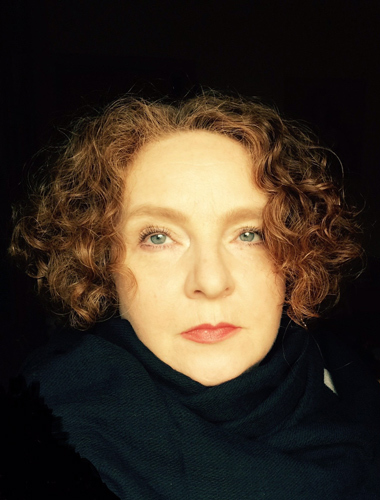
Colta.ru continues to talk about collecting art. In today's interview, Elena Rudenko shares his thoughts.
- How did you come to work as a curator at the In Artibus Foundation?
- I must immediately stipulate that I am not engaged in the collection of the fund, but by the personal assembly of Inna Bazhenova (owner of the fund in artibus . - Ed .), Which she sometimes provides the fund for work. I believe that the curators of my generation and the fact that older, in their youth, did not think that they would once engage in private collections. The art market practically did not exist, such an activity was semi-underground-it was more convenient to deal with it than to consult with someone. So I came to this, like the majority, by chance. I love art, but somehow I did not immediately determine the degree of proximity of relations. I graduated from Moscow State University, a department of art history. She worked both in the classic museum - in the Plane, and "in production" - in the restoration center named after I.E. Grabar. I looked closely at modern art. She spent six years of her life on the “Exhibition Industry” in the house of photography on Ostozhenka, simultaneously became an expert at the Ministry of Culture in the photo and Russian art of the twentieth century. I also listened to people who are well versed in the subject. It is best to listen to artists or at least read their diaries, letters are the most important resource of knowledge about art. For some reason underestimated.
At some point, I realized that I am very interested in how art is sold. Where does the work come from, which the price is made of, some buyers, who sellers ... went to work in a private gallery. It turned out that the commercial vein necessary for working in the gallery is almost not felt, but the qualities harmful to the seller are present in excess. I really wanted everyone to explain what is good and what is bad and why. Buyers were afraid of me, because they come not to study in the gallery, but to choose to their taste and want to praise this taste. I couldn't. Then Inna Bazhenova once came, and it turned out that she was just interested in what I want to tell. So we started together: she is a novice collector, I am a novice consultant. So they grew up.
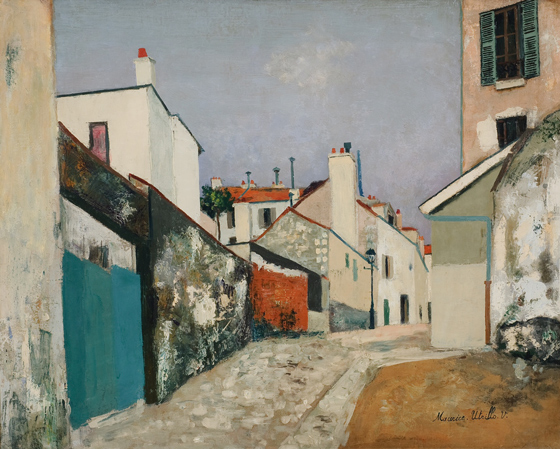 Maurice Utrillo. Street on the outskirts. 1912
- Tell us about the collection of Inna Bazhenova.
- The frequent question that Inna was asked from the very beginning of her path as a collector and still asked: "What are you collecting?" It is very difficult to answer this question monosyllabic, for example, “I collect contemporary art”, or “Moscow conceptualism”, or “Russian avant -garde”, or “salon art of the XIX century”. This, of course, sounds beautiful and exciting, but in my experience, when the collection begins to be seriously engaged, the principles of this kind are quickly violated.
Inna Bazhenova began to gather a Paris school, first deciding for herself, which was fully concentrated on this. She got Utrillo, Sutin, Pasque, Kisling, other masters - but then she felt that the eyes themselves suggested what works and authors like and which were not. She was interested in painting in itself, her inner essence, and she convinced herself that she had the right to collect everything she wants. However, quite quickly came the understanding that this right should be justified, and the next stage was waiting for her intuition - cognition. She began to study, study the subject - the history of art. Rather, in practice than at a desk.
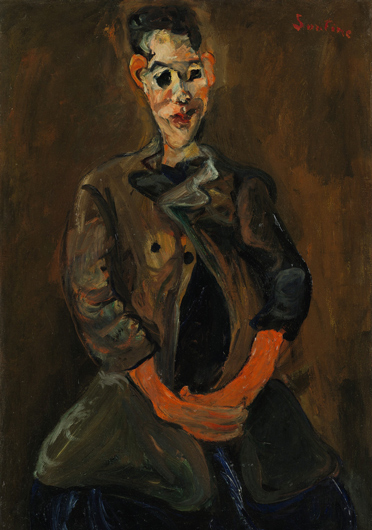 Chaim Sutin. Portrait of a young man. OK. 1923-24
-That is, at first the approach to collecting was still emotional?
- I would not say so - Inna is generally a very structured personality, mathematician, and it was always important for her to know what and why. But, of course, when you are dealing with collecting art - without intuition, you cannot do without emotions.
-And some people collect the collection with a clear understanding that it will make a profit in at least two to three years.
-Investing has never been an end in itself, but, of course, Inna, as a businessman and as a person responsible to his family, could not buy some random things like that. At first, Inna was very embarrassed that she could not accurately determine the framework of her collection, to substantiate her principle, but then, in the process of traveling along the galleries of other collectors, she began to gain confidence. The reference point for her was an acquaintance with the collection of Oscar Reinhart in Switzerland. Seeing how his work of Bruegel and Kranacha the eldest is adjacent to Picasso and Cezann, she felt how they support each other, visually coexist in one plastic harmony. Perhaps then she imagined her future museum, where the works of Mashkov and Weisberg conduct a dialogue with the canvases of the masters of the French school.
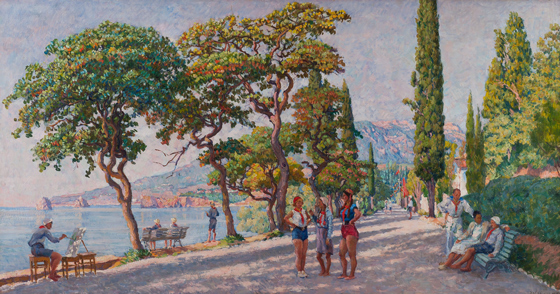 Ilya Mashkov. September morning in Artek. 1934
- It turns out that your own museum is the goal of each collector?
- You know, I have little familiar with other collectors, I can’t say anything about them. When Inna began, I am sure that she did not see a museum with columns, white walls and a suspended system, but it already exists. Because the most important museum is the history of art, and each collector builds his own history of art.
When collecting the collection, you begin to come into contact with immortality, because you become a temporary owner of things that have been known before you and will be known after. And the subsequent spectators and connoisseurs of art will not make a discount that you did not have enough time, or mind, or money to collect a really interesting collection. So any collection is the same imaginary museum.
- Does Inna have a place on the map of the world, where she would definitely like to show her collection?
- The closest plans are the most modest, and such a time that we are endlessly exposed to revision. But, I think, any collector has a share of vanity, and in the end they must receive some reward for the fact that they give so much time, effort and money for art. So, of course, I want to show, but the places are all known: these are London, Paris, Berlin.
It is best to listen to artists or at least read their diaries, letters are the most important resource of knowledge about art.
- And how do you distribute roles in work on the collection? What is the role of Inna, what decisions does it leave for itself, and in what situations does it listen to you?
- Inna always makes the final decision. However, she listens to my opinion as a curator of the collection and to the opinion of experts. But you know: they can be counted on our fingers, and all of them are quite mysterious people. Indeed (smiles) , good experts, as a rule, do not advertise themselves and do not appear in any lists.
- How actively, Inna interacts with other collectors, does she buy work from them?
-I would say that not very actively, because she still entered this circle as a neophyte. You see, there are some kind of hereditary collectors or those who started for a long time, and they all know each other well and actively communicate. And atna, the main platform for the purchase of work so far remain auction houses - Sotheby ' S and Christie ' S. They have a demand for today - we do not always have time to buy everything we like.
-It turns out that auctions are still the most reliable way to purchase work?
- Nobody guarantees reliability to you. When Inna began to engage in old masters at the very beginning of the way, she faced all the difficulties of the attribution process. It turned out that its results also change over time-for example, at some period, experts believed that this was one author, and then other specialists changed this decision. So we realized that you can not bet on one name, then to be at a broken trough.
I must say that with this collection, the situation is quite good. Inna regularly gives work for exhibitions, mostly foreign, because in Russia, oddly enough, it is much more difficult with this. The most important favorite in the number of requests is the still life of Juan de Surbaran, who, incidentally, is unknown whether Huan will remain Huan or will become Francisco if the attribution changes. This is the way about guarantees!
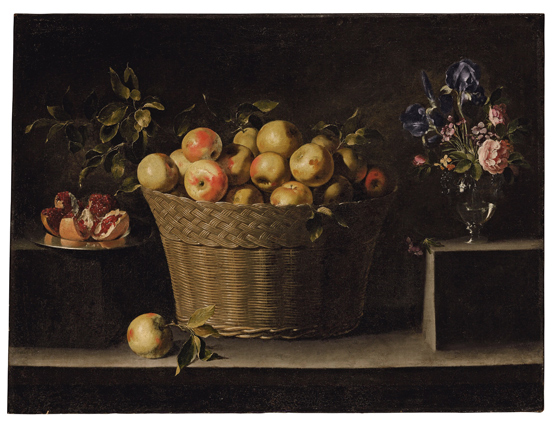 Juan de Surbaran. Apples in a basket with an open grenade and a bouquet of flowers. I half of the XVII century.
- What would you say about Russian education in the field of art, is its level enough for today's specialists?
-I would say that there is no education in the field of art, neither Russian nor any other, enough to work on the formation of the collection. Such education is necessary, but the experience and corresponding abilities are also very important - that artists, for example, call the "eye". The art historian can be without a complete set of these data, an art consultant-will not work. Good, in any case.
- Are there many private collections in our market today, what collections would you single out as deserving attention and interests of the public?
- Judging by the business cards that gather in the table drawer, there are a lot of such curators. It is difficult to say about private collections interesting to the public: to some extent, they are all interesting-as a product of human thought, taste, education. And who is better, who has gathered the collection worse - here I am addicted: it seems to me, of course, that the best is the one to which I put my hand. But besides jokes: I believe that Innina is a collection of Russian, at least, the most daring and free with very high quality. She is not going to “names”, not in prices, not within the direction, but as one canvas, as a synthesis of the best of the available in world painting. No wonder - even the audience noticed this - our artists look like they were studying with one teacher. Often, regardless of time and place. So something succeeds. By the way, in this row, unsatisfactory quality is immediately visible - such things simply do not fit into the collection, fall out. Very convenient - there are no falsehoods. This is a problem for many.
- What would you advise novice collectors in the work of the collection?
- Oh, I would advise you to study. And more humility, at least at first. And watch everything - museums, exhibitions, even reproductions in albums. Nothing will replace his own eyes.
Work from the Inna Bazhenova collection can be seen at the exhibition "under one sky" in the space in artibus.